
How to Become a Travel Nurse: Step-by-Step Guide

Disclosure: Some links in this post are affiliate links. If you click through and make a purchase, we may earn a small commission at no extra cost to you. Learn more about how we make money.
Introduction
Travel nursing offers something most nursing careers do not: the freedom to choose where you work, when you work, and how much you earn. The pay is genuinely higher, the variety keeps burnout at bay, and you get to explore parts of the country you would never see otherwise. But making the leap from staff nurse to working traveler is not as simple as filling out an application. There are licenses to manage, agencies to evaluate, contracts to decode, and a completely different financial picture to understand before you pack a single bag.
This guide walks you through the entire process, step by step, with the kind of specific detail you actually need. No vague advice, no glossing over the hard parts. Whether you are a new grad planning ahead or a seasoned RN ready to hit the road next month, this is your roadmap from bedside nurse to travel nurse.
Step 1: Meet the Basic Requirements
Before you start browsing job boards, make sure you have the foundational qualifications that every travel nurse agency requires.
An active, unencumbered RN license. This is non-negotiable. You need a current registered nurse license in good standing, with no disciplinary actions or restrictions. Both ADN (Associate Degree in Nursing) and BSN (Bachelor of Science in Nursing) holders qualify, though BSN-prepared nurses will find more doors open to them. Many Magnet-designated hospitals and large health systems now require or strongly prefer a BSN, and that preference filters down to their travel contracts too. If you are an ADN nurse, you can absolutely travel, but consider enrolling in an RN-to-BSN bridge program to expand your options over time.
Clinical experience. Most agencies require a minimum of one to two years of recent acute care experience in your specialty. The key word is “recent.” If you worked in the ICU three years ago but have been in outpatient care since then, most agencies will consider your ICU experience too dated. The industry standard that opens the widest range of assignments is 18 to 24 months of continuous experience in one specialty at one facility. Some agencies advertise that they accept nurses with just one year of experience, but the best-paying assignments at the most desirable facilities typically go to candidates with two or more years.
Current certifications. Basic Life Support (BLS) through the American Heart Association is universally required. Beyond that, your specialty determines what else you need. ICU nurses should have ACLS (Advanced Cardiovascular Life Support). Emergency department nurses need ACLS, PALS (Pediatric Advanced Life Support), and often TNCC (Trauma Nursing Core Course). Labor and delivery nurses need NRP (Neonatal Resuscitation Program). These are not optional nice-to-haves. Without the right certifications, your profile will not even be submitted to most facilities.
Clean background and drug screening. Every agency runs a background check and drug screen as part of onboarding. Certain criminal history can disqualify you, and any positive drug screen is an immediate disqualifier. Some states have stricter background check requirements than others, so research the states you want to work in ahead of time.
Step 2: Gain the Right Clinical Experience
Not all nursing experience is created equal when it comes to travel nursing marketability. The experience you build now directly determines the assignments available to you later.
High-demand specialties. Emergency department, ICU (medical, surgical, cardiac, and neuro), labor and delivery, operating room, cath lab, and medical-surgical/telemetry units are consistently the most in-demand specialties for travel nurses. Med-surg and telemetry positions are the most abundant, while OR and cath lab travelers often command the highest pay rates because of the specialized skill set. If you are still choosing a specialty, factor in travel nursing demand along with your personal interests. Check out our breakdown of the highest-demand travel nurse specialties for current data.
Build a broad skill set at your staff position. The nurses who thrive on travel assignments are the ones who are comfortable being independent. Start volunteering to float to other units. Pick up charge nurse shifts when they are offered. Precept new nurses and students. These experiences teach you to adapt quickly, manage a unit, and work with unfamiliar teams, which is exactly what you will do every 13 weeks as a traveler. Facilities hiring travelers want someone who can walk in and function at a high level with minimal orientation.
Specialty certifications that boost your profile. Beyond the required certifications, earning a specialty certification signals expertise and commitment. CCRN for critical care nurses, CEN for emergency nurses, RNC-OB for obstetric nurses, and CNOR for perioperative nurses all give you a competitive edge. These certifications do not just look good on a resume. They can directly increase your pay rate and make you a stronger candidate for competitive assignments.
The realistic timeline. If you are a new graduate, plan on spending two full years at a staff position before making the jump. Use that time intentionally. During year one, focus on becoming competent and confident in your specialty. During year two, pursue your specialty certification, volunteer for charge and float shifts, and start the licensing and agency research that comes next. Some nurses stretch this to three years and find they travel with significantly more confidence and earning power.
Step 3: Get Your Licenses in Order
Licensing strategy is one of the most important and most overlooked parts of preparing to travel. The states you are licensed in determine where you can work, and poor planning here can cost you weeks of lost income.
The Nurse Licensure Compact (NLC). The NLC is a game-changer for travel nurses. If your primary state of residence is a compact member state, your single multistate license allows you to practice in over 40 states without applying for individual licenses in each one. This dramatically expands your assignment options and eliminates weeks of waiting for license approvals. If you are not already familiar with how the compact works, read our detailed Nurse Licensure Compact explainer before you do anything else.
If your home state is a compact state, make sure your license is issued as a multistate license. Some nurses in compact states still hold single-state licenses because they obtained their license before their state joined the compact or because they did not meet the compact requirements at the time of renewal. Check with your state board of nursing to confirm your license type and convert it if necessary. The conversion process varies by state but typically involves verifying that you meet the compact eligibility requirements, including a federal background check.
If your home state is not a compact state, you will need to apply for individual licenses in each state where you want to work. This is where strategic planning saves you time and money. Identify your top three to five target states and begin applications early. Plan on two to four weeks for most state license applications, though some notoriously slow states (California, we are looking at you) can take eight to twelve weeks or longer. Application fees typically range from $100 to $300 per state. Some agencies will reimburse licensing costs, so ask about this before you pay out of pocket.
A practical licensing strategy. Start with a compact license if possible. Then add single-state licenses for the non-compact states you are most interested in. Many experienced travelers maintain a compact license plus two to three individual state licenses, which gives them access to the vast majority of available assignments. Your agency recruiter can also help you prioritize which licenses to pursue based on current demand.
Step 4: Choose a Travel Nurse Agency
Your agency is your employer, your advocate, and your first phone call when something goes wrong on assignment. Choosing the right one, or the right combination of them, matters more than most new travelers realize.
Research before you commit. Read reviews from current and former travelers, not just the testimonials on an agency’s website. Sites with nurse-submitted reviews, travel nursing forums, and social media groups dedicated to travel nursing are all valuable. Pay attention to patterns in reviews. Every agency has a few negative reviews, but if you see the same complaints repeated, like poor communication, hidden pay deductions, or unresponsive recruiters, take that seriously. Our best travel nurse agencies ranking is a good starting point for comparing the top players.
Work with multiple agencies. This is standard practice among experienced travelers, and you should start this way too. Most travelers work with two to four agencies simultaneously. Each agency has different facility contracts, so working with multiple agencies gives you access to a wider pool of assignments. There is no exclusivity requirement unless you specifically sign one, which you should avoid as a new traveler.
Questions to ask your recruiter before signing on. A good recruiter will answer these questions openly. If they dodge or get defensive, that tells you something. Ask about their complete pay breakdown, including hourly rate, housing stipend, meals and incidentals stipend, and travel reimbursement. Ask about their cancellation policy, both by you and by the facility. Ask how they handle extensions. Ask what benefits they offer and when coverage starts. Ask what happens if you have a problem at a facility. For a comprehensive list, see our recruiter questions guide.
Red flags to watch for. Be cautious of any agency that refuses to show you an itemized pay breakdown. Walk away from recruiters who pressure you to accept an offer immediately without giving you time to compare. Avoid agencies that require you to sign exclusive agreements. And be wary of pay packages that seem unusually high compared to others for the same assignment. If the numbers look too good, the agency may be cutting corners on benefits, insurance, or housing quality.
Step 5: Prepare Your Professional Profile
Once you have chosen your agencies, you need to build a professional profile that gets you submitted and hired quickly. This is the administrative heavy lifting, and it pays to do it right the first time.
Your travel nurse resume. A travel nursing resume looks different from a standard nursing resume. Recruiters and facility hiring managers want to see your specialties, certifications, EMR systems you are proficient in (Epic, Cerner, Meditech, etc.), specific skills and procedures you are competent in, and the bed count and acuity level of the units you have worked on. Keep it to two pages maximum and lead with your clinical skills, not your education. Our travel nurse resume guide walks you through the format that gets results.
Strong professional references. You need three to four solid references, and they should be clinical. Charge nurses and nurse managers carry the most weight. Let your references know in advance that they may be contacted, and make sure you have current phone numbers and email addresses for each one. Slow reference checks are one of the most common reasons travel nurse submissions stall, so do not skip this step.
Skills checklists and competency documentation. Every agency will ask you to complete detailed skills checklists for your specialty. These are self-assessments of your competence with specific procedures, equipment, and patient populations. Be honest. Overstating your skills can put you in a dangerous position on assignment. Understating them can cost you placements. If you have not performed a skill in over a year, mark it accordingly.
Compliance documents. Gather your immunization records, including Hepatitis B series, MMR titers, Varicella titers, Tdap, and current flu shot and COVID-19 vaccination records. You will also need a current TB test or chest X-ray, a physical exam within the past year, and copies of all certifications and licenses. Having these documents organized and ready to upload can shave days off your onboarding timeline. Use our assignment checklist to make sure you have not missed anything.
Step 6: Land Your First Assignment
With your profile complete and your agencies lined up, it is time to find and land your first contract. This step is where preparation meets opportunity.
How the submission process works. Your recruiter identifies open assignments that match your qualifications and preferences. You review the details, including location, facility type, shift, pay package, and contract length. If you are interested, your recruiter submits your profile to the facility. The facility reviews your profile and, if they like what they see, schedules a phone interview. These interviews are usually brief, 10 to 20 minutes, and focus on your clinical experience and availability. Some facilities skip the interview entirely and offer based on your profile alone.
Evaluating your first assignment. Do not just look at the weekly pay number. Use our pay calculator to compare the total compensation package, including stipends, overtime rates, and benefits. For your first assignment, prioritize a supportive facility over the absolute highest-paying contract. Ask your recruiter about the facility’s reputation with travelers. Is the nurse-to-patient ratio reasonable? Do they orient travelers or throw them in on day one? A good first experience builds your confidence and your resume. A terrible one can make you question the entire career move.
Negotiation basics. Yes, you can negotiate travel nurse contracts, even as a first-timer. The hourly rate has some flexibility, and you can often negotiate a completion bonus, overtime guarantees, or shift differentials. The bill rate, which is what the facility pays the agency for your services, determines how much room there is to negotiate. Do not be afraid to ask your recruiter what the bill rate is. Transparent agencies will share it. For deeper negotiation strategies, read our guide on how to negotiate your travel nurse contract.
Signing your contract. Read the entire contract before signing. Pay specific attention to the cancellation clause (how much notice is required and what penalties apply if either party cancels), the floating policy (can the facility float you to other units?), the call-off policy (what happens if they cancel your shifts?), and the overtime and holiday pay rates. Get any verbal promises from your recruiter in writing before you sign.
Step 7: Prepare for Life on the Road
You have a signed contract and a start date. Now it is time to handle the logistics that keep your life running smoothly while you are away from home.
Housing. You have two options: agency-provided housing or finding your own. Taking the housing stipend and finding your own place almost always saves you money, often $500 to $1,000 per month or more, and gives you control over where you live. Start your housing search four to six weeks before your start date. Furnished Finder, Airbnb with monthly discounts, extended-stay hotels, and travel nurse housing Facebook groups are all solid sources. For a comprehensive breakdown, see our travel nurse housing guide.
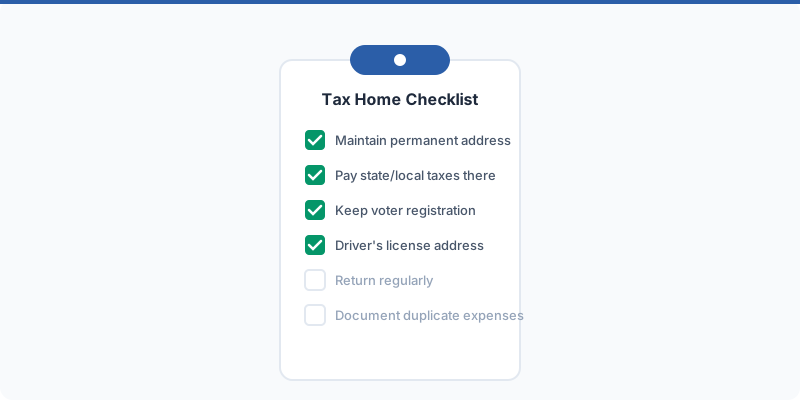
Tax home. This is arguably the most important financial concept in travel nursing, and getting it wrong can cost you thousands. Your tax-free stipends for housing, meals, and incidentals are only tax-free if you maintain a legitimate tax home. In simple terms, a tax home is a permanent residence you maintain and return to between assignments. You must be able to demonstrate to the IRS that you are duplicating living expenses, not simply living wherever your assignment takes you. The rules are specific and the stakes are high. Read our complete travel nurse tax home guide before your first contract starts, and seriously consider consulting a CPA who specializes in travel nursing.
Health insurance. Most agencies offer health insurance, but coverage often does not start until 30 to 90 days into your employment, and the plans vary wildly in quality and cost. Review your agency’s insurance options carefully. If there is a gap before coverage starts, look into short-term health insurance, COBRA from a previous employer, or ACA marketplace plans. Do not go without coverage. One ER visit without insurance can erase months of travel nursing income. Our travel nurse health insurance guide compares all your options.
Financial preparation. Build an emergency fund of at least $3,000 to $5,000 before your first assignment. This covers the gap between your start date and your first paycheck (usually two to three weeks), any upfront housing costs like security deposits, and unexpected expenses during the transition. Open a high-yield savings account if you do not already have one, and set up a simple budgeting system. Travel nursing income is higher but less predictable than staff pay, and the nurses who build wealth are the ones who plan for that variability.
What to pack. You are going to be tempted to bring everything. Do not. Experienced travelers learn to live lean. Bring your clinical essentials (stethoscope, badge accessories, comfortable shoes, and a few sets of scrubs), a capsule wardrobe of personal clothes, a basic kitchen kit if your housing does not provide one, your important documents in a small portable file, and your laptop and chargers. Everything else can be bought locally or shipped if you truly need it. Leave the “just in case” items at home.
Common Mistakes New Travel Nurses Make
Learning from other travelers’ mistakes is cheaper than making your own. Here are the most common ones, and they are all avoidable.
Accepting the first offer without comparing. When you are excited to start traveling, it is tempting to jump on the first contract your recruiter sends over. Do not. Get two to three offers for similar assignments and compare the total compensation, not just the weekly take-home. A $50 per week difference adds up to $650 over a 13-week contract.
Ignoring the cancellation clause. Every travel nurse contract includes a cancellation clause, and they are not all the same. Some facilities can cancel your contract with as little as two weeks’ notice, and some agency contracts include financial penalties if you cancel early. Read and understand these terms before you sign. Ask your recruiter to walk you through the worst-case scenario.
Not maintaining a tax home. This is the most expensive mistake on this list. If you cannot prove to the IRS that you maintain a legitimate tax home, every dollar of your housing, meals, and incidentals stipends becomes taxable income. For many travelers, that is $15,000 to $20,000 per year in stipends that suddenly get taxed. Set up your tax home correctly before your first assignment, not after.
Underestimating the adjustment period. Your first two to three shifts at a new facility are going to be stressful. You do not know where anything is, you do not know the workflows, and you do not have relationships with the staff. This is normal. Give yourself grace, ask questions early and often, and resist the urge to compare every facility to the one you came from. The nurses who adapt fastest are the ones who show up humble, helpful, and ready to learn.
Burning bridges. Travel nursing is a smaller world than you think. Charge nurses talk to recruiters. Facilities share feedback with agencies. Leaving a contract early without a legitimate reason, calling off excessively, or clashing with staff can follow you. Finish your contracts, do good work, and leave every assignment with your professional reputation intact. Your track record becomes your best asset for landing premium assignments.
Skipping malpractice insurance. Your agency carries liability insurance, but it protects the agency’s interests, not necessarily yours. An individual malpractice policy costs roughly $100 to $200 per year and gives you your own legal representation if something goes wrong. This is a small price for significant peace of mind.
How to Become a Travel RT or Surgical Tech
Travel nursing gets most of the attention, but respiratory therapists and surgical technologists follow a remarkably similar path to the road. The agencies, housing strategies, and financial structures are largely the same. What differs are the credentials, the clinical experience expectations, and a few specialty-specific details worth understanding before you apply.
Traveling Respiratory Therapists (RTs)
Credentials required. You need an active Registered Respiratory Therapist (RRT) credential from the National Board for Respiratory Care (NBRC). The RRT is the standard that virtually every agency and facility requires — the entry-level CRT (Certified Respiratory Therapist) alone will not qualify you for most travel assignments. You also need a valid state license in every state where you plan to work. Unlike nursing, respiratory therapy does not yet have a widely adopted interstate compact in effect, though the Interstate Medical Licensure Compact for RTs has been gaining legislative traction. For now, plan on applying for individual state licenses, which typically cost $50 to $200 each and take two to six weeks to process.
Experience requirements. Most agencies require one to two years of acute care respiratory therapy experience. Strong candidates have experience across adult critical care ventilator management, arterial blood gas analysis, bronchial hygiene therapy, and emergency airway management. NICU respiratory therapy experience is especially in demand and commands premium pay. If you hold additional NBRC credentials like the Neonatal/Pediatric Specialty (NPS) or Adult Critical Care Specialty (ACCS), you become significantly more competitive for the highest-paying contracts.
Agency options. Most major travel healthcare agencies — including Aya Healthcare, AMN Healthcare, Medical Solutions, Fusion Medical Staffing, and Cross Country — place respiratory therapists alongside nurses. Some RT-focused agencies like Supplemental Health Care and CompHealth have particularly strong RT assignment pipelines. Work with two to three agencies simultaneously, just as traveling nurses do, to maximize your options.
Traveling Surgical Technologists (Surgical Techs / CSTs)
Credentials required. The Certified Surgical Technologist (CST) credential from the National Board of Surgical Technology and Surgical Assisting (NBSTSA) is the industry standard. Some states require surgical techs to hold the CST or an equivalent certification by law, while others do not mandate certification. Regardless of state requirements, agencies and hospitals overwhelmingly prefer or require CST-certified candidates. You will also need current BLS certification through the American Heart Association.
Experience requirements. Agencies typically require one to two years of operating room experience as a scrub tech. Surgical techs who can demonstrate competence across multiple surgical service lines — orthopedics, general surgery, cardiovascular, neurosurgery, and robotic-assisted procedures — are the most marketable. If you specialize in a high-demand service line like open heart, neurosurgery, or robotics, you can command higher pay and access contracts that generalist techs cannot.
State-by-state variation. Surgical tech regulation varies significantly by state. Some states require certification and registration, others require only registration, and some have no regulatory requirements at all. Research the specific requirements for each state where you want to work. Your agency’s compliance team can help, but you should verify independently through the state’s department of health or surgical tech regulatory body.
Agency options. The same large agencies that place travel nurses and RTs also place surgical techs. Aya Healthcare, AMN Healthcare, Cross Country, and Medical Solutions all have active surgical tech divisions. Some agencies specialize heavily in perioperative staffing, which can mean more OR-specific contracts and recruiters who understand the surgical environment. Ask prospective agencies how many surgical tech contracts they currently have and whether they have dedicated perioperative recruiters.
The Bottom Line for Allied Health Travelers
The core advice in this guide — gain solid clinical experience, choose agencies carefully, compare pay packages, read your contracts thoroughly, and establish a tax home — applies equally to RTs and surgical techs. The travel healthcare industry has expanded well beyond nursing, and the opportunities for allied health professionals are growing every year.
Key Takeaways
- You need an active RN license and at least 18 to 24 months of acute care experience in your specialty to be competitive for the best assignments.
- A compact multistate license opens assignments in over 40 states; pursue one if your primary state of residence qualifies.
- Work with two to four agencies simultaneously to see the widest range of assignments and compare offers effectively.
- Build a strong profile with an updated travel nurse resume, current certifications, organized compliance documents, and reliable professional references.
- Your first assignment sets the tone for your travel career. Choose a supportive facility with a good traveler reputation over the highest-paying contract.
- Establish your tax home, secure health insurance, and build an emergency fund before your first contract starts.
- Read every contract thoroughly, especially cancellation clauses, floating policies, and overtime terms.
- Travel nursing is a career shift, not just a job change. The nurses who plan ahead, stay organized, and invest in the transition do significantly better than those who wing it.
Frequently Asked Questions
How long does it take to become a travel nurse from the time I start nursing school?
If you pursue an ADN, expect two years for the degree plus one to two years of clinical experience before you are competitive for travel assignments, totaling three to four years. A BSN typically takes four years, plus one to two years of experience, for a total of five to six years. Some accelerated BSN programs can shorten the academic portion to 12 to 18 months if you already hold a bachelor’s degree in another field. The experience portion is not something you should rush. Agencies and facilities want well-prepared nurses, and you will be a better traveler for the time you invest in building your clinical foundation.
Can I travel nurse with an ADN, or do I need a BSN?
You can absolutely work as a travel nurse with an ADN. Many agencies accept ADN-prepared RNs, and plenty of facilities hire them. That said, BSN-prepared nurses have access to more assignments because many Magnet hospitals and large academic medical centers require a BSN for all nursing staff, including travelers. If you hold an ADN, focus on specialties with high demand and strong skills to offset the degree limitation, and consider enrolling in an online RN-to-BSN program to broaden your options over time. Most bridge programs take 12 to 18 months to complete and can be done while you are working.
How much do travel nurses actually make?
Compensation varies significantly based on specialty, location, shift, and current market demand. As a general range, travel nurses in 2026 can expect total weekly compensation between $1,800 and $3,500 for standard 36-hour contracts. High-demand specialties like ICU, OR, and cath lab in high-cost-of-living areas can push well above $4,000 per week during peak demand. Keep in mind that a portion of that compensation is tax-free stipends (assuming you maintain a valid tax home), which means your effective take-home is higher than the gross number suggests. Use our pay calculator to model different scenarios based on your specialty and target locations.
Do I need to have my own housing, or does the agency provide it?
Both options exist, and you get to choose. Most agencies offer either company-arranged housing or a housing stipend that you use to find your own place. The stipend route is more popular among experienced travelers because it typically nets you more money. You pocket the difference between the stipend and your actual rent. For first-time travelers, agency housing can reduce stress because the agency handles the search and setup. However, you give up control over location and quality. Over time, most nurses transition to taking the stipend and managing their own housing.
What happens if my travel nurse contract gets cancelled?
Contract cancellations happen, and they are one of the realities of travel nursing. Facilities can cancel contracts due to low census, budget changes, or internal staffing shifts, sometimes with as little as two weeks’ notice. If your contract is cancelled, your agency should work to place you in a new assignment as quickly as possible. Some agencies offer guaranteed hours or cancellation pay clauses, which means they still pay you for a portion of the remaining contract even if the facility cancels. Always ask about cancellation protections before signing, and keep a financial cushion so a cancelled contract does not become a financial emergency.
Related Internal Links
- First Travel Nurse Assignment: What to Expect (/blog/travel-nurse-first-assignment-guide/)
- Best Travel Nurse Agencies - 2026 Rankings (/blog/best-travel-nurse-agencies/)
- Travel Nurse Resume Guide: Stand Out to Recruiters (/blog/travel-nurse-resume-guide/)
- Nurse Licensure Compact Explained (/blog/nurse-licensure-compact-explained/)
- Pros and Cons of Travel Nursing - Honest Review (/blog/travel-nursing-pros-cons/)
- Travel Nurse Tax Home Guide (/blog/travel-nurse-tax-home-guide/)
- How to Compare Travel Nurse Pay Packages (/blog/how-to-compare-travel-nurse-pay-packages/)
- Travel Nurse Certifications Guide (/blog/travel-nurse-certifications/)
- Staff Nurse to Travel Nurse: Making the Switch (/blog/staff-nurse-to-travel-nurse/)
Affiliate Placement Notes
- Agency referral affiliate links in Step 4 “Choose a Travel Nurse Agency” section and Key Takeaways (work with multiple agencies CTA)
- Certification course affiliate links in Step 1 (BLS/ACLS/PALS providers) and Step 2 (specialty certification prep courses)
- Resume services affiliate link in Step 5 “Your travel nurse resume” section with CTA to professional travel nurse resume review service
- Pay calculator CTA in Step 6 for evaluating assignment offers
- Housing platform affiliate link (Furnished Finder) in Step 7 housing section
- Malpractice insurance affiliate link in Common Mistakes section (individual policy providers)
