
Walk-Through States vs. Compact States
Disclosure: Some links in this post are affiliate links. If you click through and make a purchase, we may earn a small commission at no extra cost to you. Learn more about how we make money.
Introduction
If you spend any time in travel nursing forums or talking to experienced travelers, you will hear two terms tossed around constantly: “compact states” and “walk-through states.” They sound similar — both promise faster access to nursing work in new states — but they are fundamentally different concepts. One is an interstate licensing agreement. The other is a description of how quickly a state’s board of nursing processes applications. Understanding both, and knowing how to use them together, is one of the most practical things you can do to maximize your assignment options and minimize dead time between contracts.
What Are Compact States?
Compact states are members of the Nurse Licensure Compact (NLC), an interstate agreement that allows RNs and LPNs/VNs to hold a single multistate license that is valid in every member state. As of 2026, more than 40 states participate in the NLC.
Here is how it works: if your primary state of residence is a compact state and you meet the eligibility requirements, your nursing license automatically carries multistate privileges. You do not need to apply for endorsement, pay additional fees, or wait for processing in each individual compact state. You are authorized to practice in all of them from the day your license is active.
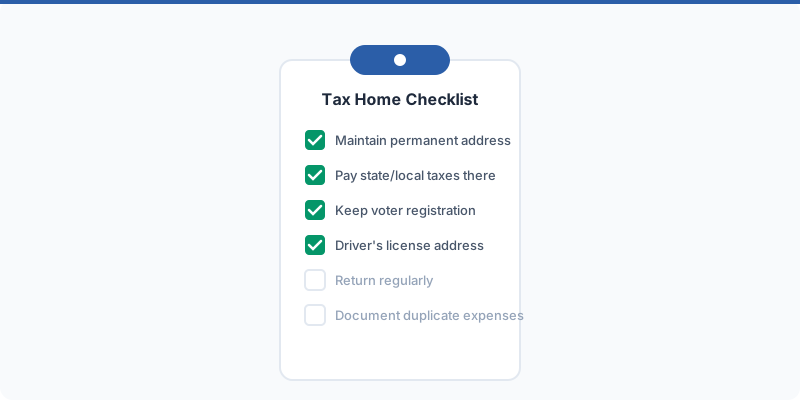
The key eligibility requirement is residency. Your primary state of residence — where you hold your driver’s license, register to vote, and file taxes — must be a compact member state. If you live in a non-compact state, you cannot hold a multistate license regardless of where you originally obtained your nursing education or passed the NCLEX.
For a complete breakdown of compact license eligibility, the current state list, and application guidance, see our full guide to the Nurse Licensure Compact explained.
What Are Walk-Through States?
Walk-through states are states whose boards of nursing process license endorsement applications very quickly — often within one to five business days, and sometimes the same day you apply. The term “walk-through” comes from the idea that you can walk into the board of nursing office (or submit online) and walk out with a license.
This is an important distinction: walk-through states issue individual state licenses, not compact licenses. A walk-through license is valid only in that specific state. You applied for endorsement, the state processed it rapidly, and you received a single-state license. There is no multistate privilege attached.
Walk-through processing does not mean there are no requirements. You still need to submit a complete application with all required documentation, pass a background check, and meet any state-specific prerequisites. The difference is simply speed — these states have streamlined their administrative processes to turn around applications in days rather than weeks or months.
States Known for Fast Processing
The following states have historically been recognized as walk-through or near-walk-through states for endorsement applications:
- Arizona — Often processes endorsements within 1 to 5 business days with complete documentation.
- Texas — Has offered walk-through processing at the Board of Nursing office; also a compact state.
- Missouri — Known for rapid endorsement processing, typically within a few days; also a compact state.
- Tennessee — Fast processing, often under one week; compact state.
- Georgia — Typically processes within 1 to 2 weeks; compact state.
- Indiana — Has historically offered quick processing; compact state.
- Oklahoma — Fast turnaround when documentation is complete; compact state.
- Mississippi — Often processes within a few business days; compact state.
Note that several walk-through states are also compact states. This means that if you already hold a compact license from another state, you do not even need to apply for endorsement — your compact license already covers you. The walk-through advantage matters specifically when you need an individual state license in that state (for example, if your primary residence is in a non-compact state).
Processing times can fluctuate based on application volume, staffing at the board, and time of year. Always verify current processing estimates directly with the state board of nursing before planning around a walk-through timeline. Our nursing license timeline by state provides the most current estimates.
Key Differences Between the Two
| Feature | Compact States | Walk-Through States |
|---|---|---|
| What you get | One multistate license valid in all compact states | One individual state license processed quickly |
| Number of states covered | 40+ states with a single license | One state per application |
| Residency requirement | Must live in a compact state | No residency requirement |
| Duration of benefit | Ongoing for the life of your license | One-time fast processing per application |
| Cost | One license fee covers all compact states | Separate fee for each state license |
| Application required per state | No (multistate privilege is automatic) | Yes (individual application per state) |
| Speed | Immediate (no application needed for compact states) | Fast (1–5 days for endorsement processing) |
| Who benefits most | Nurses who live in a compact state | Nurses who need a specific non-compact state license quickly |
The bottom line: compact status is about coverage (one license, many states). Walk-through status is about speed (one state, processed fast). They solve different problems, and the best licensing strategies use both.
Strategic Licensing for Travel Nurses
Here is how experienced travel nurses combine compact and walk-through advantages into an effective licensing strategy:
Start With Your Compact License
If you live in a compact state — or are willing to establish your primary residence in one — your compact license is the foundation of your entire strategy. It gives you immediate access to 40+ states without any additional applications, fees, or waiting. States like Texas, Florida, and Tennessee are popular choices for primary residence because they are compact members with no state income tax.
If you are currently living in a non-compact state and are serious about travel nursing, consider whether relocating your primary residence to a compact state makes sense. The savings in licensing fees and time across a multi-year travel career can be substantial. Review the how to become a travel nurse guide for more on setting up your career foundation.
Add Walk-Through Licenses for Non-Compact States You Want
Your compact license does not cover non-compact states like California, New York, Massachusetts, Oregon, or Illinois. For these states, you need individual licenses obtained through endorsement. Among non-compact states, some process faster than others. If a non-compact state you want to work in happens to be a fast processor, you can apply when an assignment becomes available and potentially start within a week or two.
Apply Early for Slow States
Not every state you want to work in will process quickly. California, for example, can take 8 to 16 weeks. New York can take 6 to 12 weeks. If you know you want to work in a slow-processing state, start your application months in advance — even before you have a specific assignment lined up. Having the license ready in your portfolio means you can accept assignments instantly when they appear. See our full nursing license timeline by state for state-by-state estimates.
Build a License Portfolio
The ideal travel nurse license portfolio looks something like this:
- Compact (multistate) license from your home state — covers 40+ states.
- California license — the largest travel nursing market and a non-compact state.
- New York license — high-demand market, non-compact, and slow to process.
- One or two additional non-compact state licenses based on your preferred regions or specialties.
This portfolio gives you access to the vast majority of available travel nursing assignments nationwide. The total investment is typically a few hundred dollars in licensing fees, compared to the thousands you would spend licensing individually in every state you might want to work.
Common Scenarios and Best Approaches
Scenario 1: You Live in a Compact State and Want to Travel Widely
This is the best-case scenario. Your compact license covers 40+ states. Add individual licenses for your top two or three non-compact target states. For non-compact walk-through states, you can apply when a specific assignment comes up and receive your license within days. For slow-processing non-compact states, apply proactively.
Scenario 2: You Live in a Non-Compact State
You cannot hold a multistate license, so every state requires an individual application. Prioritize walk-through states for quick turnaround when assignments arise. Apply proactively for slow states you want to work in. Seriously consider whether establishing your primary residence in a compact state is worthwhile — for many travel nurses, the licensing savings alone justify the move.
Scenario 3: You Have a Specific Non-Compact State Assignment Lined Up
Check the state’s processing timeline. If it is a walk-through state, you may be able to apply and start within days. If it is a slow state, ask your agency about temporary practice permits that can bridge the gap. Submit the most complete application possible and use expedited processing if available. For step-by-step guidance, see our how to get a nursing license in a new state guide.
Scenario 4: You Want Maximum Flexibility With Minimal Cost
Get your compact license (or establish residency to qualify for one). This single investment covers most of the country. Then add California and New York licenses since those are the two highest-volume non-compact markets. That three-license portfolio — one compact plus two individual — gives you access to the overwhelming majority of travel nursing assignments for a fraction of the cost of licensing state by state.
Frequently Asked Questions
What is the difference between a compact state and a walk-through state?
A compact state is a member of the Nurse Licensure Compact, an interstate agreement that allows you to hold one multistate license valid in all member states. A walk-through state is simply a state whose board of nursing processes endorsement applications very quickly, often within one to five business days. Compact status is about coverage across many states with one license, while walk-through status is about the speed of getting an individual state license. Many states are both compact and walk-through, which means compact license holders can work there immediately while non-compact nurses can still get licensed quickly.
Which states are walk-through states for nursing licenses?
Arizona, Texas, Missouri, Mississippi, Tennessee, Georgia, Indiana, and Oklahoma are consistently recognized as walk-through or near-walk-through states, processing endorsement applications within one to seven business days when all documentation is complete. Processing times can fluctuate based on application volume and board staffing, so always verify current estimates directly with the state board of nursing before planning around a walk-through timeline.
Do I need a walk-through license if I already have a compact license?
If your compact license is active and the walk-through state is also a compact member state, you do not need to apply for endorsement at all. Your multistate license already covers you. The walk-through advantage matters specifically when you need an individual license in a non-compact state that happens to process quickly, or when your primary residence is in a non-compact state and you cannot hold a compact license. Several walk-through states are also compact states, making the endorsement application unnecessary for compact license holders.
What licenses should a travel nurse have?
The ideal travel nurse license portfolio includes a compact multistate license from your home state covering forty-plus states, plus individual licenses in your top target non-compact states. California and New York are the two most commonly held non-compact licenses because they are the largest travel nursing markets. Adding one or two more non-compact state licenses based on your preferred regions gives you access to the overwhelming majority of available assignments nationwide. This three-to-five license portfolio approach is more cost-effective than licensing state by state.
How do I choose which state to make my primary residence for compact licensing?
Choose a compact state with no state income tax if possible. Texas, Florida, and Tennessee are popular choices because they are compact members with no state income tax, which provides both licensing flexibility and tax advantages. Ensure your documentation is consistent: your driver’s license, voter registration, and federal tax return should all reflect the same compact state as your primary residence. The state you choose directly impacts your licensing flexibility and potentially your tax situation for your entire travel nursing career.
Key Takeaways
- Compact states give you one license valid in 40+ states. It is about breadth of coverage.
- Walk-through states process individual licenses in days, not months. It is about speed of processing.
- They are different tools that solve different problems. Use both strategically.
- A compact license is the foundation of your travel nursing license portfolio. If you can hold one, you should.
- Walk-through licenses fill the gaps for non-compact states where you want to work quickly.
- For slow-processing states like California and New York, apply months in advance — do not wait until you have an assignment.
- Your licensing strategy directly impacts how many assignments you can access and how quickly you can start.
- Use our license lookup tool to verify your current license status and check state requirements.
Related Resources
- Nurse Licensure Compact (NLC) Explained: Which States Are In?
- How to Get a Nursing License in a New State (Fast Track)
- How Long Does It Take to Get a Nursing License by State?
- How to Become a Travel Nurse: Step-by-Step Guide
- License Lookup Tool
Affiliate Placement Notes
