
Pros and Cons of Travel Nursing (Honest Review)

Disclosure: Some links in this post are affiliate links. If you click through and make a purchase, we may earn a small commission at no extra cost to you. Learn more about how we make money.
Introduction
Travel nursing social media makes the lifestyle look like an endless vacation with fat paychecks — ocean-view apartments, hiking on days off, smiling selfies in a new city every three months. The reality is more nuanced. Yes, the pay and freedom are real, and they are genuinely life-changing for the right person. But so are the loneliness, instability, and constant adjustment that rarely make it into the highlight reel.
This is the honest breakdown — the good, the bad, and the parts nobody talks about — so you can make an informed decision rather than a romanticized one. If you are already leaning toward travel nursing, pair this with our step-by-step guide to becoming a travel nurse and our practical advice on making the switch from staff to travel.
The Biggest Pros of Travel Nursing
Let’s start with what makes travel nursing genuinely attractive, because these advantages are real and substantial.
Higher Pay
This is the headline benefit, and it holds up to scrutiny. Travel nurses consistently earn more than their staff counterparts — often significantly more. Depending on your specialty, location, and experience, the pay premium can range from 20% to 50% higher than comparable staff positions. Some high-demand specialties like ICU and OR can push that even higher.
The pay advantage comes from two sources: higher base compensation reflecting the premium facilities pay for flexibility, and tax-free stipends for housing, meals, and incidentals that effectively increase your take-home pay without increasing your tax burden. For nurses with specific financial goals — paying off student loans, saving for a house, building an emergency fund — travel nursing can compress years of saving into months.
Use the pay calculator to run realistic numbers based on your specialty and target locations.
Geographic Flexibility
You get to choose where you live and work. Want to spend winter in San Diego and summer in Maine? You can do that. Want to try living in Austin, then Portland, then Nashville? Each 13-week contract is an opportunity to experience a new place without the commitment of a permanent move.
This flexibility extends beyond tourism. It allows you to be near family members in different parts of the country, test cities before committing to a permanent relocation, and experience different healthcare systems and patient populations across diverse regions.
Career Growth Through Diverse Experience
Working at multiple facilities exposes you to different protocols, technologies, physician styles, patient populations, and institutional cultures. This diversity makes you a more adaptable, clinically well-rounded nurse than years at a single facility ever could.
Travel nurses who have worked at teaching hospitals, community hospitals, critical access facilities, and major health systems develop a breadth of clinical judgment that is difficult to replicate any other way. You learn what works, what does not, and how to perform in any environment — skills that serve you whether you continue traveling or eventually return to a staff position.
Schedule Control
Travel nursing gives you more control over your schedule than almost any other nursing career path. You choose when to work, where to work, and when to take time off. Want to take a month off between contracts? Do it. Want to work three contracts back-to-back and bank serious money? That is your call.
This level of autonomy is rare in healthcare. Staff nurses typically negotiate PTO within institutional constraints. Travel nurses design their yearly schedule around their life priorities.
Tax-Free Stipends
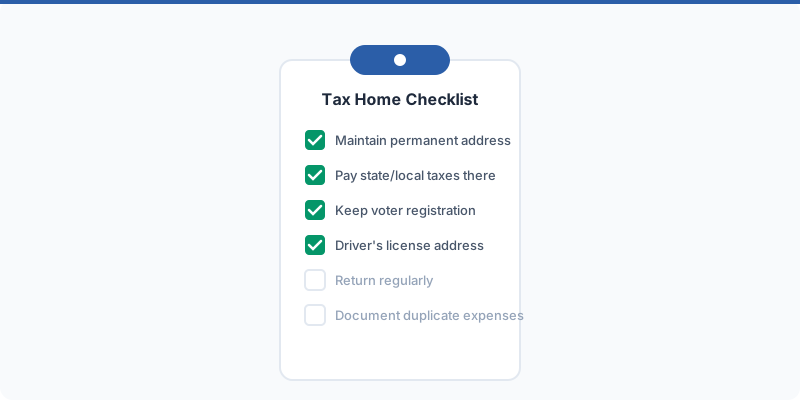
If you maintain a legitimate tax home, a significant portion of your travel nurse income comes as tax-free stipends. These stipends — for housing, meals, and incidentals — are not subject to federal income tax, which means your effective hourly rate is substantially higher than the taxable hourly rate on your pay stub.
This tax advantage is one of the most financially significant benefits of travel nursing, but it requires proper planning and compliance. Misunderstanding tax home rules can lead to a painful audit and back taxes. Get it right from the start.
Professional Development
Beyond clinical skills, travel nursing develops soft skills that make you more valuable throughout your career: adaptability, self-advocacy, rapid learning, independent problem-solving, and interpersonal communication across diverse teams. These are leadership qualities that translate to any future role — whether that is advanced practice nursing, nursing management, or an entirely different career.
The Freedom Factor
The freedom deserves its own section because it is both the biggest attraction and the most misunderstood aspect of travel nursing.
Taking extended breaks between contracts is a freedom that staff nurses almost never enjoy. Many travelers work nine months a year and take three months off for travel, education, or personal projects. The higher per-contract earnings make this financially feasible in a way that staff salaries do not.
Escaping toxic work environments has an expiration date in travel nursing — 13 weeks. If you end up on a difficult unit with poor management, you know there is a defined end. This built-in exit strategy reduces the trapped feeling that drives so much burnout in permanent positions.
Building a lifestyle around your career rather than fitting your life around a job is the philosophical shift that draws many nurses to travel. Your career becomes a tool that supports the life you want, rather than the other way around.
But here is the honest caveat: freedom requires discipline. Without the structure of a permanent position — the automatic retirement contributions, the predictable schedule, the established social circle — you have to build those support systems yourself. Some people thrive with that autonomy. Others find it destabilizing. Knowing yourself matters here.
The Real Cons of Travel Nursing
Now for the parts that travel nursing influencers understate or omit entirely.
Loneliness and Isolation
This is the most underestimated downside, and it is the one that drives more nurses back to staff positions than any other factor. You leave behind your friends, your partner, your family, your gym, your coffee shop, your community. Every 13 weeks, you start over socially.
Some travelers thrive on this cycle — they make friends easily, enjoy meeting new people, and value independence. Others find it crushing. After the novelty of a new city wears off — usually around week two or three — the reality of eating dinner alone in a furnished apartment sets in. Maintaining long-distance relationships, whether romantic, familial, or platonic, requires constant, intentional effort.
This is not a problem you can willpower your way through. It is a structural feature of the lifestyle that you need to honestly evaluate before committing.
Being the Perpetual Outsider
You will never be fully “part of the team.” Permanent staff have shared history, inside jokes, established relationships with physicians, and institutional knowledge you will not develop in 13 weeks. Some units welcome travelers warmly. Others view you as an overpaid temporary hire who took a spot that could have gone to a permanent staff member.
The emotional labor of proving yourself, earning trust, and navigating unfamiliar social dynamics — every single contract — is exhausting. It requires a thick skin, a professional demeanor, and the ability to let go of slights that would be unacceptable in a permanent role.
Job Insecurity
Travel nursing contracts can be cancelled. Facilities can reduce census and send travelers home first. Agencies can fail to find you a new assignment on your timeline. None of these risks exist in a stable staff position.
The practical impact: you need a financial cushion that staff nurses can get by without. The psychological impact: there is always a low-level hum of uncertainty about where you will be working three months from now. Some people find this exciting. Others find it anxiety-inducing.
Constant Adjustment
New charting systems. New protocols. New supply locations. New medication dispensing machines. New badge access. New parking. New coffee shop. Every 13 weeks, everything resets.
This constant adjustment is cognitively taxing. Your first week at every new facility is mentally exhausting — not because the nursing is harder, but because every routine task requires conscious thought instead of autopilot. Over time, experienced travelers develop coping strategies and the adjustment period shortens. But it never disappears entirely.
Administrative Burden
Staff nurses deal with one set of policies, one HR department, and one benefits system. Travel nurses juggle multi-state licensing, certification renewals, compliance documents across multiple agencies, tax home maintenance, self-directed retirement savings, insurance shopping, and housing logistics — on top of the actual nursing.
The administrative overhead is real, and it is ongoing. If you dislike paperwork and logistics, this aspect of travel nursing will wear on you. Many travelers spend several hours each month managing the business side of their career.
The Financial Reality Check
Higher gross pay does not automatically mean higher net income. This distinction matters.
Maintaining a tax home costs money. Whether you own a home, rent an apartment, or rent a room, you are paying for housing in your home state while also paying for housing at your assignment location. This dual-housing cost is the price of tax-free stipends, and it can significantly narrow the gap between travel and staff net income.
Benefits gaps are costly. If your agency offers expensive health insurance with high deductibles, or if you have gaps between contracts where you pay for COBRA or marketplace coverage, those costs eat into your pay premium. Retirement planning without a consistent employer 401(k) match requires more aggressive personal savings.
Travel and relocation costs accumulate. Driving to assignments, shipping belongings, furnishing temporary housing, and maintaining a vehicle all add up. Gas, tolls, flights, and the wear and tear on your car are real expenses that staff nurses do not incur.
The honest comparison: For many travelers, the net income advantage is still significant — especially in high-demand specialties and high-paying locations. But the gap between gross pay and actual take-home income is larger than most people expect. Run the real numbers, including all expenses, before making your decision. The pay calculator can help model different scenarios.
There are situations where staff nursing actually pays more after all expenses are accounted for — particularly in high-paying states, at well-compensated hospitals, and for nurses who would be paying dual housing costs in expensive markets.
The Lifestyle Trade-Offs
Beyond the financial equation, travel nursing affects your personal life in ways that deserve honest consideration.
Impact on relationships. Long-distance romantic relationships are hard. Travel nursing does not make them easier. Couples who succeed with one partner traveling tend to have strong communication skills, emotional independence, and either a flexible partner or a partner who travels along. Relationships that were already strained rarely survive the added distance and disruption.
Difficulty maintaining friendships. Friendships require proximity and shared time. When you move every 13 weeks, you gradually lose touch with your local friend group. You will build new connections on the road, but many of them are transient. The deep, long-term friendships that sustain people through difficult times require a stability that travel nursing does not provide by default.
Housing instability. You will live in furnished apartments, extended-stay hotels, and Airbnbs. Some will be great. Some will be terrible. The constant process of finding, evaluating, moving into, and moving out of temporary housing is tedious and stressful, even when it goes smoothly.
Missing life events. Birthdays, holidays, weddings, family gatherings, kids’ school events — you will miss some of them. This is the most concrete cost of geographic freedom, and it is one that many nurses underestimate until they are 2,000 miles from home on Thanksgiving.
Burnout from constant change. Change can be energizing, but it can also be exhausting. The perpetual newness of travel nursing — new cities, new units, new systems, new people — can lead to a specific kind of burnout that is different from staff nursing burnout. Instead of feeling trapped, you feel unmoored. Neither is pleasant.
Who Travel Nursing Is Best For
Travel nursing is not for everyone, and that is perfectly fine. These are the profiles that tend to thrive:
Nurses who genuinely enjoy change and new experiences. Not “I want a vacation” — genuinely energized by walking into unfamiliar situations, meeting new people, and solving new problems on a regular basis.
Those without strong geographic ties. Single nurses, nurses with mobile partners, empty nesters, and anyone whose social and personal obligations are not anchored to a specific location.
Clinically confident nurses who can provide safe, independent patient care in unfamiliar settings with minimal orientation. A minimum of two years of experience in your specialty is the practical baseline.
People targeting specific financial goals. Nurses paying off student loans, saving for a down payment, building an investment portfolio, or funding a career transition. Travel nursing as a defined financial strategy — with a clear target and end date — tends to work better than open-ended traveling.
Self-directed, organized individuals who do not need institutional structure to manage their benefits, taxes, certifications, and career logistics.
Who Should Think Twice
Be honest with yourself if any of these apply:
New nurses without a solid clinical foundation. Travel nursing demands independence and confidence that comes from experience. Rushing into travel before you are clinically ready puts patients at risk and puts your license in jeopardy.
Nurses with school-age children or partners whose careers are geographically fixed. It is possible to make this work, but the logistical and emotional complexity is significant. Make sure your family is genuinely on board, not just agreeing to keep the peace.
Nurses who prefer routine and deep team relationships. If the best part of your job is the people you work with and the familiarity of your unit, travel nursing removes exactly those elements. There is no shame in preferring stability.
Anyone expecting travel nursing to fix burnout. If you are burned out from unsafe staffing, poor management, or overwhelming workloads, travel nursing might offer temporary relief — but it can also make burnout worse by adding the stress of constant adjustment on top of the clinical demands. Address the root causes of burnout first.
Those who have not done the full financial analysis. If your decision is based on headline weekly pay numbers without accounting for dual housing, benefits costs, travel expenses, and tax complexity, you may be disappointed by the financial reality.
Frequently Asked Questions
Is travel nursing worth it financially compared to staff nursing?
For most nurses in most specialties and most locations, travel nursing provides a meaningful net income advantage — even after accounting for dual housing costs, benefits expenses, and the administrative overhead. The advantage is largest for nurses in high-demand specialties (ICU, OR, ER) working in high-paying markets. The advantage narrows for nurses in lower-paying specialties, nurses in high cost-of-living assignment areas where stipends do not fully cover housing, and nurses whose staff positions already pay well. Run the numbers for your specific situation using the pay calculator rather than relying on generalizations. For most travelers, the net advantage is $10,000 to $30,000 or more annually.
How long do most nurses stay in travel nursing?
The average travel nursing career spans two to five years, though there is enormous variation. Some nurses do one or two contracts and return to staff positions. Others travel for a decade or more. Many nurses cycle in and out — traveling for a few years, returning to staff, and then going back on the road. There is no “right” duration. The key is evaluating regularly whether travel nursing still serves your goals and adjusting when it no longer does.
Can I travel nurse with a family?
Yes, but it requires significantly more planning and flexibility than traveling solo. Some families travel together — particularly those with preschool-age children or homeschooled kids. Others have one parent travel while the other maintains the home base. The logistics of school enrollment, pediatric healthcare, and community stability for children are genuine challenges that families need to address honestly. Many traveling parents limit their assignments to within driving distance of home or take assignments only during school breaks.
Will travel nursing look bad on my resume if I want to go back to staff?
No. Travel nursing experience is increasingly valued by employers because it demonstrates adaptability, diverse clinical experience, and the ability to perform in unfamiliar environments. Some hiring managers actually prefer candidates with travel experience. The key is presenting your travel experience clearly on your resume with specific details about each assignment — unit type, patient population, charting system — that demonstrate the breadth and depth of your clinical capabilities.
What is the biggest mistake first-time travel nurses make?
The biggest mistake is inadequate financial preparation — specifically, not having an emergency fund before the first contract. Income gaps between contracts, delayed first paychecks, unexpected housing costs, and the possibility of contract cancellation all create financial pressure that leads to poor decision-making. Build a three-month emergency fund before your first assignment, understand how your tax home works, and budget for realistic expenses. Financial preparation eliminates the desperation that causes new travelers to accept bad contracts, stay in unsafe situations, or burn through their savings in the first few months.
Key Takeaways
- Travel nursing pay is genuinely higher, but actual net income depends on dual housing costs, benefits, and tax planning
- The freedom and flexibility are real advantages that staff roles cannot match — but freedom requires self-discipline
- Loneliness and constant adjustment are the most underestimated downsides that drive nurses back to staff
- Do an honest financial comparison including all costs before committing — use the pay calculator
- Travel nursing is not for everyone, and recognizing that before your first contract saves time, money, and frustration
- Try one contract before making it your long-term plan — the second assignment is dramatically easier
Related Internal Links
- How to Become a Travel Nurse: Step-by-Step Guide
- Staff Nurse to Travel Nurse: Making the Switch
- First Travel Nurse Assignment: What to Expect
- Highest-Demand Travel Nurse Specialties (2026)
- Best Travel Nurse Agencies (2026 Rankings)
- Travel Nurse Tax Home Guide
- Pay Calculator
Affiliate Placement Notes
- Travel nurse agency affiliate links in the financial section where comparing agency offers is discussed.
- Tax preparation service affiliate links near the tax home and tax complexity discussions.
- Housing platform affiliate links (Furnished Finder, etc.) in the housing instability section.
- Pay calculator tool link throughout financial comparison sections.
