
Years 2-3: Travel Nurse Financial Optimization Guide

Disclosure: Some links in this post are affiliate links. If you click through and make a purchase, we may earn a small commission at no extra cost to you. Learn more about how we make money.
Introduction: You Have the Foundation — Now Optimize
If you followed sound financial advice during your first year of travel nursing (or something close to it), you should have a functional emergency fund, a basic budget, a retirement account with at least some money in it, a tax home that is properly documented, and a general understanding of how your pay and taxes work.
Congratulations. You have done what most travel nurses never do. But you are just getting started.
Years 2 and 3 are when the financially disciplined travel nurse pulls away from the pack. You know how the game works now. You have negotiated contracts, navigated multi-state taxes, survived a contract cancellation or a housing disaster, and figured out which agencies treat you well and which ones do not. The learning curve is behind you.
Now it is time to optimize. This is where you go from “not making financial mistakes” to “actively building wealth.” The strategies in this guide — credit card optimization, stipend maximization, advanced tax planning, investment automation, pay negotiation, and housing arbitrage — are the tools that turn a good travel nursing income into a great financial outcome.
Each strategy in this guide builds on the foundation you established in Year 1. If you skipped Year 1 basics (emergency fund, tax home, budget, first retirement account), go back and complete those first. Our Year 1 financial guide covers everything you need.
Credit Card Strategy: Earning While You Spend
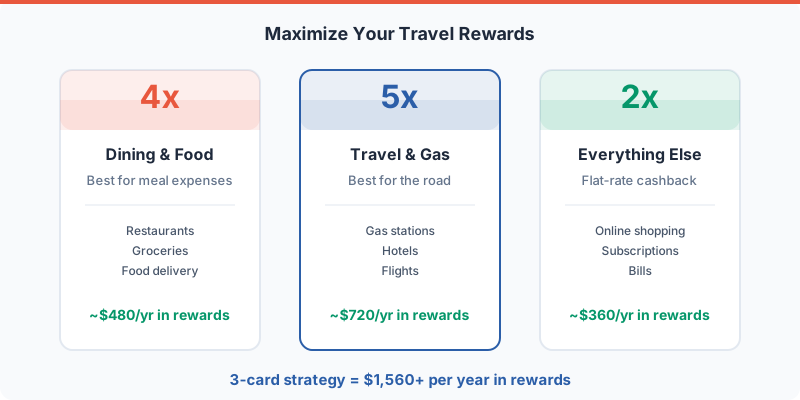
Travel nurses have a unique advantage in the credit card rewards game: your spending patterns naturally align with the highest-reward categories. You drive between assignments (gas), stay in temporary housing (hotels), eat out while settling into new cities (dining), and buy supplies for each new assignment (general spending). With the right card lineup, every dollar of that spending earns meaningful rewards.
Build a Three-Card Foundation
Card 1: A premium travel rewards card. Cards like the Chase Sapphire Preferred or the Capital One Venture X earn bonus points on travel and dining. For travel nurses, the annual fee ($95 to $395) is easily offset by the rewards earned on your normal spending. The sign-up bonus alone — often worth $500 to $1,000 in travel rewards — can cover a round-trip flight or several nights of hotels between assignments.
Card 2: A gas and commuting card. If you drive to assignments, a card that earns 3% to 5% on gas purchases adds up quickly. A nurse who drives 15,000 miles per year at an average fuel cost of $0.15 per mile spends roughly $2,250 on gas. At 4% cash back, that is $90 per year from a single spending category. See our best gas credit cards for travel nurses.
Card 3: A flat-rate cash back card for everything else. A card that earns 2% on all purchases ensures that nothing falls through the cracks. Use this for groceries, Amazon orders, subscriptions, and anything not covered by your other cards.
The Sign-Up Bonus Strategy
Credit card sign-up bonuses are the fastest way to accumulate rewards. Many premium cards offer bonuses worth $500 to $1,000 when you meet a minimum spending requirement (typically $3,000 to $5,000 in the first three months). Travel nurses routinely meet these thresholds through normal assignment-related spending without any manufactured spending.
The approach: Open one new rewards card at the start of each contract (every 13 weeks). Put your assignment-related expenses on the new card to meet the sign-up bonus requirement. Once the bonus is earned, rotate the card into your regular lineup or downgrade it to a no-fee version.
Credit score impact: New card applications cause a small, temporary dip in your credit score (typically 5 to 10 points per inquiry). However, the increase in available credit (which lowers your utilization ratio) and the length of your payment history over time generally push your score higher. As long as you pay every balance in full every month and space applications at least 90 days apart, this strategy builds credit rather than hurting it. Monitor your score with our credit score management tips.
For a comprehensive card comparison, see our best credit cards for travel nurses and our guide to earning 100,000 points as a travel nurse.
Travel Rewards Redemption
Points and miles are only valuable if you use them. The best redemption opportunities for travel nurses include flights home to your tax home between contracts (using airline miles or transferable points), hotel stays during assignment transitions (hotel points or portal bookings), and vacation travel during contract gaps. For maximizing point values, check our travel rewards programs guide.
Maximize Your Stipend Savings
Your non-taxable stipend is the most powerful wealth-building tool in the travel nurse compensation toolkit. In Years 2-3, you should be optimizing every aspect of it.
The Stipend Gap Optimization
The “stipend gap” is the difference between your housing stipend and your actual housing cost. In Year 1, you may have taken whatever housing you could find. By Year 2, you should be strategically minimizing housing costs to maximize this gap.
Target: Save at least 30% to 50% of your housing stipend. If your stipend is $2,200 per month, aim to spend $1,100 to $1,500 on housing and pocket $700 to $1,100 in non-taxable savings.
Strategies that work:
Find a roommate. Splitting a two-bedroom apartment with another travel nurse cuts housing costs in half. A $1,800 apartment becomes $900 per person. On a $2,200 stipend, that is $1,300 per month in savings — $16,900 per 13-week contract. See our roommate guide for how to find compatible housemates.
Negotiate extended-stay rates. Extended-stay hotels often offer weekly or monthly rates that are 20% to 40% below the nightly rate. When booking for 13 weeks, you have significant leverage to negotiate further. See our extended-stay hotel guide.
Target low cost-of-living assignment locations. Housing costs vary dramatically by market. A contract in rural Texas or the Midwest might let you find housing for $600 to $800 per month, while the same stipend in San Francisco covers a fraction of rent. When comparing contracts, factor the stipend gap into your total compensation analysis. The highest hourly rate does not always produce the highest savings. Our guide to the cheapest cities for travel nursing can help.
Consider RV living. Nurses who invest in an RV can dramatically reduce or eliminate housing costs. After the initial purchase (a reliable used RV runs $15,000 to $40,000), monthly lot fees at RV parks near hospitals are typically $500 to $900 — leaving you pocketing $1,300 to $1,700 of your housing stipend per month. See our RV travel nursing guide.
Meals and Incidentals Optimization
Your M&I stipend ($300 to $500 per month, depending on the GSA rate for your assignment location) is also non-taxable. Minimize your food spending and the remainder is tax-free savings.
Meal prep aggressively. Cooking your own meals costs $200 to $300 per month compared to $600 to $1,000 for eating out regularly. The difference is $300 to $700 per month in savings from a single habit change. Our meal prep guide and grocery budget guide have practical strategies.
Use cashback apps on groceries. Apps like Ibotta, Fetch Rewards, and store-specific apps add another 2% to 5% in savings on groceries. On $300 per month in grocery spending, that is $72 to $180 per year in additional savings. See our cashback apps guide.
Advanced Tax Planning
By Years 2-3, you should move beyond basic tax compliance and into active tax optimization.
Maximize Above-the-Line Deductions
Above-the-line deductions reduce your Adjusted Gross Income (AGI) regardless of whether you itemize. These are the highest-value deductions because they affect your eligibility for other tax benefits (ACA subsidies, IRA deduction phase-outs, student loan interest deduction).
Traditional IRA contributions (up to $7,000, or $8,000 if 50+) reduce your AGI dollar-for-dollar if you meet the income requirements.
HSA contributions (up to $4,300 individual, $8,550 family in 2026) reduce AGI and provide tax-free growth and withdrawals for medical expenses. If you are not maxing your HSA, this should be a Year 2-3 priority. See our HSA guide.
Student loan interest (up to $2,500) is deductible if your modified AGI is below the phase-out threshold.
State Tax Optimization
By your second or third year, you have a sense of which states you enjoy working in. Now layer in the tax dimension.
No-income-tax states (Texas, Florida, Nevada, Washington, Tennessee, Wyoming, South Dakota, Alaska, New Hampshire) let you keep 100% of your state taxable income. A contract in Texas versus California could mean a 10% to 13% difference in state tax on your taxable wages.
Example: On a 13-week contract with $20,000 in taxable wages, working in California costs approximately $1,500 to $2,000 in state income tax. The same contract in Texas costs $0. Over four contracts per year, that difference could be $6,000 to $8,000 annually.
This does not mean you should only work in no-tax states — other factors like pay rates, facility quality, and personal preference matter. But when you are deciding between two similar contracts, state tax impact should be part of your analysis. For the full picture, see our tax deductions guide.
Quarterly Tax Reviews
Instead of waiting until year end, review your tax situation quarterly. Check your withholding against your estimated liability every 13 weeks (conveniently, at the end of each contract). Adjust your W-4 with each new agency if withholding is off track. Make estimated payments if needed. See our year-end tax planning guide for the review framework.
Investment Automation
In Year 1, you opened your first retirement account. In Years 2-3, you automate your investing so wealth builds without requiring constant attention.
Set Up Automatic Investments
Roth IRA: Set up a recurring monthly transfer from your checking account to your Roth IRA. If you are aiming to max it out at $7,000 per year, that is $583 per month. If you cannot swing the full amount, automate whatever you can and increase it by $50 per month each quarter.
401(k): Set your contribution percentage at the start of each contract and do not touch it. Aim for at least 10% to 15% of your taxable wages, ideally maxing out at $23,500 if your income supports it.
Taxable brokerage account: Once your Roth IRA is maxed, consider opening a taxable brokerage account for additional investing. Set up a monthly automatic investment into a low-cost index fund (total stock market or S&P 500). Even $200 to $500 per month in a taxable account starts building serious wealth over time.
Keep It Simple: Index Fund Investing
You do not need to pick individual stocks or time the market. A simple portfolio of two to three low-cost index funds is sufficient for most travel nurses in Years 2-3:
- U.S. total stock market index fund (70% to 80% of portfolio)
- International stock market index fund (15% to 25% of portfolio)
- U.S. bond index fund (0% to 10% of portfolio, increasing as you get older)
This approach, called a “lazy portfolio,” consistently outperforms actively managed funds over the long term due to lower fees and broad diversification. For more detail, see our investing guide.
Negotiate Higher Pay
By Years 2-3, you have the experience and track record to command higher rates. Do not accept the first offer — negotiate every contract.
Your Leverage Points
Track record. You have completed multiple contracts successfully. Agencies and facilities value reliability. A nurse who shows up on time, finishes contracts, and gets good reviews is worth a premium.
Specialty experience. Two to three years of travel experience, combined with your pre-travel staff experience, gives you a clinical depth that newer travelers lack. Highlight specific competencies, certifications, and EMR proficiency in your negotiations.
Multiple agency relationships. By now, you should be working with two to four agencies simultaneously. When Agency A offers you a rate, you can honestly say Agency B is offering more. Competition drives rates up.
What to Negotiate
Base hourly rate. Ask for $2 to $5 more per hour than the initial offer. Over a 36-hour week for 13 weeks, a $3/hour increase is $1,404 in additional income per contract. Over four contracts per year, that is $5,616.
Stipend amounts. Some agencies have flexibility on housing and M&I stipends, especially if the GSA rates for your assignment area support higher amounts. Ask.
Completion bonuses. Request a completion bonus of $500 to $2,000 even if one is not initially offered. Many agencies have discretionary budgets for this.
Overtime guarantees or opportunities. Ask about overtime availability. Some contracts offer guaranteed overtime hours at time-and-a-half, which dramatically increases your total compensation. See our overtime pay guide.
Travel reimbursement. Ask for reimbursement for mileage or travel costs to your assignment, especially for distant locations.
For the full negotiation playbook, see our contract negotiation guide.
Multiple State License ROI
Investing in additional state licenses expands your assignment options and can pay for itself many times over.
The Compact License Advantage
If you do not already have a Nurse Licensure Compact (NLC) multistate license, getting one should be a Year 2 priority. A single compact license gives you access to over 40 states without individual applications. The cost of converting or obtaining a compact license varies by state but is typically $50 to $200 — a fraction of what you would pay for multiple individual state licenses.
Strategic Single-State Licenses
Even with a compact license, several high-demand, high-paying states are not compact members. The most valuable non-compact licenses to consider:
California. High pay rates, massive demand, and the largest population of any state. California licenses take 8 to 12 weeks to obtain and cost $200 to $300, but the earning potential in California assignments can be significantly higher than average. See our state licensing timeline guide.
New York. Another high-demand, high-paying state. Processing times are moderate, and the license opens access to New York City’s enormous hospital system.
Ohio, Pennsylvania, Massachusetts. These non-compact states have strong hospital markets and consistent travel nurse demand.
The ROI Calculation
A single state license costs $100 to $300 and takes a few weeks of administrative effort. If it enables you to take even one higher-paying contract that you would otherwise miss, the license pays for itself 10 to 50 times over. If you are serious about maximizing your income, strategically adding one to two non-compact state licenses per year is a smart investment.
For step-by-step guidance on obtaining new licenses, see our guide to getting a nursing license in a new state.
FAQ
How much should I be saving by Years 2-3?
By your second and third years, you should be saving 25% to 35% of your take-home pay. This includes retirement contributions (Roth IRA, 401(k)), taxable investment contributions, and short-term savings goals. On a $90,000 total compensation package, that translates to roughly $22,500 to $31,500 per year in total savings. If you are below 25%, look for optimization opportunities in housing costs, dining spending, and subscription expenses.
When should I start investing in a taxable brokerage account?
Start a taxable brokerage account after you have met these prerequisites: full emergency fund (three to six months of expenses), high-interest debt paid off, Roth IRA maxed or nearly maxed ($7,000 per year), and at least 10% of your taxable income going to your 401(k). Once those boxes are checked, extra money should go into a low-cost index fund in a taxable brokerage account. The earlier you start, the more time compound growth works in your favor.
Is it worth paying annual fees on credit cards?
For most travel nurses in Years 2-3, yes. A card with a $95 annual fee that earns 3x points on dining and travel can easily generate $300 to $600 or more in annual rewards value on normal travel nurse spending. The key is doing the math: estimate your annual spending in the card’s bonus categories, multiply by the rewards rate, and subtract the annual fee. If the result is positive, the card is worth it. If you are not using the card enough to justify the fee, downgrade to a no-fee version.
How do I handle retirement accounts from multiple agencies?
Roll them over into a single IRA. Every time you leave an agency, you can roll your 401(k) balance into a Traditional IRA (or Roth IRA if it was a Roth 401(k)) at any brokerage of your choice. Consolidating into one IRA gives you a clearer picture of your retirement savings, lower fees (since you control the investment choices), and easier management. Most brokerages make the rollover process straightforward — contact them and they will walk you through it.
Should I consider working as a 1099 contractor for better tax deductions?
Proceed with extreme caution. While 1099 arrangements offer more deduction opportunities (business expenses on Schedule C), they also come with significant costs: self-employment tax (15.3% on net income), no employer-paid FICA, no agency benefits, and full responsibility for your own insurance, liability coverage, and compliance. For most travel nurses, the W-2 arrangement with non-taxable stipends provides a better overall financial outcome. Consult with a travel nursing CPA before making this switch. See our W-2 vs. 1099 analysis for a detailed comparison.
Key Takeaways
- Build a three-card credit card lineup (travel rewards, gas, flat-rate cash back) and pursue sign-up bonuses at the start of each contract to maximize rewards on your normal spending.
- Optimize your stipend gap by targeting affordable housing through roommates, negotiated extended-stay rates, low-cost locations, or RV living. Saving 30% to 50% of your housing stipend translates to $10,000 to $20,000+ per year in tax-free savings.
- Advance your tax strategy beyond compliance to optimization: maximize above-the-line deductions (IRA, HSA), factor state income tax into contract decisions, and review your tax situation quarterly.
- Automate your investments with recurring transfers to your Roth IRA, 401(k), and eventually a taxable brokerage account. Keep it simple with low-cost index funds.
- Negotiate every contract. A $3/hour rate increase across four contracts per year adds $5,600 annually. Always ask for higher rates, completion bonuses, and overtime opportunities.
- Invest in strategic state licenses to expand your assignment options and access higher-paying markets. The ROI on a $200 license can be thousands of dollars in better contracts.
Years 2 and 3 are where the gap between “good income” and “real wealth” starts to form. Every optimization you implement compounds over time. The credit card rewards fund your vacations. The stipend savings build your investment portfolio. The tax planning keeps more money in your pocket. And the negotiation skills ensure your income grows alongside your expenses. Stack these strategies, and you are not just earning well — you are building wealth.
Related Internal Links
- Year 1 Travel Nurse Financial Guide
- Best Credit Cards for Travel Nurses
- Travel Nurse Investing Guide
- How to Negotiate a Travel Nurse Contract
- Travel Nurse Tax Deductions
- Cheapest Cities for Travel Nursing
- Travel Nurse Roommate Guide
- Nurse Licensure Compact States
Affiliate Placement Notes
- Credit card affiliate links throughout the credit card strategy section (specific card recommendations)
- Investment platform links in the investment automation section
- High-yield savings account links where referenced
- Travel rewards program links in the redemption section
- Cashback app affiliate links in the M&I optimization section
- Budgeting app links in spending tracking mentions
