
Year 1 Travel Nurse Financial Guide: Building Your Foundation

Disclosure: Some links in this post are affiliate links. If you click through and make a purchase, we may earn a small commission at no extra cost to you. Learn more about how we make money.
Introduction: Your First Year Sets the Trajectory
Your first year as a travel nurse will likely be the highest-earning year of your life up to this point. That is not an exaggeration — travel nurse compensation routinely exceeds staff nurse pay by 30% to 50% or more, and the combination of higher hourly rates and non-taxable stipends puts serious money in your pocket.
Here is the uncomfortable truth: many first-year travel nurses end the year with almost nothing to show for it. The money comes in fast, and without a plan, it goes out just as fast. New city, new restaurants, new apartment to furnish, new gear to buy. The excitement of travel nursing — seeing new places, meeting new people, living a life most people only dream about — comes with spending temptations that can drain a paycheck before you realize what happened.
But the nurses who get their finances right in Year 1 set themselves up for extraordinary outcomes. A travel nurse who saves aggressively in their first year can build a full emergency fund, open their first retirement account, establish a tax home properly, and avoid the financial traps that keep other nurses living paycheck to paycheck despite earning six figures.
This guide is your financial roadmap for the first 12 months. Follow it in order, and you will finish Year 1 with a foundation that supports everything you want to build in the years ahead.
Disclaimer: This guide is for educational purposes only and does not constitute tax or financial advice. Consult qualified professionals for guidance on your specific situation.
Priority 1: Establish Your Tax Home (Do This Before Your First Assignment)
Your tax home is the single most important financial decision you will make as a travel nurse, and it needs to be settled before your first contract starts. Getting it wrong can cost you tens of thousands of dollars in unexpected taxes.
What a Tax Home Is
A tax home is the general area where your main place of business or employment is located. For travel nurses, it is typically a permanent residence that you maintain, return to regularly, and where you incur real living expenses. Having a valid tax home is what makes your housing, meal, and incidental stipends non-taxable.
Without a valid tax home, all of your stipends become taxable income. On a typical travel nurse contract with $25,000 to $35,000 in annual stipends, losing the non-taxable status could cost you $6,000 to $10,000 or more in additional federal and state taxes.
How to Set Up Your Tax Home
Option 1: Keep your current residence. If you already rent or own a home, maintaining it as your tax home is the simplest path. Continue paying rent or mortgage, keep utilities in your name, and return to this address between assignments. This is the easiest tax home to defend because you have an established history.
Option 2: Establish a new tax home. If you are giving up your current home to start traveling, you need to establish a new permanent residence. Options include renting an apartment or room in a city where you plan to return between contracts, living with family while paying fair market rent (with a documented lease), or maintaining a room in your parents’ home if you pay rent and contribute to household expenses.
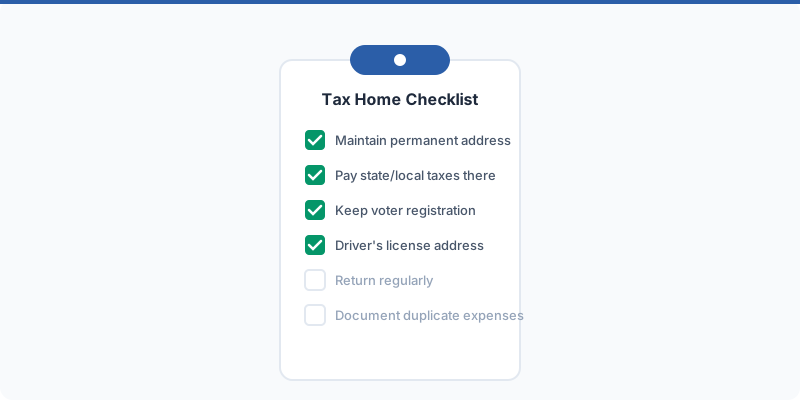
What the IRS looks for. You need to demonstrate three things: (1) you perform part of your work in the area of your tax home, (2) you have living expenses at your tax home that you duplicate while on assignment, and (3) you have not abandoned your tax home (you return there regularly and maintain connections).
Document everything from day one. Keep your lease or mortgage statements, utility bills, records of trips back to your tax home, voter registration or vehicle registration at that address, and any other evidence of your connection to the area. Start a folder (digital or physical) for tax home documentation and add to it throughout the year.
For the full breakdown, read our tax home guide. And for understanding how stipends work in relation to your tax home, see our stipend explainer.
Priority 2: Build Your Emergency Fund
Before you invest, before you pay off debt aggressively, before you do anything else with your money — build an emergency fund. This is your financial shock absorber, and travel nursing’s inherent instability makes it non-negotiable.
The Target
Phase 1: $1,000 as fast as possible. This is your starter fund. It prevents a single unexpected expense from going on a credit card. Most first-year travel nurses can save $1,000 within the first two to three weeks of their first contract if they prioritize it.
Phase 2: One month of essential expenses ($3,000 to $5,000). This covers a short gap between contracts or a minor emergency. Build this during your first contract.
Phase 3: Three to six months of essential expenses ($10,000 to $25,000). This is your full emergency fund target. It covers contract cancellations, extended gaps, major car repairs, medical emergencies, and anything else life throws at you. Aim to reach this by the end of Year 1.
Where to Keep It
Open a high-yield savings account at an online bank that pays 4% to 5% APY. Keep this account separate from your daily checking account to prevent the temptation to dip into it. Set up an automatic transfer from your checking account on every payday.
For the complete emergency fund strategy — including the stipend saver method and the contract kickoff transfer — see our detailed emergency fund guide.
Priority 3: Set Up a Budget That Works for Variable Income
Travel nurse income is not consistent. Your hourly rate changes with each contract. Your stipends vary by location. Overtime availability fluctuates. Your expenses shift every 13 weeks as you move to new cities with different costs of living. A rigid budget will break under this variability. You need a flexible system.
The Percentage-Based Approach
Instead of fixed dollar amounts, budget by percentages of your take-home pay each contract:
- 50% for needs: Housing (at your assignment location), groceries, transportation, insurance, minimum debt payments, and tax home expenses
- 30% for wants: Dining out, entertainment, exploring your new city, shopping, and personal spending
- 20% for savings and goals: Emergency fund, retirement contributions, debt payoff above minimums, and other financial goals
These percentages are starting points. As a first-year traveler, consider pushing toward 25% to 30% savings if you can swing it — the higher earning potential of travel nursing compared to staff nursing is your biggest advantage, and the nurses who capitalize on it in Year 1 pull ahead fast.
Track Your Spending
You need to know where your money goes. Use a budgeting app (YNAB, Mint successor apps, or a simple spreadsheet) and categorize every transaction for at least the first three months. Most people are surprised by what they find. The $15 daily coffee-and-lunch habit that seems harmless adds up to $5,400 per year.
For a complete budgeting framework tailored to travel nurses, see our budget guide and download our budget template.
Priority 4: Understand Your Pay and Taxes
Travel nurse compensation is more complex than a staff nurse salary, and first-year travelers who do not understand their pay structure make expensive mistakes.
Know Your Pay Package Components
Every travel nurse pay package consists of several components. Your taxable hourly rate is your base wage, subject to federal, state, and FICA taxes. Your housing stipend is a non-taxable payment intended to cover housing costs at your assignment location (non-taxable only if you maintain a valid tax home). Your meals and incidentals stipend (M&I or per diem) is a non-taxable payment intended to cover food and incidental costs while on assignment. And your travel reimbursement covers transportation costs to and from your assignment.
Understanding how these components fit together is essential. See our guides on reading your pay stub and comparing pay packages for detailed breakdowns.
Set Aside Money for Taxes
This catches more first-year travel nurses off guard than almost anything else. If you work in multiple states, you may owe state income tax in each one. Your agency may not withhold enough for all of your state obligations. And if your W-4 is not set up correctly, your federal withholding could be short too.
The safe play: Set aside 25% to 30% of your taxable wages in a separate savings account earmarked for taxes. This is in addition to what your agency withholds. If your agency withheld enough, great — you will get that money back when you file. If they under-withheld (common with multi-state situations), you will be glad you planned ahead.
Hire a CPA in Your First Year
Do not try to file your first travel nurse tax return yourself. Multi-state filing, tax home documentation, stipend compliance, and potential deductions create a level of complexity that general tax software does not handle well. A CPA who specializes in travel nursing typically charges $300 to $500 for tax preparation and can save you many times that amount in properly handled deductions and compliance. Find one early — do not wait until April. See our travel nurse CPA guide.
Priority 5: Open Your First Retirement Account
Your first year of travel nursing is the best time to start retirement savings, because the habit you build now will compound for decades.
Where to Start
Roth IRA: The best first retirement account for most new travel nurses. A Roth IRA lets you contribute after-tax dollars that grow tax-free and can be withdrawn tax-free in retirement. The 2026 contribution limit is $7,000 ($8,000 if you are 50 or older).
Why Roth over Traditional in Year 1? Most first-year travel nurses are in a lower tax bracket than they will be in the future. You are early in your earning career, possibly still paying off student loans, and your income may grow significantly as you gain experience and negotiate higher rates. Paying taxes now at a lower rate and letting the money grow tax-free is a strong bet.
Agency 401(k): Worth it if there is a match. If your agency offers a 401(k) with employer matching and you can access it without a long waiting period, contribute at least enough to capture the full match. A 50% match on 6% of your salary is an immediate 50% return on your money — you will never find that in any investment.
If you can only do one: Start with the Roth IRA. It is portable (it stays with you regardless of your agency), flexible (you can withdraw contributions penalty-free if needed), and straightforward to set up through any major brokerage (Fidelity, Vanguard, Charles Schwab).
How Much to Contribute
If you cannot afford to max out your Roth IRA at $7,000 for the year, start with whatever you can: $100 per month, $200 per month, $50 per paycheck. The amount matters less than the habit. You can always increase it later.
A first-year travel nurse who invests $300 per month in a Roth IRA starting at age 27, earning an average 7% annual return, will have approximately $480,000 by age 60 — all of it tax-free. Start now. Not next year. Now.
For a deeper dive into retirement account options, see our 401(k) and retirement guide and our investing guide.
Priority 6: Make Smart Insurance Decisions
Insurance decisions in your first year protect you from catastrophic financial events. Do not skip this section.
Health Insurance
You have three main options: agency-sponsored insurance, an ACA marketplace plan, or a spouse or parent’s plan (if you are under 26, you can remain on a parent’s plan).
For most first-year travel nurses, the ACA marketplace is worth investigating because your non-taxable stipends reduce your subsidy-eligible income. However, if you value simplicity and your agency offers a competitive plan with a broad PPO network, agency insurance is a reasonable choice in Year 1 while you learn the ropes. See our health insurance guide and open enrollment guide for a thorough comparison.
Malpractice Insurance
Your agency provides malpractice coverage, but carrying your own supplemental policy ($100 to $300 per year) gives you an extra layer of protection. It covers you regardless of which agency you work for and protects you in situations where the agency’s policy might not fully cover your interests. See our malpractice insurance guide.
Renter’s Insurance
At $15 to $30 per month, renter’s insurance covers your belongings at your assignment housing and your tax home. It also provides liability coverage if someone is injured in your rental. Given how frequently you move and the value of the gear you carry, this is a no-brainer.
Disability Insurance
This is often overlooked by young, healthy nurses, but it is arguably the most important insurance you can carry. If an injury or illness prevents you from working, disability insurance replaces a portion of your income. Travel nurses are especially vulnerable because there is no employer sick leave or short-term disability to fall back on. A personal disability policy costs $50 to $150 per month depending on your age, health, and coverage amount. See our disability insurance guide.
Common First-Year Money Mistakes (and How to Avoid Them)
Mistake 1: Not Setting Up a Tax Home
We covered this in Priority 1, but it bears repeating because it is the costliest mistake a new travel nurse can make. Without a valid tax home, your stipends become fully taxable. On $30,000 in annual stipends, that is $7,500 to $9,000 in additional taxes. Set up your tax home before your first assignment and document everything.
Mistake 2: Lifestyle Inflation
Your first travel nurse paycheck will probably be the largest paycheck you have ever received. The temptation to upgrade your lifestyle immediately — nicer housing, more dining out, new car — is powerful. Resist it. Live on what you earned as a staff nurse (or close to it) and save the difference. You can always increase your spending later once your financial foundation is solid. The nurses who inflate their lifestyle in Year 1 end up earning more and saving less than they did as staff nurses.
Mistake 3: Ignoring Multi-State Tax Obligations
If you work in three states during the year, you may need to file tax returns in all three (plus your home state). Your agency may not withhold enough state tax for each jurisdiction. The result: a surprise tax bill in April. Set aside extra money for state taxes and work with a CPA who handles multi-state returns.
Mistake 4: Spending the Stipend
Your non-taxable stipend is designed to cover housing, meals, and incidentals at your assignment location. But nothing stops you from spending it on other things. The financially savvy approach is to find housing that costs less than your stipend and bank the difference. If your housing stipend is $2,000 per month and you find a room for $1,000, that $1,000 monthly surplus is $12,000 per year in tax-free savings. See our housing guide for strategies to find affordable accommodations.
Mistake 5: Skipping Retirement Savings
“I will start saving for retirement when I am more settled” is a phrase that delays wealth building by years. Compound interest rewards early action disproportionately. $5,000 invested at age 25 is worth more at age 65 than $15,000 invested at age 40 (assuming 7% returns). Start now with whatever you can afford.
Mistake 6: Not Tracking Expenses
If you do not know where your money goes, you cannot control it. Track every dollar for at least your first three contracts. You will find spending leaks you did not know existed, and you will be able to make informed decisions about where to cut and where your spending genuinely reflects your values.
Mistake 7: Buying Too Much Gear Too Fast
New travel nurses often overspend on gear — luggage, kitchen equipment, bedding, work supplies — before their first assignment. Start with the essentials and add items only as you discover genuine needs. Your second assignment’s packing list will look very different from your first. See our packing list guide for what you actually need versus what you can skip.
Your Year 1 Financial Timeline
Before Your First Assignment
- Establish your tax home and begin documentation
- Open a high-yield savings account for your emergency fund
- Open a checking account at a nationwide bank with no fees (see best banks)
- Research and select a CPA who specializes in travel nursing
Months 1-3 (First Contract)
- Build your starter emergency fund ($1,000) within the first three weeks
- Set up your budget and start tracking spending
- Enroll in health insurance (agency or marketplace)
- Purchase renter’s insurance and malpractice insurance
- Reach one month of essential expenses in your emergency fund
Months 4-6 (Second Contract)
- Open a Roth IRA and make your first contribution
- Build your emergency fund to three months of essential expenses
- Review your first contract’s spending and adjust your budget
- Begin researching credit card rewards strategies for travel nursing
Months 7-9 (Third Contract)
- Increase retirement contributions
- Build emergency fund toward the six-month target
- Evaluate your housing strategy — are you saving enough on the stipend gap?
- Make Q3 estimated tax payment if needed
Months 10-12 (Fourth Contract)
- Complete your year-end tax planning
- Reach your full emergency fund target (three to six months)
- Review your complete first-year financial performance
- Set goals for Year 2
FAQ
How much should I expect to earn in my first year as a travel nurse?
First-year travel nurse compensation varies by specialty, location, and agency, but most nurses earn between $75,000 and $110,000 in total compensation (taxable wages plus non-taxable stipends) during their first full year. High-demand specialties like ICU and ER tend toward the upper end, while med-surg and telemetry are typically lower. Your actual take-home depends on how many weeks you work, your negotiation skills, and your contract locations. See our salary guide for current rate ranges by specialty.
Do I need to set up an LLC as a first-year travel nurse?
No. The vast majority of travel nurses are W-2 employees of their staffing agency, and forming an LLC is unnecessary and provides no tax benefit for W-2 workers. LLCs are relevant only for 1099 independent contractor nurses, which is uncommon. Do not let anyone sell you on LLC formation as a tax savings strategy until you have consulted with a CPA who understands travel nursing. See our LLC guide for the full analysis.
What if I have student loan debt? Should I focus on paying that off before saving?
Not entirely. Follow this priority order: (1) build a $1,000 starter emergency fund, (2) make minimum payments on all debts, (3) build a full emergency fund, (4) pay off high-interest debt (credit cards, personal loans with rates above 8%), (5) start retirement savings, (6) then aggressively pay down student loans. If your student loans are at a relatively low interest rate (under 6%), you can invest for retirement simultaneously because the expected investment return (7% to 10% historically) exceeds your loan interest rate. See our student loan guide for detailed payoff strategies.
How do I choose between taking the housing stipend and letting my agency provide housing?
Take the stipend in almost every case. Agency-provided housing comes at a hidden cost — the agency deducts the housing expense from your total pay package, and you lose the ability to pocket the difference between the stipend and your actual housing cost. The stipend gap (stipend minus actual housing cost) is one of the most powerful savings tools available to travel nurses. Find affordable housing through platforms like Furnished Finder, extended-stay hotels, or roommate arrangements, and bank the difference. See our housing stipend vs. agency housing analysis for a detailed comparison.
What is the biggest financial mistake first-year travel nurses make?
Not setting up a proper tax home. This single mistake can cost $6,000 to $10,000 or more in additional taxes on stipend income that should have been non-taxable. The second biggest mistake is lifestyle inflation — earning significantly more than they did as staff nurses but saving no more (or even less) because spending rose to match the higher income. Both are entirely preventable with planning.
Key Takeaways
- Establish your tax home before your first assignment and document it meticulously. This protects the non-taxable status of your stipends and can save you $6,000 to $10,000 or more per year.
- Build your emergency fund in phases: $1,000 immediately, one month of expenses during your first contract, three to six months by year end. Keep it in a high-yield savings account earning 4% to 5%.
- Set up a percentage-based budget (50% needs, 30% wants, 20%+ savings) that adapts to your variable income. Track every dollar for at least your first three contracts.
- Open a Roth IRA as your first retirement account. Start with any amount you can afford and increase over time. The habit matters more than the initial amount.
- Hire a CPA who specializes in travel nursing for your first tax return. Multi-state filing and stipend compliance are too complex for general tax software.
- Avoid the big mistakes: lifestyle inflation, spending the stipend gap, skipping retirement savings, ignoring multi-state taxes, and buying too much gear upfront.
- Follow the Year 1 timeline to build your financial foundation systematically. By the end of 12 months, you should have a full emergency fund, an active retirement account, proper insurance, and a clear picture of your financial trajectory.
Your first year sets the trajectory for your entire travel nursing career. The nurses who build their financial foundation in Year 1 compound that advantage for every year that follows. The ones who wait find themselves starting over again and again. Choose to start now.
Related Internal Links
- How to Become a Travel Nurse
- Travel Nurse First Assignment Guide
- Travel Nurse Tax Home Guide
- Travel Nurse Emergency Fund
- Travel Nurse Budget Guide
- Travel Nurse 401(k) and Retirement
- Travel Nurse Health Insurance Guide
- Travel Nurse Financial Planning
Affiliate Placement Notes
- High-yield savings account affiliate links in the emergency fund section
- Budgeting app affiliate links in the budget section
- CPA referral links in the tax section
- Retirement account platform (Fidelity, Vanguard, Schwab) links in the retirement section
- Gear recommendation links in the common mistakes section (packing list cross-reference)
- Insurance comparison links in the insurance decisions section
