
Year-End Tax Planning for Travel Nurses: December Checklist
Disclosure: Some links in this post are affiliate links. If you click through and make a purchase, we may earn a small commission at no extra cost to you. Learn more about how we make money.
Introduction: December Is Your Last Chance to Lower This Year’s Tax Bill
For most travel nurses, tax season means scrambling to gather W-2s in February and hoping for the best. But by the time you file, it is too late to change anything. The real tax planning happens in December — the last month you can take actions that reduce your tax liability for the current year.
December is when you can make last-minute retirement contributions that lower your taxable income. It is when you should review your estimated tax payments to avoid underpayment penalties. It is when charitable donations still count for this year’s return. And it is when organizing your records saves you hours of frustration (and potentially thousands of dollars in missed deductions) when filing season arrives.
Travel nurses face a more complex tax picture than most W-2 employees. Multiple states, non-taxable stipends, variable income across contracts, and the ever-present question of tax home compliance all create opportunities to save — and traps that cost money if you are not careful.
This December checklist walks you through every action you should take before midnight on December 31 to minimize your tax bill and set yourself up for a smooth filing season.
Disclaimer: This guide is for educational purposes only and does not constitute tax advice. Consult a qualified CPA or tax professional for guidance on your specific situation.
Step 1: Review Your Year-to-Date Income
Before you can plan, you need to know where you stand. Pull together a complete picture of your income for the year.
Gather Your Pay Information
Log in to each agency’s payroll portal and download your year-to-date earnings statements. If you worked with multiple agencies during the year, you will receive a separate W-2 from each one. Your year-to-date statement should show your total taxable wages (which will appear in W-2 Box 1), total federal tax withheld (W-2 Box 2), state taxes withheld (W-2 Box 17), and Social Security and Medicare wages.
Do not confuse your total compensation with your taxable income. Your non-taxable stipends for housing, meals, and incidentals do not appear in Box 1 of your W-2 (assuming you have a valid tax home). Your taxable income is almost certainly lower than your total earnings.
Calculate Your Estimated AGI
Your Adjusted Gross Income (AGI) is the number that drives most tax calculations. To estimate it, add together all taxable wages from all agencies, any interest and dividend income from bank accounts and investments, any side gig or freelance income (1099 income), and any other taxable income sources.
Then subtract above-the-line deductions you have already taken or plan to take: traditional IRA contributions, student loan interest (up to $2,500), HSA contributions, and self-employment tax deduction (if applicable).
The result is your estimated AGI. Write this number down — you will need it for nearly every step that follows.
Check Your Tax Bracket
For 2026, the federal income tax brackets for single filers are approximately:
- 10% on income up to $11,925
- 12% on income from $11,926 to $48,475
- 22% on income from $48,476 to $103,350
- 24% on income from $103,351 to $197,300
- 32% on income from $197,301 to $250,525
- 35% on income from $250,526 to $626,350
- 37% on income above $626,350
Knowing your bracket tells you the tax benefit of each additional dollar of deductions. If you are in the 22% bracket, every $1,000 in deductions saves you $220 in federal tax. If you are in the 24% bracket, that same $1,000 saves $240. This matters when deciding whether certain year-end strategies are worth the effort.
Step 2: Maximize Retirement Contributions
Retirement contributions are the single most powerful tax reduction tool available to most travel nurses. Every dollar you contribute to a tax-deferred account reduces your taxable income dollar-for-dollar.
Traditional IRA Contributions
You have until April 15 of the following year to make Traditional IRA contributions for the current tax year. But there is a strategic advantage to contributing in December: you know your approximate income, you can calculate the tax benefit precisely, and you free up your January-through-April cash flow for other priorities.
The 2026 contribution limit is $7,000 ($8,000 if you are 50 or older). If you have not contributed yet this year, a full $7,000 contribution in December at the 22% bracket saves $1,540 in federal tax. At the 24% bracket, it saves $1,680.
Deductibility check: If you are covered by an employer retirement plan (including an agency 401(k)), your Traditional IRA deduction may be limited based on your income. For 2026, the deduction phases out for single filers covered by a workplace plan between approximately $79,000 and $89,000 of modified AGI. If your income exceeds the phase-out, consider a Roth IRA contribution instead (no tax deduction, but tax-free growth). See our retirement planning guide for a deeper comparison.
Agency 401(k) Contributions
Unlike IRA contributions, 401(k) contributions must be made through payroll deductions during the calendar year. If you are currently on assignment with an agency that offers a 401(k) and you have not been contributing (or have been contributing less than the maximum), contact your agency’s HR or benefits department immediately to increase your contribution for your remaining December paychecks.
The 2026 401(k) limit is $23,500 ($31,000 if you are 50 or older). Even if you cannot max it out, every additional dollar contributed in December reduces your taxable income.
Employer match check: If your agency offers a match, make sure you are contributing enough to capture the full match before year end. Leaving matching dollars on the table is leaving free money behind. Review vesting schedules too — if you plan to stay with the agency through the vesting period, the match is worth prioritizing.
Roth IRA Considerations
Roth IRA contributions do not reduce your current-year taxes. However, December is a good time to fund your Roth for the year if you have not already. You can contribute to a Roth IRA for 2026 if your modified AGI is below $161,000 (single) or $240,000 (married filing jointly). The same $7,000/$8,000 limits apply.
If your income is too high for a direct Roth contribution, ask your CPA about a backdoor Roth IRA strategy.
HSA Contributions
If you have a High Deductible Health Plan (HDHP), your Health Savings Account is a triple-tax-advantaged powerhouse: contributions are tax-deductible, growth is tax-free, and withdrawals for qualified medical expenses are tax-free. The 2026 limits are $4,300 for individual coverage and $8,550 for family coverage.
Like IRA contributions, you technically have until April 15 to contribute for the current year. But contributing in December lets you lock in the deduction while you are still doing year-end planning. If you have not maxed out your HSA, this should be near the top of your December to-do list. For more on HSA strategy, see our HSA vs. FSA guide.
Step 3: Review Estimated Tax Payments
Travel nurses are at higher risk for underpayment penalties than typical W-2 employees because of variable income, multiple employers, and the possibility that withholding was not set up optimally with each agency.
Check Your Withholding
Compare your total federal tax withheld (across all agencies) to your estimated tax liability. If you have been working the full year and your W-4 was set up correctly with each agency, your withholding should be close to your actual liability. But if you changed agencies mid-year, had gaps between contracts, earned significantly more or less than expected, or had side income that was not subject to withholding, your withholding may be off.
Use the IRS Tax Withholding Estimator (available at irs.gov) to compare your withholding to your expected liability. If you owe more than $1,000 in tax after accounting for withholding, you could face an underpayment penalty.
Making a Q4 Estimated Payment
If your withholding is short, you have until January 15 of the following year to make a fourth-quarter estimated tax payment. Paying estimated tax through IRS Direct Pay or EFTPS (Electronic Federal Tax Payment System) is straightforward and avoids the penalty.
How much should you pay? The safe harbor rules say you avoid penalties if you have paid at least 100% of the prior year’s tax liability (110% if your AGI exceeds $150,000) or 90% of the current year’s tax liability through a combination of withholding and estimated payments.
Your CPA can calculate the exact amount, but a rough approach is: estimate your total tax liability for the year, subtract your total withholding, and if the difference exceeds $1,000, pay enough to bring you within the safe harbor.
State Estimated Tax Payments
Do not forget state taxes. If you worked in multiple states, you may owe estimated taxes in several jurisdictions. States that have high income tax rates (California, New York, New Jersey, Oregon) are especially likely to result in underpayment if your agency did not withhold enough. Review each state’s estimated tax payment rules and deadlines. Some states align with the federal Q4 deadline; others do not. A CPA who specializes in travel nursing is invaluable for multi-state tax situations.
Step 4: Harvest Tax Losses (If You Invest)
If you have a taxable brokerage account (outside of retirement accounts), December is the time to review your portfolio for tax-loss harvesting opportunities.
Tax-loss harvesting means selling investments that have declined in value to realize a capital loss. That loss can offset capital gains you realized during the year, reducing your tax bill. If your losses exceed your gains, you can deduct up to $3,000 of excess losses against your ordinary income.
Example: You bought $5,000 of a total stock market fund in March, and it is now worth $3,800. If you sell, you realize a $1,200 loss. If you also sold a different investment earlier in the year for a $1,000 gain, the loss offsets the gain completely, and you can deduct the remaining $200 against ordinary income.
Watch the wash sale rule. If you sell an investment at a loss and buy a “substantially identical” security within 30 days (before or after the sale), the IRS disallows the loss. To stay compliant, wait 31 days before reinvesting in the same fund, or immediately reinvest in a similar but not identical fund (for example, sell a total U.S. stock fund and buy an S&P 500 fund).
If you are not yet investing, our investing guide for travel nurses covers the basics of getting started.
Step 5: Charitable Giving Strategies
If you plan to make charitable donations, doing so before December 31 ensures the deduction counts for this year’s return.
Cash Donations
Cash donations to qualified charities are deductible if you itemize. The limit is generally 60% of your AGI. Make sure you have written acknowledgment from the charity for any single donation of $250 or more.
Donated Goods
If you are moving between assignments and downsizing, donating household items, clothing, and gear to a qualified charity generates a deduction at fair market value. Keep a detailed inventory of donated items, their condition, and their estimated value. Photograph items before donating them for documentation purposes. Use tools like the Salvation Army’s donation value guide to establish fair market values.
The Standard Deduction Question
Here is the reality check: many travel nurses take the standard deduction ($15,000 for single filers in 2026) because their itemized deductions do not exceed that amount. If you are taking the standard deduction, additional charitable donations do not provide a federal tax benefit. However, some states offer charitable deductions even for taxpayers who take the federal standard deduction.
Bunching Strategy
If your annual charitable giving is close to the standard deduction threshold, consider “bunching” two years of donations into one year. Give two years’ worth in December, itemize that year, and take the standard deduction the following year. This converts charitable giving that would otherwise have no tax benefit into a meaningful deduction in the bunching year.
Step 6: Verify Your Tax Home Compliance
December is the time to audit your tax home status for the year. Your non-taxable stipends are only legitimate if you maintained a proper tax home. A year-end review ensures you have the documentation to support your position if questioned.
Tax Home Documentation Checklist
Confirm you can produce the following for the current tax year:
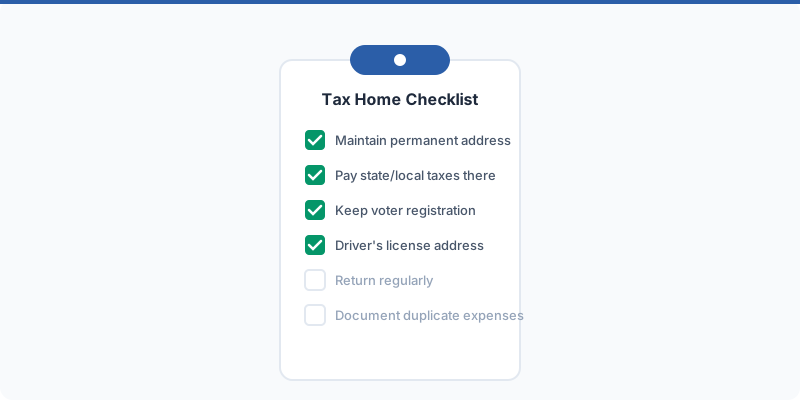
- Lease or mortgage documentation for your permanent residence at your tax home address
- Utility bills (electric, gas, water, internet) showing ongoing service at your tax home
- Records of return trips to your tax home (flight or fuel receipts, dates)
- Evidence of duplicate expenses — proof that you maintained housing at your tax home while also paying for housing at your assignment locations
- Voter registration, vehicle registration, or driver’s license at your tax home address
If any of these items are missing or weak, December gives you a last window to strengthen them. For example, if you have not returned to your tax home recently, a trip back before year end creates documentation. If your lease at your tax home lapsed, renewing before December 31 covers this year.
For the full breakdown of tax home requirements, see our tax home guide. For the details on how stipends work, review our stipend explainer.
Step 7: Organize Your Records for Filing
Do not wait until March to organize your tax documents. Setting up a clean filing system in December — while the year’s details are fresh — saves you hours of work and ensures nothing is missed.
Documents to Collect and Organize
Income documents:
- Year-to-date pay stubs from every agency you worked with (your W-2s will arrive in January, but stubs help you verify accuracy)
- 1099 forms for any side income (freelance, per diem work, interest income)
- Records of any other income sources
Expense documentation (especially important for 1099 nurses):
- Mileage logs for work-related travel (if you are a 1099 contractor)
- Receipts for licensing fees, certifications, and continuing education
- Receipts for work-related supplies, scrubs, and equipment
- Professional membership and union dues receipts
Tax home documentation: Everything from the checklist in Step 6.
Investment documents:
- Year-end brokerage statements showing gains, losses, and dividends
- Records of IRA and HSA contributions
- 401(k) contribution summaries from each agency
Insurance documentation:
- Form 1095-A (if you used the ACA marketplace)
- Form 1095-B or 1095-C (from agency health plans)
- HSA contribution and distribution statements (Form 5498-SA and Form 1099-SA)
Set Up a Filing System
Create a digital folder structure for the tax year: one folder for income documents, one for expenses, one for tax home documentation, one for investment records, and one for insurance forms. Scan paper receipts and save them digitally. Use a consistent naming convention (for example, “2026-Agency-Name-W2.pdf”) so you can find anything quickly.
If you use an expense tracking app, export your full year’s data now and save it to your tax folder. Do not rely on the app being available when you need it later.
Schedule Your CPA Appointment
If you work with a travel-nurse-savvy CPA, December is the time to schedule your filing appointment. Good CPAs fill up fast during tax season, and booking early ensures you get their attention when you need it. Many CPAs also offer a year-end planning call where they can review your situation and recommend last-minute actions before December 31.
If you do not have a CPA and plan to file yourself, invest in reputable tax software that handles multi-state filing and W-2 income from multiple employers.
Step 8: Plan for Next Year
While you are in planning mode, take 30 minutes to set up systems for the coming year.
Set W-4 withholding with your next agency. If you underpaid this year, adjust your W-4 for your next contract. You can request additional withholding per paycheck (Line 4(c) on the W-4) to avoid the same problem next year.
Automate retirement contributions. If you are starting a new contract in January, set up your 401(k) contribution on day one. Do not wait for the “right time” — automate it immediately. For IRAs, set up a monthly automatic transfer to your IRA account.
Create a tracking system for next year’s expenses. Whether you use an app, a spreadsheet, or a dedicated bank account, start tracking work-related expenses from January 1. The nurses who track expenses throughout the year claim more deductions and spend less time preparing their returns.
Review your financial plan. Use the year-end momentum to update your broader financial plan. Did you meet your savings goals this year? Do you need to adjust your budget for next year? Are you on track for retirement?
FAQ
What is the deadline for making retirement contributions that count for this tax year?
For 401(k) contributions, the deadline is December 31 — contributions must be made through payroll during the calendar year. For Traditional IRA, Roth IRA, and HSA contributions, you have until the tax filing deadline (April 15 of the following year) to make contributions that count for the current tax year. However, making these contributions in December lets you finalize your tax planning with certainty.
Do I need to make estimated tax payments if I am a W-2 travel nurse?
Most W-2 travel nurses do not need to make separate estimated payments because their agencies withhold federal and state taxes from each paycheck. However, if your withholding is significantly short of your actual liability — common when you work with multiple agencies, have gaps between contracts, or earn side income — you may need to make an estimated payment by January 15 to avoid underpayment penalties. Check your withholding against your estimated liability using the IRS Tax Withholding Estimator.
Should I itemize or take the standard deduction?
For most W-2 travel nurses, the standard deduction ($15,000 for single filers, $30,000 for married filing jointly in 2026) is larger than their total itemized deductions. Itemizing only makes sense if your combined deductions for state and local taxes (capped at $10,000), mortgage interest, charitable contributions, and other itemizable expenses exceed the standard deduction. Your CPA can run both scenarios and recommend the better option. If you are a 1099 contractor, your business deductions are separate from this decision and are claimed on Schedule C regardless of whether you itemize.
How do I handle taxes if I worked in multiple states this year?
Multi-state filing is one of the most complex aspects of travel nurse taxes. You will generally need to file a return in each state where you earned income, as well as your home state (if it has an income tax). Most states offer a credit for taxes paid to other states, which prevents true double taxation, but the mechanics vary. This is one of the strongest arguments for working with a CPA who specializes in travel nurse taxes rather than attempting multi-state filing on your own.
What records do I need to keep and for how long?
Keep all tax-related records — W-2s, 1099s, receipts, tax home documentation, and filed returns — for at least three years from the date you filed the return (or the due date, whichever is later). If you underreported income by more than 25%, the IRS has six years to audit. For records related to your tax home, keep them for the duration you claim non-taxable stipends plus three years after your last return claiming them. When in doubt, keep records longer rather than shorter. Digital storage makes this easy and inexpensive.
Key Takeaways
- December is your last window to take actions that reduce your current-year tax bill. Do not wait until filing season when it is too late to make changes.
- Maximize retirement contributions before year end. A $7,000 Traditional IRA contribution can save $1,540 to $1,680 in federal tax depending on your bracket. Max your 401(k) through payroll by December 31.
- Review estimated tax payments and make a Q4 payment by January 15 if your withholding is short. The safe harbor rule protects you from penalties if you have paid 100% (or 110%) of the prior year’s liability.
- Verify your tax home compliance and ensure you have documentation for every requirement. A year-end trip home, an active lease, and utility records strengthen your position.
- Organize your tax records now, while the year is fresh. Create a digital filing system, collect all documents, and schedule your CPA appointment before the rush.
- Plan ahead by setting up W-4 withholding, automating retirement contributions, and creating expense tracking systems for the coming year.
Your year-end tax checklist is the bridge between earning well and keeping what you earn. Spend a few hours in December on these steps, and you will start the new year with a clean financial slate and the confidence that your tax situation is under control.
Related Internal Links
- Travel Nurse Tax Deductions
- Travel Nurse Tax Home Guide
- Travel Nurse Stipend Explained
- Finding a Travel Nurse CPA
- Travel Nurse 401(k) and Retirement
- Travel Nurse HSA vs. FSA
- Travel Nurse Investing Guide
Affiliate Placement Notes
- Tax software affiliate links in the record organization section
- CPA referral links throughout (year-end planning call mention, multi-state filing)
- Retirement account platform links in the retirement contribution section (IRA, HSA)
- Expense tracker app affiliate links in the record organization section
