
Travel Nurse Weekly Pay Report: February 2026
Disclosure: Some links in this post are affiliate links. If you click through and make a purchase, we may earn a small commission at no extra cost to you. Learn more about how we make money.
Travel Nurse Weekly Pay Report: February 2026
This is our monthly snapshot of the travel nurse job market. We track average weekly gross pay by specialty, highlight the top-paying states, and flag notable market shifts that could affect your next contract decision. Bookmark this page and check back monthly for updated data.
Average Weekly Rates by Specialty (February 2026)
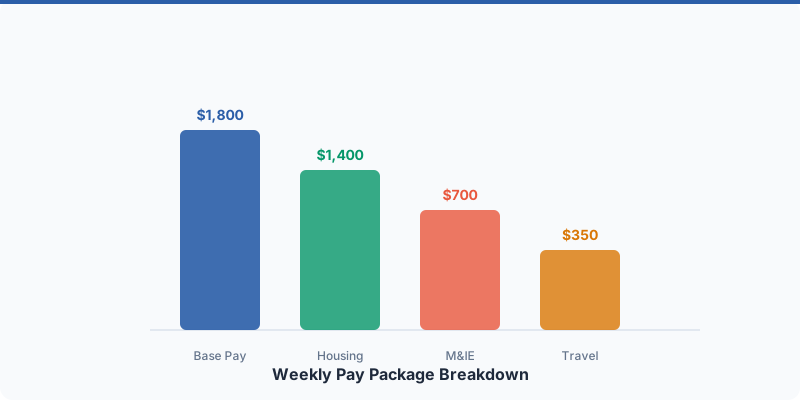
The following table shows estimated total weekly gross pay (taxable wages + non-taxable stipends) for a standard 36-hour-per-week travel nurse contract. Ranges reflect differences in location, facility type, and agency.
| Specialty | Low End | Mid Range | High End | Trend vs. Last Month |
|---|---|---|---|---|
| ICU | $2,300 | $2,700 | $3,400 | Stable |
| ER | $2,200 | $2,600 | $3,200 | Slight increase (+2%) |
| OR | $2,400 | $2,750 | $3,300 | Stable |
| Med-Surg | $1,800 | $2,100 | $2,600 | Stable |
| L&D | $2,200 | $2,600 | $3,100 | Slight increase (+1%) |
| Telemetry | $1,900 | $2,300 | $2,800 | Stable |
| NICU | $2,200 | $2,650 | $3,200 | Stable |
| Cath Lab | $2,400 | $2,800 | $3,400 | Slight increase (+2%) |
| Step-Down/PCU | $1,950 | $2,350 | $2,850 | Stable |
| Psych | $1,900 | $2,200 | $2,700 | Slight increase (+3%) |
| Travel RT | $1,750 | $2,050 | $2,500 | Stable |
Key observations:
- ER and Cath Lab rates ticked up slightly as winter census remains elevated in many regions.
- Psych nursing continues its upward trend, driven by persistent behavioral health staffing shortages nationwide.
- Med-Surg remains the most widely available specialty with the largest volume of open positions but the lowest average pay.
- ICU rates are stable compared to January, with most demand concentrated in the Midwest and Southeast.
Top-Paying States This Month
Based on average weekly gross pay across all specialties, these states are currently offering the highest travel nurse rates:
- California — $3,100/week average (highest raw pay, but also highest cost of living)
- New York — $2,900/week average (strong demand in NYC metro and upstate)
- Alaska — $2,750/week average (premium for remote locations)
- Massachusetts — $2,800/week average (teaching hospital demand)
- Washington — $2,700/week average (Seattle metro driving rates)
Best value states (high pay relative to cost of living):
- Texas — $2,350/week average with 93 COL index
- Illinois — $2,450/week average with 94 COL index (outside Chicago metro)
- Ohio — $2,250/week average with 90 COL index
- Pennsylvania — $2,400/week average with 96 COL index
- Missouri — $2,200/week average with 89 COL index
For full state-by-state data, see our interactive salary by state table.
Market Trends: February 2026
Flu Season Impact
February marks the typical peak of flu season, and hospitals in the Midwest and Southeast are running at or above capacity. This is driving a modest increase in ICU and ER rates in those regions. If you are between assignments and have ICU or ER experience, this is a strong window to lock in a higher rate.
Behavioral Health Demand
Psych nursing demand has been climbing steadily for the past 12 months. Several states have expanded crisis stabilization units and psychiatric emergency departments, creating new travel positions. Nurses with CPI (Crisis Prevention Institute) training and PMH-BC certification are seeing the strongest offers.
Compact License Expansion
With 41 states now participating in the Nurse Licensure Compact, travel nurses with compact licenses have more options than ever. Non-compact states (California, New York, Massachusetts, and others) continue to command premium rates partly because the licensing barrier reduces competition.
Contract Length Trends
Standard 13-week contracts remain the norm, but we are seeing more 8-week contracts and short-term rapid-response positions (4-6 weeks) at premium rates. If you are flexible on length, shorter contracts can yield 15-25% higher weekly pay.
Agency Housing Market
Agency-provided housing costs continue to rise in high-demand metros. More travelers are opting for the housing stipend and finding their own accommodations through platforms like Furnished Finder, Airbnb, and extended-stay hotels. For guidance on this decision, see our housing stipend vs. agency housing guide.
Notable Changes from Last Month
- ER rates up 2% nationally, driven by winter census and respiratory illness volumes.
- Psych rates up 3%, continuing a 12-month upward trend.
- California introduced new staffing ratio enforcement measures that are expected to increase demand for travel nurses in the state over the coming months.
- GSA per diem rates for 2026 are now in effect. Several metro areas saw increases of 3-5% in housing and M&IE allowances. Check the salary by state page for updated stipend figures.
- Allied health travel demand (RTs and surgical techs) remains steady with a slight uptick in respiratory therapy positions related to winter respiratory volumes.
How to Use This Data
This report is designed to help you make informed decisions about your next assignment. Here is how to put it to work:
- Compare your current offer against the ranges listed above. If your offer falls below the “Low End” for your specialty, negotiate or explore other agencies.
- Use our Pay Package Calculator to do a detailed side-by-side comparison of two specific contract offers.
- Check Salary by State and Salary by Specialty for more granular data.
- Factor in cost of living. A $2,100/week contract in a low-COL state may leave you with more money than a $2,800/week contract in San Francisco or Boston.
- Confirm your tax home status using our Tax Home Quiz before making financial projections based on stipend amounts.
Methodology
The data in this report is compiled from multiple sources:
- Job board aggregation: We monitor major travel nursing job boards (Vivian, Wanderly, Travel Nurse Source) for posted rates across all specialties and states.
- Agency-reported data: Select staffing agencies share anonymized rate data with us on a monthly basis.
- Recruiter interviews: We speak with active recruiters monthly to validate trends and identify shifts not yet visible in posted data.
- GSA rate tables: Non-taxable stipend estimates are based on published GSA per diem rates for lodging and M&IE.
All figures represent estimated total weekly gross compensation for a standard 36-hour/week contract. Actual pay varies based on agency, facility, shift differential, overtime, and individual negotiation. These numbers should be used as benchmarks, not guarantees.
Previous Reports
This report is published monthly. Previous editions:
- January 2026 (this page — first edition)
This is a recurring monthly report. Bookmark this page or subscribe to our newsletter to get the latest data delivered to your inbox.
Frequently Asked Questions
How often is this pay report updated?
We publish a fresh edition of the Travel Nurse Weekly Pay Report at the beginning of each month. The data reflects conditions from the prior month and is validated against multiple sources before publication.
Are these numbers guaranteed pay rates?
No. These figures represent averages and ranges based on market data. Your actual pay depends on your specific agency, facility, location, specialty, experience, and negotiation. Use these numbers as benchmarks to evaluate whether your offer is competitive.
Where can I compare specific contract offers?
Use our free Pay Package Calculator to enter the exact details of two offers and see which one puts more money in your pocket after housing, stipends, and estimated taxes.
What is the difference between weekly pay and take-home pay?
Weekly pay in this report refers to total gross compensation (taxable wages + non-taxable stipends). Your actual take-home pay will be lower after federal and state income taxes are withheld from the taxable portion. Stipends are not taxed if you maintain a valid tax home.
