
Travel Nurse Tax Home Guide: Everything You Need to Know (2026)
Disclosure: Some links in this post are affiliate links. If you click through and make a purchase, we may earn a small commission at no extra cost to you. Learn more about how we make money.
Introduction: Why Your Tax Home Is the Most Important Financial Decision You’ll Make
If there is one concept that separates travel nurses who build real wealth from those who unknowingly leave thousands on the table, it is the tax home. Your tax home status can mean a $15,000 to $20,000 difference in annual take-home pay. That is not an exaggeration. It is the single most consequential financial factor in your travel nursing career.
A tax home is the IRS’s way of determining whether you are a legitimate traveler who incurs duplicated living expenses or simply someone who moves from place to place with no fixed base. If you qualify as having a tax home, a large portion of your pay package — your housing stipend, meals and incidentals stipend, and travel reimbursement — can be received tax-free. If you do not qualify, every dollar you earn is taxable.
The problem is that the IRS guidelines on tax homes are notoriously vague. There is no single checkbox or form you fill out. Instead, the IRS looks at a combination of factors and makes a judgment call. That ambiguity is exactly why so many travel nurses are confused, why so much bad advice circulates in Facebook groups, and why this guide exists.
By the end of this article, you will understand exactly what a tax home is, how to establish one, how to maintain it, what documentation to keep, and what happens if you get it wrong.
Disclaimer: This guide is for educational purposes only and does not constitute tax advice. Consult a qualified CPA or tax professional for your specific situation. Tax law is nuanced, and your individual circumstances matter. Nothing in this article should be interpreted as legal or financial guidance tailored to your personal tax situation.
What Is a Tax Home? The IRS Definition
Your tax home, according to the IRS, is your “regular place of business or post of duty,” regardless of where you maintain your family home. For most permanent employees, this is straightforward: your tax home is wherever your employer is located. But for travel nurses, the definition gets more interesting.
Because you do not have a single permanent employer location, the IRS looks at where you “regularly live” and whether you maintain meaningful ties to that area. In practical terms, your tax home is the city or general area where your permanent residence is located, provided you meet certain criteria that prove you have not abandoned that area.
It is important to understand that your tax home is not necessarily the same thing as your legal residence or domicile. Your domicile is your permanent legal address — the state where you vote, where your driver’s license is issued, where you intend to return. Your tax home can be the same as your domicile, and often is, but they are technically separate concepts under the law.
Why does the IRS care about your tax home? Because tax-free stipends exist to reimburse you for the extra cost of maintaining two residences: your permanent home and your temporary assignment housing. If you only have one residence — wherever your current assignment happens to be — the IRS considers you an “itinerant worker,” and there are no duplicated expenses to reimburse. In that case, stipends are simply additional income and must be taxed accordingly.
For travel nurses specifically, the tax home concept means you need a place you can genuinely call your permanent base. It is the anchor that makes the entire travel nursing pay structure work in your favor.
The Three IRS Factors for a Tax Home
The IRS evaluates your tax home using three factors laid out in Publication 463. You do not need to satisfy all three, but you need to meet at least two of them to have a strong tax home claim. Here is what each factor means and how to satisfy it.
Factor 1: You Perform Part of Your Work in the Area of Your Tax Home
This factor asks whether you do some work — any work — in the area where you claim your tax home. For travel nurses, this typically means picking up PRN (as-needed) shifts, per-diem shifts, or part-time work at a facility near your tax home address.
You do not need to work there full-time. Even a handful of shifts per year demonstrates that you have an ongoing professional connection to the area. Most tax professionals recommend working at least a few shifts per quarter, or roughly 10 to 15 shifts per year, at a facility near your tax home. Some CPAs are comfortable with fewer shifts, but the more you work locally, the stronger your position.
What counts as working in the area:
- PRN shifts at a local hospital or clinic
- Per-diem work through a local staffing agency
- Part-time employment at a facility within commuting distance of your tax home
- Agency assignments that happen to be located near your tax home (though these should not be your only assignments)
What does not count:
- Remote charting or telehealth from your assignment location (the work needs to physically take place near your tax home)
- Simply having an active nursing license in your tax home state without actually working there
Documentation needed: Keep copies of your pay stubs, schedules, and W-2s from any local employer. A simple spreadsheet tracking dates and locations of local shifts is also helpful.
This factor is not strictly required if you strongly satisfy the other two, but it significantly strengthens your position. If you can reasonably pick up PRN shifts between assignments, do it.
Factor 2: You Have Duplicated Living Expenses
This is the factor the IRS cares about most. The entire logic behind tax-free stipends is that you are paying to maintain a home in one place while also paying for housing at your assignment location. If you have duplicated expenses, the stipends are reimbursing a real cost. If you do not, the stipends are just extra income.
To satisfy this factor, you need to demonstrate that you are paying for a residence at your tax home even while you are away on assignment. This means ongoing, regular expenses such as:
- Mortgage payments on a home you own
- Rent payments on an apartment or house you lease
- Utility bills (electricity, water, gas, internet) in your name
- Property taxes and homeowner’s insurance
- Maintenance costs (lawn care, repairs, HOA fees)
The key word is “substantial.” A $50-per-month storage unit does not establish duplicated living expenses. A $900-per-month apartment lease does. The IRS wants to see that you are paying fair-market-rate costs to maintain a genuine residence, not a token amount to check a box.
Documentation needed: Monthly mortgage or rent receipts, utility bills with your tax home address, property tax records, insurance statements, and bank or credit card statements showing recurring payments. Keep at least 12 months of records at all times.
This is the single most important factor. If you own or rent a home and continue paying for it while traveling, you have a strong foundation for your tax home regardless of the other two factors.
Factor 3: You Have Not Abandoned Your Tax Home
The third factor looks at whether you still treat your tax home as your actual home. The IRS wants to see that you return to the area regularly and maintain meaningful personal and community ties there.
Returning between assignments is the most straightforward way to satisfy this factor. You do not need to spend weeks at home between every contract, but you should go back periodically. Most tax professionals recommend returning to your tax home at least every 12 months and ideally between assignments when practical. Even a long weekend counts.
Maintaining community ties also strengthens your case:
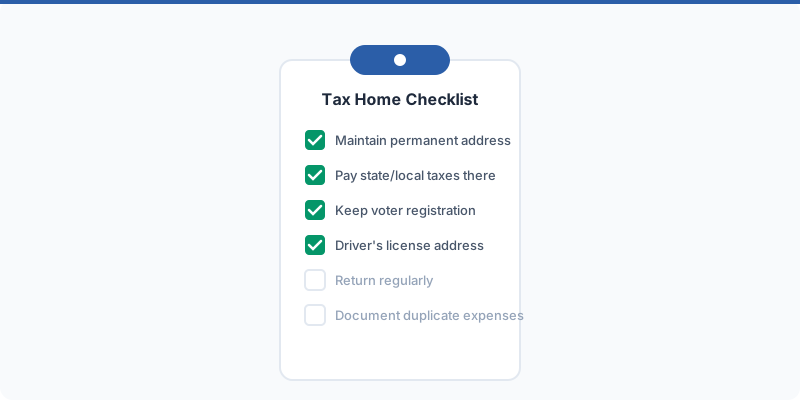
- Your driver’s license is issued in your tax home state
- You are registered to vote at your tax home address
- Your vehicle is registered at your tax home address
- Your bank accounts and financial institutions list your tax home address
- You receive mail at your tax home address (not just a PO Box)
- You have memberships, religious affiliations, or social connections in the area
- Your primary care physician, dentist, and other providers are in the area
The “transient worker” risk: If you never return to your tax home, change your driver’s license to your assignment state, register to vote at your temporary address, and have no ongoing reason to go back, the IRS may determine you have abandoned your tax home. At that point, you are an itinerant worker with no tax home, and every dollar of your stipends becomes taxable income.
How long is too long away? There is no hard rule, but staying away from your tax home for more than 12 consecutive months on assignments in the same general area is a major red flag. The IRS may argue that your new location has become your tax home. General best practice: return home between assignments, even briefly, and avoid taking back-to-back contracts in the same city for more than 12 months.
Documentation needed: Travel receipts showing trips back to your tax home (flights, gas receipts, tolls), copies of your driver’s license and voter registration, vehicle registration, and a calendar or log showing the days you spent at your tax home versus on assignment.
How the IRS Weighs These Factors
The IRS states that you should satisfy at least two of the three factors to claim a tax home. However, not all combinations are equally strong.
Strongest combination: Factors 2 and 3. You pay for a residence at your tax home (duplicated expenses) and you return regularly and maintain ties (not abandoned). This is the most common and most defensible position for travel nurses. Even if you do not pick up local shifts (Factor 1), owning or renting a home and returning to it regularly is a very strong claim.
Strong combination: Factors 1 and 2. You work locally and pay for a residence. Even if you do not return as frequently as you should, having both financial and professional ties to the area is solid.
Weakest combination: Factors 1 and 3. You work locally and return regularly, but you do not pay for a residence. This is the riskiest of the three valid combinations because the IRS may argue that without duplicated expenses, there is nothing to reimburse tax-free.
Failing all three factors means you definitively do not have a tax home. If you only satisfy one factor, your claim is weak and vulnerable to audit. The bottom line: satisfy at least two factors, and aim for all three if possible.
Common Tax Home Setups
Every travel nurse’s situation is different. Here are the most common tax home arrangements, ranked from strongest to most vulnerable.
Homeowner Who Travels
Example: Sarah owns a home in Austin, Texas. She pays a $1,400 monthly mortgage, $200 in utilities, and $150 for lawn care and maintenance while she takes 13-week assignments in California and Oregon. She returns home for one to two weeks between most contracts, keeps her Texas driver’s license, and picks up two or three PRN shifts at a local hospital between assignments.
Sarah has one of the strongest tax home positions possible. She satisfies all three IRS factors: she works locally (Factor 1), she pays substantial duplicated expenses (Factor 2), and she returns regularly and has not abandoned her home (Factor 3).
What if you rent out your home while traveling? This is a gray area. If you rent out your entire home on a long-term lease, the IRS may argue you no longer maintain it as your residence. A better approach: rent it out on a short-term or partial basis, keep one room for yourself, or ensure the lease allows you to return between assignments. Discuss this specific situation with a CPA, as the details matter significantly.
Documentation checklist: Mortgage statements, property tax records, homeowner’s insurance, utility bills, receipts for return travel, local work pay stubs.
Renter Who Travels
Example: Marcus rents a one-bedroom apartment in Nashville, Tennessee for $1,100 per month. He keeps the lease active, has a friend check on the apartment while he is away, and returns between most assignments. He is registered to vote in Tennessee and keeps his Tennessee driver’s license.
Renting is a perfectly valid tax home as long as you maintain the lease and continue paying rent while traveling. The lease should be in your name, the rent should be at or near fair market value, and you should be able to prove you are paying it through bank records — not cash.
Subletting considerations: If you sublet your apartment while on assignment, you are still maintaining the lease and paying rent, which helps. But if the subletter covers 100% of your rent, you may weaken your duplicated-expense argument because you are not personally bearing the cost. Partial subletting is generally fine.
Documentation checklist: Signed lease agreement, monthly rent payment records (bank transfers or checks), utility bills in your name, return travel receipts.
Living With Family (Paying Rent)
Example: Priya lives with her parents in Phoenix, Arizona when she is not on assignment. She pays her parents $800 per month in rent, which is roughly the fair-market rate for a room in their area. She has a written rental agreement, pays via bank transfer (never cash), and keeps her Arizona driver’s license and voter registration at their address.
This setup is valid, but it requires careful structuring. The IRS wants to see that the arrangement is genuine and not just a paper trail. To make this work:
- Written lease agreement at fair market rent (look up comparable room rentals on Craigslist or Zillow to justify the amount)
- Payments via traceable methods: bank transfers, Venmo, Zelle, or personal checks — never cash
- Your family member should report the rental income on their tax return (this is a strong indicator that the arrangement is real)
- You should have your own room or space in the home, not just a mailing address
Living With Family (Not Paying Rent)
This is the weakest tax home position, and many CPAs will advise against it. If you live with family but pay no rent, you cannot demonstrate duplicated living expenses (Factor 2). Without that factor, you need to strongly satisfy both Factor 1 (local work) and Factor 3 (not abandoned), and even then your position is fragile.
How to strengthen this setup: Start paying fair-market rent and formalize the arrangement. Even if you have been living rent-free for years, it is not too late to create a legitimate rental agreement going forward. But do not backdate anything or fabricate records.
When this does NOT qualify: If you have no rent, no local work, and only a mailing address at your family member’s home, you almost certainly do not have a valid tax home. Receiving mail at an address is not the same as maintaining a residence there.
Married Couples and Domestic Partners
Example: David and Jessica are both nurses. Jessica works as a staff nurse at a hospital in Raleigh, North Carolina, and David travels. Their home in Raleigh serves as David’s tax home because Jessica maintains it full-time, they pay the mortgage together, and David returns regularly.
When one spouse maintains the home while the other travels, the tax home situation is generally straightforward and strong. The home is clearly not abandoned because one partner lives there full-time.
Both partners traveling simultaneously is trickier. If neither spouse lives at the tax home for extended periods, you need to be especially diligent about returning between assignments and maintaining ties. The same three-factor test applies. Consider staggering assignments so that one of you is home periodically.
Filing jointly vs. separately: This is a complex decision that depends on your combined income, deductions, and state tax situations. There is no universal answer. A travel-nurse-savvy CPA can model both scenarios and tell you which saves more.
What Happens If You Do NOT Have a Tax Home
If you cannot establish a valid tax home, the IRS classifies you as an “itinerant worker.” This means you have no fixed base of operations, and every dollar you earn is subject to federal and state income tax. You are not entitled to receive tax-free stipends because you have no duplicated expenses to reimburse.
Here is why this matters in real dollars.
A Concrete Example: The Cost of Losing Your Tax Home
Let’s say you are offered a pay package worth $2,000 per week in total compensation. Here is how that package might break down and how it changes depending on your tax home status.
With a valid tax home:
| Component | Weekly Amount |
|---|---|
| Taxable hourly pay (36 hrs x $22/hr) | $792 |
| Housing stipend (tax-free) | $868 |
| M&IE stipend (tax-free) | $340 |
| Total weekly gross | $2,000 |
Your taxable income is only $792 per week. Assuming a combined federal and state marginal tax rate of roughly 25%, you pay about $198 in taxes per week. Your net take-home is approximately $1,802 per week.
Without a valid tax home (itinerant worker):
Your agency must now pay the full $2,000 as taxable wages. The stipends no longer qualify as tax-free. At the same 25% marginal tax rate, you pay about $500 in taxes per week. Your net take-home drops to approximately $1,500 per week.
That is a difference of $302 per week, which adds up to roughly $15,700 per year over a full 52-week working schedule. Over a five-year travel nursing career, you are looking at nearly $80,000 in lost income simply because you did not establish or maintain a tax home.
Use our pay calculator to model your own numbers and see exactly how a tax home affects your specific pay package.
And there is another risk: if the IRS audits you and determines that you did not have a valid tax home during years when you received tax-free stipends, you may owe back taxes plus interest and penalties on all of those stipends. That bill can be devastating.
Setting Up Your Tax Home: Step-by-Step
If you are new to travel nursing or have been traveling without a proper tax home, here is how to set one up correctly.
Step 1: Choose Your Tax Home Location
Pick a location where you have genuine ties. This is usually the place where you grew up, where your family lives, where you went to nursing school, or where you previously worked as a staff nurse. There is no requirement that your tax home be in a specific state, but choosing a state with no income tax (Texas, Florida, Tennessee, Nevada, Washington, Wyoming, South Dakota, Alaska, or New Hampshire) can save you additional money.
The location should be one you realistically plan to return to between assignments and eventually settle in. The IRS can see through arrangements where someone claims a tax home in a state they have no real connection to.
Step 2: Establish or Maintain a Residence
You need a physical residence — not a PO Box, not a storage unit. This can be a home you own, an apartment you rent, or a room you rent from a family member at fair market value. The residence must be available for you to live in when you return. If you rent out your home entirely or let your lease lapse, you may lose your tax home claim.
Step 3: Maintain Financial Ties
Make sure your financial life is anchored to your tax home:
- Bank accounts list your tax home address
- Credit cards and financial statements go to your tax home address
- Vehicle registration and insurance reflect your tax home address
- Any business registrations or professional accounts use your tax home address
Step 4: Maintain Physical Presence
Return to your tax home between assignments. You do not need to spend months there, but regular visits show the IRS that you have not abandoned the area. Between 13-week contracts, try to spend at least a few days at your tax home. Keep receipts from your return travel as documentation.
Step 5: Set Up a Documentation System
Documentation is your armor. Start a system now, before you need it. Create a digital folder (on Google Drive, Dropbox, or a dedicated app) where you store:
- Monthly rent or mortgage receipts
- Utility bills
- Travel receipts for trips home
- Local work pay stubs and schedules
- Copies of your driver’s license, voter registration, and vehicle registration
- A calendar marking days at your tax home vs. on assignment
The best time to organize this was when you started traveling. The second best time is today.
Step 6: Consult With a Travel-Nurse-Savvy CPA
A general-practice CPA may not understand the nuances of travel nurse tax homes. Find one who specializes in travel healthcare professionals and has experience with the IRS’s treatment of itinerant workers, stipends, and multi-state filing. The cost of a good CPA (typically $300 to $600 for a travel nurse return) is trivial compared to the cost of getting your tax home wrong.
Our guide to finding the right travel nurse CPA can help you ask the right questions.
Documentation You Must Keep
If the IRS ever questions your tax home, your documentation is your defense. Without it, your word alone will not be enough. Keep the following records organized and accessible for at least three to seven years:
- Monthly rent receipts or mortgage statements showing consistent payments at your tax home address
- Utility bills in your name at the tax home address (electricity, water, gas, internet)
- Return travel receipts — flight confirmations, gas receipts, highway tolls — proving you traveled back to your tax home
- Voter registration showing your tax home address
- Driver’s license from your tax home state
- Bank and financial account statements listing your tax home address
- Vehicle registration in your tax home state
- Per-diem or PRN work records at local facilities near your tax home, including pay stubs and schedules
- A calendar or log showing the number of days you spent at your tax home versus on assignment each year
Consider using a cloud-based document storage app or scanner app to digitize everything. Paper receipts fade, get lost in moves, and are hard to organize. A five-minute weekly habit of photographing receipts and filing them digitally can save you thousands of dollars and hours of stress if you are ever audited.
Tax preparation software designed for travel nurses or self-employed professionals can also help you stay organized throughout the year rather than scrambling at filing time.
Common Tax Home Mistakes
These are the errors that get travel nurses in trouble. Avoid every one of them.
Claiming a tax home at a parent’s address with no rent paid. Simply listing a family member’s address on your paperwork does not create a tax home. You need to pay fair-market rent, have a written agreement, and pay through traceable methods.
Never returning to your tax home between assignments. If you have not set foot in your tax home city in 18 months, the IRS will have a hard time believing it is still your home. Make the trip, even if it is a short one.
Keeping a PO Box but no actual residence. A mailing address is not a residence. The IRS can see the difference between a PO Box and a genuine home. This strategy does not work and can trigger an audit.
Letting a lease lapse while on a long assignment. If your lease expires in March but your assignment runs through June, and you do not renew or find another residence, you may not have had a tax home during that gap. Keep your lease current or arrange a new one before the old one ends.
Changing your driver’s license to the assignment state. Some states require you to get a new license after living there for a certain period. If you change your license, you are signaling that your new state is your home. Talk to a CPA before changing your license to an assignment state.
Taking all assignments in the same metro area. If every single contract you take is within commuting distance of the same city, the IRS may argue that city is your tax home, not the address you claim elsewhere. Travel nurses, by definition, travel. Diversify your assignment locations.
Not keeping documentation until audit time. By the time the IRS sends you a letter, it is too late to gather receipts from three years ago. Build the documentation habit now.
Tax Home and State Taxes
Your tax home affects your state tax situation as well as your federal one. Here is what you need to understand.
Your tax home state is generally where you will file your primary state tax return. If your tax home is in Texas (which has no state income tax), this is a significant advantage — your stipends are tax-free at both the federal and state levels, and your taxable wages are not subject to state income tax from your home state.
Your assignment state may also tax your income. Most states require you to pay state income tax on wages earned within their borders, regardless of where your tax home is. This means that if your tax home is in Florida but you take an assignment in California, you will likely owe California state income tax on the wages you earn there. You will not, however, owe Florida state tax (because Florida has none).
Multi-state filing is a reality for most travel nurses. If you work in three states during the year, you may need to file three state returns plus your federal return. This is one of the biggest reasons travel nurses benefit from a CPA who understands their situation.
States with no income tax — Texas, Florida, Tennessee, Nevada, Washington, Wyoming, South Dakota, Alaska, and New Hampshire (which only taxes interest and dividends) — are popular tax home states for travel nurses for obvious reasons. Establishing a genuine tax home in one of these states can save you thousands per year in state taxes alone.
When your domicile and tax home are in different states, the tax implications get complicated. Some states are aggressive about claiming you as a resident and taxing your worldwide income. Work with a CPA to ensure you are not accidentally creating dual residency claims.
What to Do If You Are Audited
First, do not panic. IRS audits for travel nurses typically focus on the validity of your tax home and the tax-free treatment of your stipends. They are not criminal investigations. Here is how to handle it.
What the IRS will request: They will ask for documentation proving your tax home — lease agreements, mortgage statements, utility bills, return travel receipts, voter registration, driver’s license, and records of any local work. They may ask for a calendar of days spent at your tax home versus on assignment. This is exactly the documentation we discussed above, which is why keeping it organized is so important.
Steps to take immediately:
- Do not ignore the notice. Respond within the deadline stated in the letter.
- Contact a CPA or tax professional experienced with travel nurse audits. This is not the time for DIY.
- Gather all documentation from the tax year(s) in question.
- Do not volunteer additional information beyond what is requested.
- Let your CPA communicate with the IRS on your behalf.
When you need a tax attorney vs. CPA: If the audit involves potential fraud allegations, criminal charges, or amounts over $50,000 in disputed taxes, consult a tax attorney. For standard audits questioning your tax home validity, a qualified CPA can represent you.
How to reduce your audit risk proactively: Maintain clean documentation, file your returns accurately and on time, do not accept stipend amounts that far exceed GSA rates for your area, and ensure your reported income is consistent across all forms. Travel nurses are more likely to be audited than the general population because the IRS knows that tax home abuse is common in the industry. The best defense is a well-documented, genuinely maintained tax home.
FAQ: Travel Nurse Tax Home
“Can I use my parents’ address as my tax home?”
Yes, but only if you are actually living there when you are not on assignment and you are paying fair-market rent through traceable methods (bank transfer, check, Venmo — not cash). You need a written rental agreement, and ideally your parents should report the rental income on their tax return. Simply using their address as a mailing address without paying rent and maintaining a real living space there does not establish a tax home. Not sure if your setup qualifies? Our tax home quiz can help you evaluate your situation quickly.
“How often do I need to return to my tax home?”
There is no specific number of days mandated by the IRS, but most travel nurse CPAs recommend returning at least once every 12 months and ideally between assignments. The more frequently you return, the stronger your case. Even a four- or five-day visit between 13-week contracts demonstrates that you have not abandoned the area. Keep all travel receipts as proof of these visits.
“Can I change my tax home?”
Yes. Your tax home can change if you establish a genuine new residence in a different location. This means signing a lease or purchasing a home, setting up utilities, transferring your driver’s license and voter registration, and meeting the three IRS factors in the new location. You do not need to keep your old tax home forever. Just ensure there is no gap period where you have no valid tax home, because any stipends received during that gap could be taxable.
“What if I sell my home and buy an RV?”
This is one of the most common questions in travel nursing, and the answer is not great for RV travelers. An RV that moves with you from assignment to assignment is generally considered your primary (and only) residence, which means you do not have a separate tax home to duplicate expenses against. Without a fixed, stationary residence that you maintain while you are on assignment, it is very difficult to claim a tax home. Some RV travelers maintain a rented apartment, room, or lot in addition to their RV to establish a tax home, but this needs to be a genuine arrangement, not a token one. Talk to a CPA before making this transition.
“Does my tax home have to be where my nursing license is?”
No. Your tax home is a tax concept determined by where you maintain a residence and ties. Your nursing license state is a professional licensing matter. You can hold a compact license or licenses in multiple states while your tax home is in a completely different state. That said, having a nursing license in your tax home state can strengthen your Factor 1 claim if you use it to pick up local shifts.
“My agency says I do not need a tax home — are they right?”
No, and this is a major red flag. Some agencies, unfortunately, offer tax-free stipends to all their nurses without verifying tax home status because it makes their pay packages look more attractive. The agency is not the one who will owe back taxes and penalties if you are audited — you are. Your tax home status is your responsibility, not your agency’s. If an agency tells you not to worry about it, that is a sign you should worry about it and consult an independent CPA. To understand more about how stipends work and when they are taxable, read our guide on whether travel nurse stipends are taxable.
“How far does my assignment need to be from my tax home?”
The IRS does not specify an exact mileage requirement, but the general guideline is that your assignment should be far enough from your tax home that it is impractical to commute daily. Most tax professionals use 50 miles as a minimum threshold, and many prefer to see at least 100 miles between your tax home and your assignment. If you are taking assignments 20 minutes from your tax home address, the IRS may question why you need a housing stipend at all. For a deeper look at how distance affects your pay structure, check out how stipends and per diem work.
Key Takeaways
- A valid tax home is required to receive tax-free stipends. Without one, every dollar of your pay is taxable, potentially costing you $15,000 or more per year.
- Satisfy at least two of the three IRS factors. Duplicated living expenses (Factor 2) is the most important. Combine it with not abandoning your home (Factor 3) for the strongest position.
- Documentation is your armor in an audit. Keep mortgage or rent records, utility bills, return travel receipts, and a calendar of days at home. Digitize everything and store it in the cloud.
- Do not rely on your agency to verify your tax home status. This is your responsibility, and the consequences of getting it wrong fall on you.
- When in doubt, hire a CPA experienced with travel nurses. The cost of professional guidance is a fraction of the cost of an audit gone wrong.
- Start today. If your tax home situation is shaky, take one step right now: sign a lease, set up a formal rental agreement with family, or book a consultation with a travel nurse CPA. Use our tax home quiz to quickly evaluate where you stand, then review your pay package with our pay calculator to see the financial impact.
For more on managing your travel nurse finances, explore our guides on travel nurse tax deductions and understanding your stipend breakdown.
Related Internal Links
- Travel Nurse Stipend Explained
- Are Travel Nurse Stipends Taxable?
- Travel Nurse Tax Deductions
- Travel Nurse CPA
- Travel Nurse W2 vs 1099
- How to Compare Travel Nurse Pay Packages
- Tax Home Quiz
- Pay Calculator
Affiliate Placement Notes
- CPA referral affiliate link in “Setting Up Your Tax Home” Step 6 and “What to Do If Audited” section
- Tax software affiliate link in “Documentation You Must Keep” section
- Document storage / scanning app affiliate link in “Documentation You Must Keep” and “Setting Up Your Tax Home” Step 5
- Pay calculator CTA in “What Happens If You Do Not Have a Tax Home” (shows impact on pay)
