
Travel Nurse Side Hustles: Earn Extra Income Between Assignments

Disclosure: Some links in this post are affiliate links. If you click through and make a purchase, we may earn a small commission at no extra cost to you. Learn more about how we make money.
Introduction: Your Nursing License Is One of the Most Versatile Income Tools in America
Travel nurses already earn more than most nurses. But the real financial power of your RN license goes far beyond what shows up in your contract. Between assignments, during slow seasons, or even alongside your regular contracts, your clinical skills, your license, and your healthcare knowledge open doors to income streams that most people cannot access.
Some travel nurses pick up per diem shifts at local hospitals to strengthen their tax home and earn extra cash. Others build telehealth practices they can run from anywhere. Some start IV hydration businesses that operate on weekends. A growing number create content — blogs, social media accounts, YouTube channels — that generate passive income for years.
The point is not to work yourself to exhaustion. The point is to use the unique gaps, flexibility, and earning potential of travel nursing to build additional income streams that accelerate your financial goals, whether that is paying off student loans, building your emergency fund, investing toward early retirement, or simply having more financial breathing room.
This guide covers the best side hustles for travel nurses, what each one pays, how to get started, and — critically — the tax implications you need to understand before you start.
This is educational content, not financial or business advice. Consult a CPA for tax questions and an attorney for business formation questions specific to your situation.
Per Diem and PRN Shifts: The Easiest Side Income
Picking up per diem (PRN) shifts at hospitals and clinics near your tax home is the most straightforward side hustle for travel nurses. It requires no additional training, no business setup, and no marketing — just your existing nursing license and skills.
How It Works
Register with one or more per diem staffing agencies or apply directly to hospitals near your tax home for PRN positions. When you are between assignments or home for a break, pick up shifts as your schedule allows.
What It Pays
Per diem rates vary by specialty and location, but typically range from $35 to $65 per hour for RNs, with critical care and specialty areas commanding the higher end. Some facilities pay premium rates for hard-to-fill shifts (nights, weekends, holidays), and per diem rates often include a differential because there are no benefits included.
A travel nurse picking up two per diem shifts per week between assignments at $50/hour for 12-hour shifts earns $1,200 per week — $4,800 per month of “gap” income.
Why Travel Nurses Should Do This
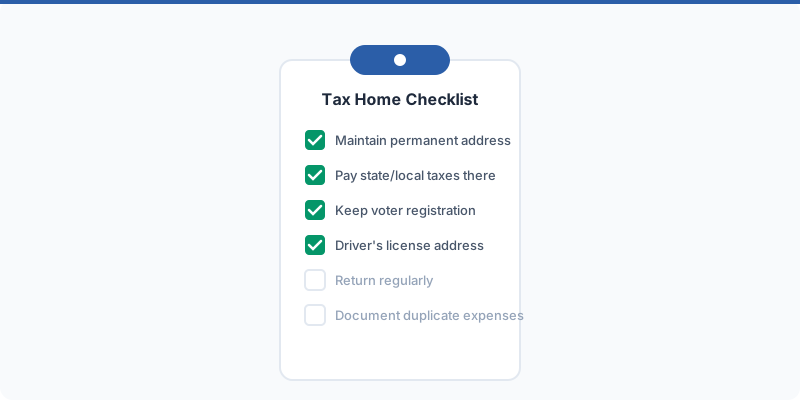
Beyond the income, per diem shifts near your tax home satisfy the IRS’s first tax home factor: performing work in the area of your tax home. This strengthens your tax home claim and protects your eligibility for tax-free stipends on your travel assignments. You are literally getting paid to protect your tax-free income.
Tax Implications
Per diem income through a staffing agency is typically W-2 income with taxes withheld. If you work directly for a facility as a W-2 employee, the same applies. The income is added to your total taxable wages for the year.
Getting Started
- Sign up with per diem staffing agencies that operate near your tax home (IntelyCare, ShiftKey, CareRev, Clipboard Health)
- Apply directly to local hospitals for PRN positions in your specialty
- Maintain active certifications and keep your skills current
- Set boundaries — do not burn out by working every single day between assignments
Telehealth Nursing: Work From Anywhere
Telehealth has exploded in recent years, and RNs are in high demand for remote clinical roles. For travel nurses, telehealth offers the ability to earn income from literally any location with an internet connection.
Types of Telehealth Nursing Work
Triage nursing. You assess patient symptoms over the phone or video and direct them to the appropriate level of care. This is one of the most common telehealth nursing roles.
Care coordination. You follow up with patients after hospital discharge, manage chronic disease programs, or coordinate between providers.
Insurance utilization review. You review medical records and make coverage determinations for insurance companies. This is well-paid and typically done remotely.
Nurse health coaching. You provide ongoing health coaching to patients managing chronic conditions.
What It Pays
Telehealth nursing roles range from $28 to $50 per hour depending on the role, employer, and your experience. Utilization review and care management roles tend to pay at the higher end. Some telehealth companies offer per-call or per-case compensation.
Employment Classification Matters
Some telehealth companies hire you as a W-2 employee, while others classify you as a 1099 independent contractor. This distinction significantly affects your taxes.
W-2 telehealth: Taxes are withheld, and the income is straightforward. No additional tax filing complexity.
1099 telehealth: You are self-employed. You must pay self-employment tax (15.3%) on top of income tax, make quarterly estimated tax payments, and file Schedule C. On the positive side, you can deduct business expenses (home office, internet, computer, headset) against this income. If your 1099 telehealth income is substantial (over $50,000/year), consider whether an LLC with S-Corp election makes sense.
Getting Started
- Research telehealth companies hiring RNs (Teladoc, Included Health, Ro, various insurance companies)
- Ensure your nursing license covers the states where patients are located (compact license helps enormously — see our compact state guide)
- Set up a quiet, professional workspace with reliable internet
- Some roles require specific experience (triage, ER, ICU) — highlight relevant experience in your application
IV Hydration and Wellness Services: Build a Clinical Business
The IV hydration and wellness industry has grown significantly, with mobile IV services popping up in every major city. If you are an experienced RN comfortable with IV insertion, this can be a lucrative side business.
How It Works
You provide IV hydration therapy (saline, vitamins, supplements) to clients at their homes, offices, hotels, or events. Services include hangover recovery, immune support, athletic recovery, beauty drips, and general wellness hydration.
What It Pays
IV hydration services typically charge $150 to $350 per treatment. The cost of supplies per treatment runs $20 to $60, depending on the additives. A nurse performing five treatments per weekend can gross $750 to $1,750, with net profit of $650 to $1,450 after supplies.
The Legal and Regulatory Landscape
This is where it gets complicated. IV hydration businesses are regulated differently in every state:
- Medical director requirement. Most states require a physician medical director to oversee IV hydration services administered by RNs. The medical director reviews protocols, signs standing orders, and provides clinical oversight. This typically costs $500 to $2,000 per month.
- Business licensing. You need a business license and potentially specific health services permits.
- Liability insurance. You need business liability insurance beyond your personal malpractice policy.
- Scope of practice. Some states restrict what RNs can administer without a physician present. Research your specific state’s regulations.
Tax Implications
IV hydration income is self-employment income reported on Schedule C. You pay self-employment tax (15.3%) plus income tax. However, you can deduct:
- Supplies (IV bags, tubing, vitamins, needles)
- Medical director fees
- Business insurance
- Marketing costs
- Vehicle mileage for mobile services
- Business-related phone and internet
At significant income levels, forming an LLC provides liability protection and potential tax savings through S-Corp election.
Getting Started
- Research your state’s regulations for IV hydration services
- Find a medical director willing to oversee your practice
- Get business liability insurance
- Develop protocols and standing orders with your medical director
- Build a website and social media presence
- Start with a mobile model to keep overhead low
Health Coaching and Wellness Consulting
Your clinical expertise positions you perfectly for health coaching — helping individuals achieve health goals through behavior change, nutrition guidance, exercise planning, and accountability.
What It Pays
Health coaches charge $100 to $300 per month per client for ongoing coaching, or $75 to $200 per individual session. Group coaching programs can generate $500 to $2,000 per cohort. Online courses or digital products (meal plans, fitness programs, health guides) create passive income that earns while you work your assignments.
Why Travel Nurses Excel at This
You have clinical credibility that non-medical coaches do not. Clients trust an RN’s health advice more than a certification-only coach. Your travel nursing lifestyle also gives you a compelling personal brand — a healthcare professional who practices what they preach about balance, wellness, and adventure.
Getting Started
- Consider a health coaching certification (ICF, NBHWC, or integrative health coaching programs) to supplement your nursing credentials
- Define your niche (weight management, stress reduction, chronic disease management, nurse wellness, shift worker health)
- Build a simple website and social media presence
- Start with a few pro bono or discounted clients to build testimonials
- Use video calls for coaching sessions so you can serve clients from any assignment location
Tax Implications
Health coaching is typically self-employment income (1099/Schedule C). Deductible expenses include certification costs, website hosting, marketing, software subscriptions, and home office space. Track everything.
Content Creation: Blog, YouTube, Social Media
A growing number of travel nurses earn significant income by sharing their experiences, knowledge, and advice through content platforms. This is a long-term play that builds slowly but can become substantial.
Types of Content That Earn
Blog/website. Write about travel nursing topics (gear reviews, city guides, financial tips, day-in-the-life content). Monetize through affiliate links, display ads, and sponsored content. A well-established nursing blog can earn $1,000 to $10,000+ per month.
YouTube. Create videos about your travel nursing experience, apartment tours, packing guides, pay breakdowns, or clinical education. Monetize through AdSense, sponsorships, and affiliate links. Channels with 10,000+ subscribers can earn $500 to $5,000+ per month.
Instagram/TikTok. Build a following around your travel nursing lifestyle. Monetize through brand partnerships, sponsored posts, and affiliate links. Accounts with 10,000+ engaged followers can earn $200 to $2,000+ per post from brands.
Podcast. Interview other travel nurses, discuss industry topics, and share advice. Monetize through sponsorships and affiliate partnerships.
The Reality Check
Content creation is not fast money. Most creators spend six to twelve months building an audience before earning meaningful income. It requires consistency — posting regularly even when you are exhausted from a 12-hour shift. But the upside is significant: content can generate passive income that continues earning while you sleep, work, or sit on a beach.
Tax Implications
Content creation income is self-employment income. Track all related expenses: camera equipment, editing software, website hosting, internet costs, travel specifically for content creation, and home office space. Report on Schedule C and pay self-employment tax.
Getting Started
- Choose one platform and commit to it for at least six months before expanding
- Focus on a specific niche (travel nurse finances, travel nurse housing, specialty-specific content)
- Be authentic — audiences connect with real experiences, not polished perfection
- Learn basic SEO, video editing, or social media strategy (free resources are abundant)
- Set realistic expectations about the timeline to profitability
Tutoring Nursing Students
If you enjoy teaching, tutoring nursing students is a side hustle that leverages your clinical expertise and earns good hourly rates.
What It Pays
Nursing tutors charge $40 to $100 per hour for one-on-one tutoring. NCLEX prep tutoring commands the higher end of that range. Group sessions or small study groups can multiply your hourly earnings.
Opportunities
- Private tutoring (advertise on Wyzant, Tutor.com, or locally near nursing schools)
- NCLEX prep coaching (high demand, premium rates)
- Clinical skills tutoring (IV insertion, assessment, medication administration)
- Online course creation (create a self-paced NCLEX prep course and sell it indefinitely — this is where the real scalability lies)
- Adjunct clinical instructor at nursing schools (typically $25 to $50/hour, but some programs pay more and it strengthens your resume)
Getting Started
- Create a profile on tutoring platforms
- Reach out to local nursing schools about clinical instructor positions
- Develop structured study materials for the topics you tutor
- Consider creating an online course for passive income
Other Side Hustle Ideas for Travel Nurses
Legal nurse consulting. Review medical records for law firms handling malpractice, personal injury, or workers’ compensation cases. Requires additional training but pays $75 to $200 per hour. Can be done remotely.
Medical writing. Write clinical articles, patient education materials, continuing education content, or pharmaceutical marketing materials. Pays $50 to $150+ per hour for experienced medical writers.
CPR/BLS instruction. Become a certified instructor and teach BLS, ACLS, or PALS courses. Especially useful near your tax home, where you can offer classes between assignments. Charge $50 to $100 per student per class.
Real estate investing. Purchase rental properties near your tax home and earn passive rental income. This strengthens your tax home while building long-term wealth. See our complete real estate investing guide.
Pet sitting/house sitting. Platforms like Rover or TrustedHousesitters can provide free housing (reducing your tax home costs) while earning income during gaps between assignments.
Photography. If you have photography skills, sell stock photos from your travels or offer portrait sessions at your assignment locations on days off.
Tax Implications of Side Income: What Every Travel Nurse Must Know
This section is critical. Side income has tax consequences that can catch you off guard if you are not prepared.
Self-Employment Tax
Any income earned outside of W-2 employment is subject to self-employment tax of 15.3% (12.4% Social Security + 2.9% Medicare) on net self-employment income, in addition to your regular federal and state income taxes. This is because you are paying both the employer and employee portions of FICA taxes.
If you earn $20,000 in side income, your SE tax alone is approximately $3,060 — before income tax.
Quarterly Estimated Taxes
If you expect to owe $1,000 or more in taxes for the year (after withholding), you must make quarterly estimated tax payments to the IRS (and potentially your state). The deadlines are April 15, June 15, September 15, and January 15 of the following year. Missing these payments results in penalties and interest.
Set aside 25-35% of your side income for taxes. Keep this money in a separate high-yield savings account so it earns interest until payment is due.
Deductible Business Expenses
Self-employment income on Schedule C allows you to deduct ordinary and necessary business expenses:
- Supplies and equipment
- Home office (dedicated space used exclusively for business)
- Internet and phone (business-use percentage)
- Professional development and training
- Marketing and advertising
- Business insurance
- Mileage (standard mileage rate or actual expenses)
- Software subscriptions related to the business
Keep receipts and records for everything. Good bookkeeping software (QuickBooks Self-Employed, Wave, or FreshBooks) makes tracking expenses simple.
How Side Income Interacts With Your Travel Nurse Taxes
Your side income is added to your W-2 travel nursing income on your tax return. This total income determines your tax bracket, your eligibility for certain deductions and credits, and your estimated tax obligations.
Important: Side income does not affect your tax-free stipend eligibility. Stipends are based on your tax home status, not your total income. However, side income increases your Adjusted Gross Income, which can affect income-based calculations like student loan IDR payments, ACA premium subsidies, and IRA deduction eligibility.
Work with a CPA who understands travel nursing to ensure your side income is reported correctly and you are taking all available deductions.
When to Consider an LLC for Side Income
If your side income exceeds $30,000 per year and involves any business liability risk (working with clients, providing clinical services), consider forming an LLC for liability protection. If net self-employment income exceeds $50,000 to $60,000, an S-Corp election can provide meaningful tax savings. See our complete LLC guide for the full analysis.
Key Takeaways
- Per diem shifts near your tax home are the easiest side income and double as tax home protection by satisfying IRS work-in-the-area requirements
- Telehealth nursing allows you to earn income from any location and can be a steady income stream between or alongside assignments
- IV hydration businesses have high earning potential but require a medical director, business insurance, and compliance with state regulations
- Content creation (blogs, YouTube, social media) is a long-term play that builds slowly but can generate significant passive income over time
- All self-employment side income is subject to 15.3% self-employment tax plus regular income tax — set aside 25-35% for taxes
- Make quarterly estimated tax payments if you expect to owe more than $1,000 for the year
- Side income does not affect your tax-free stipend eligibility but does increase your AGI, which affects student loan payments, ACA subsidies, and other income-based calculations
- Consider forming an LLC when side income exceeds $30,000/year for liability protection, or when net self-employment income exceeds $50,000-$60,000 for S-Corp tax savings
Frequently Asked Questions
What is the best side hustle for travel nurses between assignments?
Per diem shifts at hospitals near your tax home are the best starting point. They require no additional setup, leverage your existing skills and license, pay well ($35-$65/hour), and strengthen your tax home status by satisfying the IRS requirement that you work in the area of your tax home. For longer-term income diversification, telehealth nursing and content creation offer flexibility and scalability.
Do I need to pay taxes on side hustle income?
Yes. All side income is taxable. If you earn more than $400 in net self-employment income, you must report it on your tax return and pay self-employment tax (15.3%) in addition to regular income tax. If you expect to owe more than $1,000 in taxes after withholding, you must make quarterly estimated payments. Set aside 25-35% of your side income for taxes.
Can I do telehealth from my assignment location?
Yes, but you must be licensed in the state where the patient is located, not just where you are physically sitting. A compact nursing license covers you in 40+ states. For patients in non-compact states, you need individual state licenses. Verify your telehealth employer’s licensing requirements before starting.
Will side income affect my travel nurse stipends?
No. Your eligibility for tax-free stipends depends on your tax home status, not your total income. In fact, working per diem shifts near your tax home actually strengthens your tax home claim. However, side income does increase your Adjusted Gross Income, which can affect student loan income-driven repayment calculations and ACA marketplace premium subsidies.
Should I form an LLC for my side hustle?
It depends on the amount and type of side income. For per diem W-2 shifts, no. For self-employment income under $30,000/year with low liability risk, an LLC is optional (a sole proprietorship works fine). For self-employment income over $30,000/year with any client-facing or clinical work, an LLC provides valuable liability protection. For net self-employment income over $50,000-$60,000, an LLC with S-Corp election can provide meaningful tax savings. See our complete LLC guide.
Affiliate Placement Notes: Telehealth platform signup or job board referral in the telehealth section. Online course platform (Teachable, Kajabi) referral in the tutoring/content creation sections. LLC formation service referral in the LLC discussion. Bookkeeping software (QuickBooks, Wave) referral in the tax implications section. Per diem app referrals (IntelyCare, ShiftKey) in the per diem section.
