
Travel Nurse Salary in 2026: How Much Do Travel Nurses Make?

Disclosure: Some links in this post are affiliate links. If you click through and make a purchase, we may earn a small commission at no extra cost to you. Learn more about how we make money.
Introduction: The Travel Nurse Salary Landscape in 2026
Ask ten travel nurses how much they make and you will get ten different answers. That is not because anyone is being evasive — it is because travel nurse compensation varies enormously based on specialty, location, timing, experience, and how the pay package is structured.
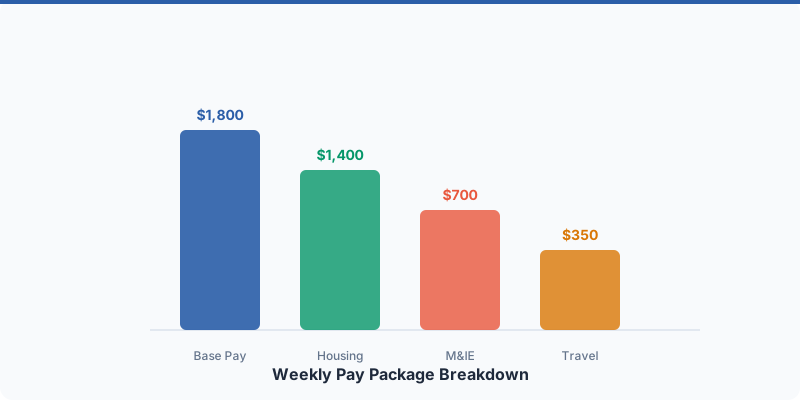
A med-surg nurse working a 36-hour contract in a low-cost area might gross $1,800 per week, while an ICU nurse on a crisis contract during a staffing emergency might bring in $4,000 or more. Both are travel nurses. Both numbers are real.
Understanding what “salary” actually means in travel nursing is the first step to evaluating your earning potential. Unlike a staff nurse who earns a fixed annual salary or hourly wage, a travel nurse’s compensation is a blend of taxable wages and tax-free stipends that changes with every new contract. Your total compensation is not the same as your taxable income, and your taxable income is not the same as your take-home pay.
This article gives you a clear picture of where travel nurse pay stands in 2026, broken down by specialty, state, and experience level. The data reflects market conditions as of early 2026 and draws from industry reports, job board postings, and recruiter-confirmed ranges. Keep in mind that pay fluctuates with demand, so treat these numbers as a reliable snapshot rather than a guarantee.
Average Travel Nurse Salary: The Big Numbers
In 2026, the national average weekly gross pay for a travel nurse working a standard 36-hour contract is approximately $2,100 to $2,600, depending on specialty and location. That translates to a gross annual compensation of roughly $109,000 to $135,000 if you work 52 weeks (most travel nurses take some time off between contracts, so actual annual earnings are typically slightly lower).
Here is how that breaks down for a typical package:
| Component | Weekly Amount |
|---|---|
| Taxable hourly rate (36 hrs) | $800 - $1,100 |
| Housing stipend | $900 - $1,400 |
| M&IE stipend | $300 - $450 |
| Travel reimbursement (prorated) | $50 - $100 |
| Total weekly gross | $2,050 - $3,050 |
Compared to staff nurses, travel nurses typically earn 20-40% more in total compensation. The national average staff RN salary sits around $89,000 to $95,000 per year. However, the comparison is not perfectly apples-to-apples because travel nurses often pay for their own health insurance and do not receive employer-funded retirement matches, PTO, or other benefits that staff nurses enjoy.
Post-pandemic context: Travel nurse pay spiked dramatically in 2020-2022, with some crisis contracts exceeding $10,000 per week. Those rates have corrected significantly. The market in 2026 has stabilized at levels that are higher than pre-pandemic norms but well below the pandemic peak. Nurses who entered travel nursing during the boom should calibrate expectations to current market reality.
Travel Nurse Salary by Specialty
Your nursing specialty is one of the strongest predictors of your travel nurse salary. Specialties with higher acuity, greater demand, or smaller talent pools consistently command higher rates.
Critical Care (ICU, CVICU, NICU)
Average weekly gross: $2,400 - $3,200
Critical care nurses remain among the highest-paid travel nurses. ICU experience is in perpetual demand because critical care skills are not easily cross-trained and the patient acuity requires deep expertise. CVICU (cardiovascular ICU) and NICU (neonatal ICU) nurses often see premiums above general ICU rates due to additional subspecialty requirements.
Peak demand periods for ICU travel nurses include flu season (November through March) and any period of census surges. Nurses with CCRN certification typically see higher offers than those without.
Emergency Department (ER)
Average weekly gross: $2,300 - $3,000
Emergency department nurses are consistently in demand, particularly in urban trauma centers and rural facilities that struggle to staff their EDs year-round. ER pay is driven by high patient volumes, unpredictable acuity, and the broad skill set required.
Urban ER assignments tend to pay more in raw dollars, but rural ER positions sometimes offer surprisingly competitive packages because facilities in underserved areas need to offer premium rates to attract travelers. Certifications like CEN (Certified Emergency Nurse) and TNCC (Trauma Nursing Core Course) can boost your marketability and negotiating position.
Medical-Surgical (Med-Surg)
Average weekly gross: $1,900 - $2,500
Med-surg is the most widely available travel nursing specialty. There are more med-surg contracts posted at any given time than any other specialty, which means you have maximum flexibility in choosing your location. However, the large supply of med-surg nurses means pay rates tend to be lower than critical care or ER.
To maximize your med-surg earnings, consider taking assignments in high-demand areas during peak seasons, getting certified in telemetry monitoring (which qualifies you for tele/med-surg hybrid positions at higher rates), and being flexible on shift and schedule.
Labor & Delivery (L&D)
Average weekly gross: $2,200 - $2,900
L&D is a specialized field with strong demand, particularly in regions with high birth rates or limited OB staffing. Pay tends to be higher in the South and Midwest, where smaller hospitals have difficulty retaining permanent L&D staff.
Certifications that boost L&D pay include RNC-OB (Inpatient Obstetric Nursing), NRP (Neonatal Resuscitation Program), and AWHONN intermediate or advanced fetal monitoring. Nurses with high-risk OB experience are especially sought after.
Operating Room (OR)
Average weekly gross: $2,400 - $3,300
OR nurses command some of the highest travel nurse salaries. Operating room nursing requires specialized skills that take years to develop, and the learning curve makes it difficult for facilities to quickly train new staff. This creates persistent demand for experienced OR travelers.
Within the OR specialty, subspecialty experience in cardiac surgery, neurosurgery, or robotic-assisted procedures can push rates even higher. OR nurses who are comfortable circulating and scrubbing across multiple service lines are the most marketable.
Telemetry / PCU
Average weekly gross: $2,000 - $2,700
Telemetry and progressive care unit (PCU) nurses occupy a middle ground between med-surg and ICU. Pay is higher than med-surg but generally lower than full ICU rates. However, tele/PCU contracts are plentiful, and many nurses use them as a stepping stone to ICU travel assignments.
The market for tele/PCU has remained steady in 2026, with consistent demand across most regions. Nurses with strong cardiac monitoring skills and ACLS certification are preferred.
Other Specialties
Several niche specialties offer strong travel nurse salaries that are worth mentioning:
- PACU (Post-Anesthesia Care Unit): $2,200 - $2,800/week. Demand is steady because PACU staffing directly impacts surgical throughput.
- Cath Lab: $2,500 - $3,200/week. Highly specialized with a small talent pool, which drives premium rates.
- Interventional Radiology: $2,400 - $3,100/week. Similar dynamics to cath lab, with high pay for a niche skill set.
- Psych/Behavioral Health: $1,800 - $2,400/week. Growing demand as mental health needs increase nationwide. Pay is lower than acute care specialties but contracts are abundant and often in desirable locations.
Travel Nurse Salary by State
Highest-Paying States
The states with the highest average weekly gross pay for travel nurses in 2026 include:
- California — $2,800 - $3,500/week
- New York — $2,600 - $3,300/week
- Massachusetts — $2,500 - $3,200/week
- Washington — $2,400 - $3,000/week
- Oregon — $2,300 - $2,900/week
- Connecticut — $2,300 - $2,900/week
- New Jersey — $2,300 - $2,800/week
- Alaska — $2,400 - $3,100/week
- Hawaii — $2,300 - $2,900/week
- Minnesota — $2,200 - $2,800/week
These states pay more because of some combination of high cost of living, strong nurse union influence (which pushes up bill rates), chronic staffing shortages, and high patient volumes. But higher gross pay does not always mean higher take-home pay. California, for example, has a state income tax rate that can reach 13.3% for high earners, which significantly cuts into your net income.
States With No Income Tax
These states have no state income tax, which means more of your taxable wages stay in your pocket:
- Alaska
- Florida
- Nevada
- New Hampshire (no tax on wages; taxes investment income)
- South Dakota
- Tennessee
- Texas
- Washington
- Wyoming
Assignments in these states are popular among travel nurses for good reason. A contract in Texas or Florida at $2,200 per week gross may net more take-home than a $2,600 per week contract in California after state taxes. Use the pay calculator to model the difference for your specific situation.
Lowest-Paying States
States at the lower end of the pay spectrum include parts of the rural South and Midwest: Mississippi, Arkansas, West Virginia, Iowa, and South Dakota. Average weekly gross in these areas may range from $1,700 to $2,200.
However, “low-paying” does not always mean a bad deal. Cost of living in these states is often dramatically lower. A $1,900 weekly package in rural Mississippi where your rent is $600 per month can go further than a $2,800 package in Los Angeles where a studio apartment costs $2,500 per month. Always evaluate pay relative to local costs.
Factors That Affect Your Travel Nurse Salary
Beyond specialty and location, several other factors influence what you earn:
Years of experience. Most agencies require a minimum of one to two years of bedside experience. Nurses with five or more years of experience, especially in a single specialty, can negotiate higher rates. Seasoned travelers who know how to evaluate packages and negotiate also tend to earn more simply because they ask for more.
Shift differential. Night shifts and weekend shifts often come with a $2 to $6 per hour differential on top of your base rate. Over a 36-hour week, that adds $72 to $216 to your weekly taxable pay.
Seasonal demand. Flu season (late fall through early spring) consistently drives up rates, particularly for ICU, ER, and med-surg. Summer months can see rate increases in vacation-heavy areas where staff nurses take time off. Holiday assignments often carry premium rates.
Facility type. Academic medical centers and large health systems often have higher bill rates and can offer better packages. Smaller community hospitals may pay less but can offer a better work environment and easier patient loads.
Crisis and rapid-response rates. During genuine staffing emergencies, facilities may offer crisis rates that are 50-100% above standard rates. These contracts are typically short (4-8 weeks) with less flexibility, but the pay can be exceptional.
Agency margin. Every agency takes a margin from the bill rate. Some agencies are transparent about this; others are not. Working with multiple agencies and comparing offers is the best way to ensure you are getting a fair deal. Ask your recruiter about the bill rate — not all will share it, but those who do signal trustworthiness.
Travel Nurse Salary Trends (2020-2026)
The story of travel nurse pay over the past six years is a story of extremes.
2020-2022: The pandemic boom. COVID-19 created unprecedented demand for travel nurses, particularly in ICU and ER. Weekly rates soared, with some crisis contracts paying $5,000 to $10,000 or more per week. Nurses who had never considered travel nursing left staff positions for contracts paying three to five times their normal salary.
2023-2024: The correction. As the acute phase of the pandemic subsided, bill rates dropped sharply. Many hospitals brought travel nurses on at significantly reduced rates, and some facilities cut travel positions entirely as they rebuilt permanent staff. Rates fell 40-60% from pandemic peaks.
2025-2026: Stabilization. The market has settled into a new normal. Rates are higher than pre-pandemic levels (2019) by roughly 15-25%, reflecting a permanent shift in how hospitals view travel nursing as a staffing strategy. Demand remains strong in most specialties, though not at crisis levels.
Looking ahead through the rest of 2026, several trends are worth watching: continued strong demand for critical care and OR nurses, growing interest in telehealth and ambulatory care travel positions, and potential legislative actions in some states that could cap agency bill rates (which would affect nurse pay). Staying flexible on location and specialty remains the best hedge against market fluctuations.
How to Maximize Your Travel Nurse Income
Here are the strategies that experienced travel nurses use to consistently earn at the top of their pay range:
Get additional certifications. Specialty certifications (CCRN, CEN, RNC-OB, CNOR) signal expertise and make you more marketable. Many facilities prefer or require them, and you can use them as leverage in negotiations.
Be flexible on location. Nurses who are open to assignments in less glamorous locations often find higher-paying contracts. Rural areas and less popular states frequently offer above-average pay because they have fewer applicants.
Negotiate using the bill rate. If you can find out the bill rate (or at least estimate it), you can negotiate from an informed position. Our guide on how to compare pay packages walks you through this process.
Stack tax-free stipends properly. Maintain a valid tax home to ensure your stipends remain tax-free. The difference between taxable and non-taxable stipends can be $5,000 to $10,000 per year in your pocket.
Take assignments during peak demand. Flu season, holiday periods, and summer vacation windows often carry higher rates. Planning your contract calendar around demand cycles is a powerful income strategy.
Consider overtime and bonus opportunities. Some contracts offer guaranteed overtime or completion bonuses. Use the pay calculator to model how these extras affect your total compensation.
Travel Nurse Salary vs. Staff Nurse Salary
The question of whether travel nursing pays more than staff nursing comes up constantly, and the answer is: it depends.
| Factor | Travel Nurse | Staff Nurse |
|---|---|---|
| Average annual gross compensation | $109,000 - $135,000 | $80,000 - $95,000 |
| Tax-free stipends | Yes (with tax home) | No |
| Health insurance | Self-funded or agency plan (often costly) | Employer-subsidized |
| Retirement (401k/403b) | Limited; some agencies offer match | Employer match common |
| PTO / Sick time | Usually none | Accrued |
| Pension | No | Available at some facilities |
| Job security | Contract-based | Permanent |
| License costs | Multiple states or compact | Single state |
| Housing costs | Duplicated | Single residence |
In raw dollar terms, travel nurses almost always earn more. But the hidden costs of travel nursing — paying for your own health insurance, maintaining a tax home, travel expenses, licensing fees, and the lack of PTO — eat into that premium.
There are also situations where staff nursing actually pays more on an effective hourly basis. A staff nurse earning $85,000 with a generous benefits package (employer-paid health insurance, 5% 401k match, four weeks PTO, and a pension) may have an effective total compensation exceeding $110,000. A travel nurse earning $120,000 gross but paying $600/month for health insurance, maintaining a $1,200/month tax home, and working 50 weeks per year without PTO might net a similar amount.
The financial advantage of travel nursing is real, but it is not as enormous as the gross numbers suggest. The lifestyle advantages — variety, adventure, flexibility — are often the bigger draw.
Travel RT and Surgical Tech Salary Ranges
Travel nursing dominates the salary conversation, but respiratory therapists and surgical technologists working travel contracts earn competitive compensation that follows the same pay structure — taxable base rate plus tax-free stipends.
Travel Respiratory Therapist (RT) Pay
Average weekly gross: $1,700 - $2,400
Travel RTs earn less than travel RNs on average, but the gap is narrower than most people assume. The taxable hourly base rate for traveling RTs in 2026 typically ranges from $25 to $38 per hour, with housing and M&IE stipends structured identically to nursing contracts.
Highest-paying RT specialties:
- NICU respiratory therapy: $2,000 - $2,700/week. NICU RT experience is scarce and in high demand. RTs with NPS (Neonatal/Pediatric Specialty) certification consistently command the top end of the pay range.
- Adult critical care: $1,900 - $2,500/week. RTs managing ventilators in ICU settings, particularly those with ACCS (Adult Critical Care Specialty) certification, earn above-average rates.
- ECMO specialists: $2,200 - $3,000/week. RTs trained and certified in extracorporeal membrane oxygenation are among the highest-paid allied health travelers. The skill is rare and the stakes are high, which drives premium compensation.
- General floor/PRN therapy: $1,600 - $2,100/week. Routine respiratory care assignments pay the least, but contracts are widely available and offer maximum location flexibility.
Travel RT pay follows the same geographic trends as nursing: California, New York, and Washington pay the most, while rural Southern and Midwestern states pay less but with lower cost of living.
Travel Surgical Technologist (Surgical Tech / CST) Pay
Average weekly gross: $1,500 - $2,200
Surgical techs typically earn the lowest base among the three professions, but the stipend structure (housing, M&IE, travel reimbursement) is comparable, which narrows the real-world income gap. The taxable hourly base rate in 2026 ranges from $22 to $34 per hour.
Highest-paying surgical tech specialties:
- Cardiovascular / open heart: $1,900 - $2,600/week. CV surgery techs with experience on bypass cases are in persistent demand and command top rates.
- Neurosurgery: $1,800 - $2,500/week. The specialized instrumentation and case complexity justify premium pay.
- Robotic surgery (da Vinci systems): $1,800 - $2,400/week. As robotic-assisted procedures expand, techs trained on these platforms are highly sought after.
- Orthopedics (total joints, spine): $1,700 - $2,300/week. High surgical volume and a steady demand for experienced orthopedic techs keep rates competitive.
- General surgery / multi-specialty: $1,500 - $2,000/week. Generalist techs have the widest selection of available contracts but earn less than subspecialists.
How RT and Surgical Tech Pay Compares to RN Travel Pay
| Profession | Avg Weekly Gross | Avg Taxable Hourly | Stipend Structure |
|---|---|---|---|
| Travel RN | $2,100 - $2,600 | $22 - $35/hr | Housing + M&IE + travel |
| Travel RT | $1,700 - $2,400 | $25 - $38/hr | Housing + M&IE + travel |
| Travel Surgical Tech | $1,500 - $2,200 | $22 - $34/hr | Housing + M&IE + travel |
The stipend portions of all three professions are determined by the same GSA per diem rates and are location-dependent, not profession-dependent. The primary difference in total compensation comes from the taxable hourly rate and the bill rate the facility pays the agency. RNs generally have higher bill rates due to scope of practice, liability exposure, and market demand.
That said, specialized RTs (NICU, ECMO) and specialized surgical techs (CV surgery, neuro) can match or exceed general med-surg travel nurse pay. The highest-earning strategy for RTs and surgical techs is the same as for nurses: specialize in a high-demand niche, get certified, and be flexible on location.
FAQ: Travel Nurse Salary
How much does a first-year travel nurse make?
A first-year travel nurse with the minimum one to two years of bedside experience will typically earn at the lower end of their specialty’s range. For a med-surg nurse, that might be $1,800 to $2,200 per week gross. For an ICU nurse, $2,200 to $2,700. First-year travelers are still learning how to evaluate packages, negotiate, and choose assignments strategically, so their earnings tend to increase significantly by their second and third years as they become more savvy about the business side of travel nursing.
Do travel nurses really make $100K+ per year?
Yes, many travel nurses earn six figures in total compensation. An ICU or OR nurse working 48 weeks per year at $2,500 per week gross would earn $120,000 annually. However, it is important to distinguish between gross compensation and take-home pay. After taxes on the taxable portion, health insurance costs, and tax home maintenance, your actual net income will be lower. Still, clearing $100,000 in total compensation is realistic for most specialties if you work consistently throughout the year.
Are travel nurse salaries going down?
Compared to the pandemic peak, yes — travel nurse pay has decreased substantially from the highs of 2021-2022. However, compared to pre-pandemic levels (2019), rates are still 15-25% higher in most specialties and markets. The market has stabilized in 2026, and there is no indication of a further significant decline. Demand for travel nurses remains strong due to ongoing staffing challenges across the healthcare industry.
How much do travel nurses make per hour?
The per-hour answer depends on whether you are talking about the taxable base rate or the effective hourly rate. Taxable base rates typically range from $20 to $35 per hour. But when you add in tax-free stipends and prorate them across your worked hours, the effective hourly rate is much higher — often $50 to $75 per hour or more. When someone quotes a “blended rate” of $55/hour, they are typically expressing this all-in effective rate. Always ask for the itemized breakdown.
Do travel nurses get raises on extensions?
Extension pay is negotiable and not guaranteed to match or exceed your original contract rate. Bill rates can change between contracts, and agencies may adjust your package. Some nurses successfully negotiate a raise on extension by pointing out that they are a proven performer at the facility and that the agency saves on onboarding costs. Others find that extension rates are slightly lower as the facility’s urgency decreases. Always run extension offers through the pay calculator and treat them as new contracts for evaluation purposes.
Key Takeaways
- Travel nurse salary ranges are wide — your specialty, location, and timing all have a major impact on what you earn.
- Total compensation, not hourly rate, is what matters. Factor in stipends, taxes, benefits costs, and cost of living to get the true picture.
- Critical care, OR, and ER consistently pay the highest rates. Med-surg offers the most contract availability but lower pay.
- No-income-tax states can significantly boost your take-home pay even when the gross rate is lower.
- The market has stabilized post-pandemic at levels above pre-2020 norms. Stay informed on trends and stay flexible.
- Use the pay calculator to model your specific situation before accepting any contract.
Related Internal Links
- How to Compare Travel Nurse Pay Packages
- Travel Nurse Pay Calculator Guide
- Travel Nurse Tax Home Guide
- How to Negotiate Travel Nurse Contract
- Travel Nurse Overtime Pay
- Pay Calculator
Affiliate Placement Notes
- Pay calculator tool CTA in “How to Maximize Your Travel Nurse Income” section
- Agency comparison affiliate links in “Factors That Affect Your Salary” section
- Certification course affiliate links in specialty sections where certifications are mentioned
