
Travel Nurse Roommate Guide: Split Costs, Not Sanity

Disclosure: Some links in this post are affiliate links. If you click through and make a purchase, we may earn a small commission at no extra cost to you. Learn more about how we make money.
Introduction: The Case for a Travel Nurse Roommate
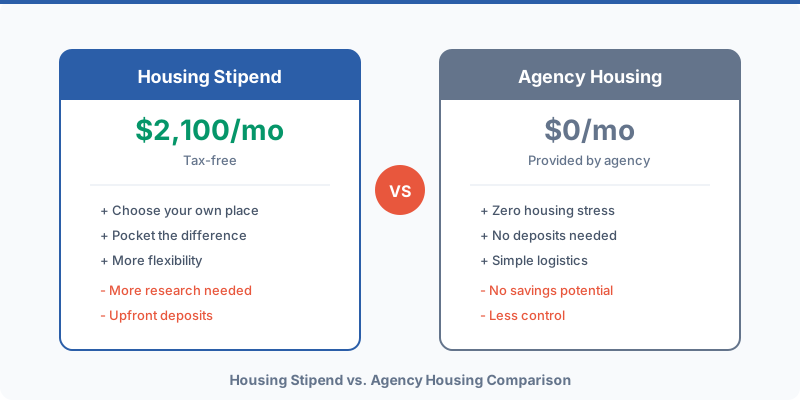
Housing is the single biggest expense on any travel nurse assignment, and it is the one that eats into your stipend savings the fastest. A one-bedroom furnished apartment that runs $1,800 per month wipes out most of your housing stipend in a mid-range market. But split a two-bedroom with a roommate at $2,200 total, and suddenly you are paying $1,100 per month instead — pocketing an extra $700 every month, or roughly $2,275 over a 13-week contract.
That is real money. It is a student loan payment, a retirement contribution, or a plane ticket to visit family.
But here is the other side of the equation: a bad roommate can ruin your entire assignment. Sleep disruption when you are working 12-hour shifts is not just annoying, it is dangerous. Tension in your living space bleeds into your work, your mood, and your mental health. The financial savings mean nothing if you are counting down the days until you can escape your own home.
This guide covers how to find the right roommate, set ground rules that prevent conflict, and make shared living work on a 13-week timeline. Done right, a roommate does not just save you money — they give you a built-in friend in a new city.
Where to Find Travel Nurse Roommates
The best roommates are other travel nurses. They understand the lifestyle, the schedules, and the temporary nature of the arrangement. Here is where to find them.
Facebook Groups
Facebook is the most popular platform for finding travel nurse roommates. Search for groups like:
- “Travel Nurse Housing” (national, with thousands of members)
- “Travel Nurse Housing - [City Name]” (city-specific groups)
- “Gypsy Nurse Housing” and “Highway Hypodermics” (large travel nurse communities with housing channels)
- “[Hospital Name] Travel Nurses” (facility-specific groups)
Post a clear listing that includes your assignment city, start and end dates, budget, gender preference (if any), and what you are looking for in a roommate. Be specific. A post like “Looking for a female travel nurse roommate in Denver, starting March 15 for 13 weeks, budget $1,000-1,200/month for my share, day shift, non-smoker” will attract compatible matches far better than a vague “anyone need a roommate in Denver?”
Furnished Finder
Furnished Finder has roommate-matching features and shared-housing listings. Some landlords specifically market two-bedroom units to pairs of travel nurses and will help connect single tenants looking to share. Search for multi-bedroom listings within your budget and contact the landlord to ask if they can connect you with another nurse looking for a roommate at the same property.
Through Your Agency
Your staffing agency may be able to help. Ask your recruiter:
- “Are there other nurses heading to the same facility on similar timelines?”
- “Does our agency have a housing board or community forum where nurses connect?”
- “Can you put me in touch with another nurse who is also looking for housing at this facility?”
Some agencies offer shared housing as part of their agency-provided options. If you are taking the stipend but want to find a roommate through your agency’s network, most recruiters are happy to facilitate introductions.
At the Facility
Sometimes the best roommate is someone you meet during orientation. Many travel nurses find roommates by asking around during their first few days at the hospital. Staff nurses who have worked with previous travelers may also know of other incoming travelers looking for housing. The nursing education coordinator or staffing office can sometimes connect you with other travelers starting around the same time.
Reddit and Online Forums
The r/TravelNursing subreddit and other online nursing communities have regular housing and roommate threads. The tone is more anonymous than Facebook, which some nurses prefer for initial outreach.
How to Vet a Potential Roommate
Finding someone is the easy part. Making sure they are the right someone is what matters. Take these steps before committing to a shared living arrangement.
Have a Video Call
Never agree to live with someone you have only communicated with via text. A 20 to 30-minute FaceTime or Zoom call lets you gauge personality, communication style, and general vibe. If the conversation flows easily and you feel comfortable, that is a good sign. If something feels off, trust that instinct.
Ask the Right Questions
These are not small-talk questions. They are the questions that prevent conflicts later.
Schedule and sleep:
- What shift do you work? (Day shift and night shift roommates can work, but both parties need to be explicit about noise and quiet-hour expectations.)
- Are you a light or heavy sleeper?
- What time do you usually go to bed and wake up on days off?
Lifestyle and habits:
- How clean would you describe yourself? (Be honest about your own standards too.)
- Do you smoke or vape? Indoors?
- How often do you have guests or significant others visiting?
- Do you have pets?
- Do you drink? How often?
Living preferences:
- Are you more of a socializer or someone who keeps to themselves?
- How do you feel about sharing food and kitchen supplies?
- What is your take on shared spaces — do you clean as you go or do a big weekly clean?
Deal-breakers:
- What are your absolute non-negotiables in a living situation?
- Have you had roommates before? What worked and what did not?
Ask for References
This might feel awkward, but a quick conversation with a previous roommate or colleague can confirm that this person is who they say they are. If they have traveled before, ask for contact information of a previous roommate or a nurse they have worked with.
Trust Your Instincts
If anything feels off during the vetting process — inconsistent stories, evasiveness about basic questions, pressure to commit quickly — keep looking. There will always be another potential roommate. There is no recovering from 13 weeks with someone who makes your life harder.
Setting Ground Rules Before Move-In
The number one reason roommate situations go wrong is unspoken expectations. You both assumed the other person would handle things a certain way, and when reality does not match the assumption, resentment builds. Prevent this by having one clear, honest conversation before move-in and writing down what you agree to.
Financial Agreements
Rent split. How will you split the rent? A 50/50 split is standard for equal rooms. If one bedroom is significantly larger or has an en-suite bathroom, a 55/45 or 60/40 split is fair.
Who is on the lease? Ideally, both names are on the lease. If only one person is on the lease, the other should have a written sublease or agreement that outlines their financial commitment and protects both parties.
Payment logistics. Decide how and when you will pay. If one person pays the landlord directly, the other pays their share via Venmo, Zelle, or Splitwise by a specific date each month. Put this in writing.
What if one person leaves early? This happens. Contracts get cancelled, emergencies arise, or the living situation does not work out. Agree upfront on how early departure will be handled: How much notice is required? Who is responsible for finding a replacement roommate or covering the remaining rent?
Shared expenses. Will you split utilities, WiFi, and household supplies (toilet paper, dish soap, trash bags)? Splitwise is a free app that makes tracking shared expenses painless.
Living Arrangements
Shared vs. private spaces. Bedrooms are private. Living room, kitchen, and bathroom are shared. That part is obvious. What is less obvious: where do you draw the line on shared use? Can your roommate use your desk? Your bathroom products? Clarify early.
Cleaning schedule. Agree on a cleaning standard and a schedule. Some pairs alternate weeks for shared-space cleaning. Others divide by area (one person handles the kitchen, the other handles the bathroom). The specific system matters less than having any system at all.
Quiet hours. This is the most important agreement for shift workers. If one of you works nights, the daytime quiet hours are non-negotiable. Agree on specific times: “No loud music, vacuuming, or phone calls in common areas between 8 AM and 4 PM” (or whatever matches the night-shifter’s sleep schedule). A white noise machine and blackout curtains for the night-shift roommate’s bedroom are essential investments.
Guest and significant-other policies. How often can guests visit? Can significant others stay overnight? For how many nights in a row? These conversations feel awkward in advance but prevent serious conflict later. A common agreement: overnight guests are fine occasionally, but extended stays (more than 2 to 3 nights per week) require a conversation and potentially a contribution to rent.
Communication Plan
Check-ins. Agree to a brief weekly or biweekly check-in (even just a 5-minute conversation) to address small issues before they become big ones. “Hey, is the cleaning schedule working for you? Anything bugging you?” A proactive check-in costs nothing and prevents resentment from building silently.
Conflict resolution. Agree that if something is bothering either person, you will bring it up directly and respectfully rather than letting it fester. A simple framework: “When [specific behavior happens], I feel [emotion] because [reason]. Can we [proposed solution]?”
Move-out timeline. Agree on how much notice each person will give before the end of the contract. Two weeks is standard. This helps both parties plan their next steps without surprises.
Making Shared Living Work on 13-Week Contracts
The beautiful thing about travel nurse roommate situations is their built-in expiration date. If the arrangement is great, you have made a friend for life. If it is merely tolerable, it is only 13 weeks. And if it is genuinely bad, there is a light at the end of the tunnel.
Be a good roommate yourself. Clean up after yourself. Communicate clearly. Respect quiet hours. Be the kind of roommate you would want to live with. This sounds basic, but travel nursing is stressful, and it is easy to let shared-living standards slip when you are exhausted after a string of 12-hour shifts.
Friendship vs. professionalism. Some roommate pairs become close friends who explore the city together, share meals, and stay in touch for years. Others maintain a friendly but professional dynamic — they share a space but lead separate lives. Both approaches are perfectly valid. Do not feel pressured to be best friends, and do not feel disappointed if your roommate prefers their own space.
Respect boundaries. Even in a shared space, everyone needs alone time. If your roommate closes their bedroom door, that is a signal. If you need solitude to recharge after a tough shift, communicate that. “I had a rough day, I am going to decompress in my room” is a perfectly healthy thing to say.
If it is not working mid-contract, address it directly. Have a conversation using the conflict-resolution framework above. If the issue is fixable (noise, cleaning, guests), give your roommate a chance to adjust. If the issue is fundamental and unfixable, explore your options: Can you switch rooms within the same property? Can you find alternative housing for the remaining weeks? Talk to your agency if the situation becomes untenable.
When Roommates Are Not Worth It
Roommates are not for everyone, and there is no shame in that. Consider solo living if:
You work nights and your potential roommate works days. This can work with very strict quiet-hour agreements, but it often creates friction. The day-shift roommate wants to cook, watch TV, and have a normal evening at home while the night-shift roommate is trying to sleep. If both roommates work nights, the compatibility is much better.
Your mental health requires solitude. Travel nursing is emotionally demanding. If you recharge through quiet and solitude, a roommate may cost you more in mental energy than they save you in rent. Only you know whether the financial savings outweigh the psychological cost.
The savings are minimal. In lower-cost markets where a studio apartment rents for $900 per month, splitting a $1,200 two-bedroom saves you only $300 per month. That $300 may not be worth sharing a bathroom and a kitchen for 13 weeks.
You are traveling with family. If your spouse, partner, or children are with you, a roommate does not make sense. Your family needs their own space.
You have had consistently bad experiences. If three out of four roommate situations have been negative, the pattern is clear. Whether the issue is compatibility, communication, or just personal preference, solo living is a legitimate choice.
For strategies to find affordable solo housing, see our complete housing guide and our guide to the cheapest cities for travel nursing.
Key Takeaways
- A good roommate can save you $700 to $1,500 per month on housing. Over a 13-week contract, that adds up to $2,275 to $4,875 in extra savings.
- Vet thoroughly. Video call, ask the right questions, request references, and trust your instincts. Fifteen minutes of screening prevents 13 weeks of regret.
- Put financial agreements in writing before move-in. Rent split, payment method, early departure terms, and shared expenses should all be documented.
- Set ground rules for cleaning, guests, and quiet hours. Unspoken expectations are the root of almost every roommate conflict.
- Communicate early. If something is bothering you, bring it up respectfully before it becomes a bigger issue. A weekly check-in keeps small problems from becoming resentment.
- It is okay to decide roommates are not for you. Solo living is a valid choice if the savings do not justify the compromise.
Find roommate-compatible housing on Furnished Finder , and check out our budget guide to see how roommate savings fit into your overall financial plan.
Related Internal Links
- Travel Nurse Housing Guide
- How to Find Travel Nurse Housing
- Cheapest Cities for Travel Nursing
- Travel Nurse Budget & Save
- Housing Stipend vs. Agency Housing
- Furnished Finder Review
- Travel Nurse Budget Template
Affiliate Placement Notes
- Furnished Finder affiliate link in “Where to Find” section and key takeaways
- White noise machine affiliate link in the quiet hours section
- Blackout curtain affiliate link in the quiet hours section
