
Travel Nurse Roommate: How to Find and Live With a Roommate

Disclosure: Some links in this post are affiliate links. If you click through and make a purchase, we may earn a small commission at no extra cost to you. Learn more about how we make money.
Should You Get a Travel Nurse Roommate?
Housing is the biggest line item in your travel nurse budget, and getting a roommate is the fastest way to slash it. Splitting a two-bedroom apartment with another travel nurse can save you $700 to $1,500 per month — money that goes straight into savings, student loan payments, or your retirement fund.
But roommates are not for everyone, and the wrong match can turn a great assignment into a miserable one. This article covers the essentials: the financial case, where to find roommates, what to watch out for, and how to decide whether shared living is right for you.
For the full deep dive — including vetting checklists, ground-rule templates, conflict-resolution strategies, and night-shift compatibility tips — head to our comprehensive travel nurse roommate guide.
The Financial Case for a Roommate
The math is straightforward. Here is a typical mid-range market example:
| Solo | With Roommate | |
|---|---|---|
| Housing type | 1BR furnished apartment | 2BR furnished apartment (split) |
| Monthly cost | $1,800 | $1,100 ($2,200 split two ways) |
| 13-week total | $5,850 | $3,575 |
| Savings | — | $2,275 over the contract |
In higher-cost markets, the savings are even larger. A roommate in San Francisco, Boston, or New York can save you $1,500 or more per month.
The flip side: in lower-cost markets where a studio rents for $900, splitting a two-bedroom might only save you $250 to $350 per month. At that level, the savings may not justify the trade-offs in privacy and independence. Use our cost of living tool to check housing costs in your specific assignment city.
Where to Find a Travel Nurse Roommate
The best roommates are other travel nurses. They get the schedules, the short-term nature of the arrangement, and the general lifestyle. Here are the top places to connect.
Facebook groups are the most active source. Search for “Travel Nurse Housing” (national), “Travel Nurse Housing - [City Name]” (local), and community groups like Gypsy Nurse and Highway Hypodermics. Post your dates, budget, and preferences clearly.
Furnished Finder has shared-housing listings and can connect you with other nurses looking at the same property. Some landlords actively market two-bedroom units to pairs of travelers.
Your staffing agency may know of other nurses heading to the same facility. Ask your recruiter to make introductions. Some agencies also maintain housing boards or community forums.
At the hospital during orientation. Many travel nurses find roommates simply by asking around during their first few days on the job.
Quick Screening Checklist
Before committing to any roommate, have a video call and cover these topics:
- Shift schedule — Day shift and night shift roommates can work, but you need explicit agreements about quiet hours
- Cleanliness standards — Are you both on the same page about kitchen messes, bathroom cleaning, and shared-space tidiness?
- Guest and visitor policies — How often? Overnight? Extended stays?
- Smoking, vaping, and pet policies — Any deal-breakers?
- Communication style — Will they bring up problems directly, or let them fester?
- Previous roommate experience — What worked? What did not?
If the conversation flows naturally and you feel comfortable, that is a strong positive signal. If something feels off, trust your gut and keep looking.
For the full vetting process with detailed questions and reference-checking tips, see our roommate guide.
The Must-Have Agreements
Get these in writing before move-in. They do not need to be formal — a shared Google Doc or a text thread works. But get them documented.
- Rent split and payment method. Who pays the landlord? How does the other person pay their share? By what date each month?
- Early departure terms. What happens if one person’s contract is cancelled? How much notice? Who covers the remaining rent?
- Quiet hours. Especially critical if one person works nights. Specific times, not vague promises.
- Cleaning responsibilities. Alternate weeks, divide by area, or hire a cleaning service and split the cost.
- Guest policy. Occasional overnight guests are fine; a significant other who moves in for free is not.
Common Roommate Conflicts and Quick Fixes
Cleanliness mismatch. The most common complaint. Fix: Agree on a specific cleaning standard and schedule. If standards truly differ, a biweekly cleaning service ($60 to $100 split two ways) eliminates the conflict entirely.
Noise during sleep hours. Critical for shift workers. Fix: Invest in a white noise machine and blackout curtains . Set firm quiet-hour boundaries and enforce them. If your roommate repeatedly violates them, have a direct conversation immediately.
Guest overload. When a roommate’s significant other is there every night, it stops being a two-person arrangement. Fix: Set a clear limit (for example, overnight guests no more than 2 to 3 nights per week) and discuss it upfront.
Financial disagreements. One person feels they are covering more than their share of shared expenses. Fix: Use Splitwise (free app) to track every shared purchase transparently.
Personal space boundaries. Using each other’s food, toiletries, or belongings without asking. Fix: Designate separate shelves in the fridge and bathroom. Label what is shared vs. personal.
Agency-Provided Shared Housing
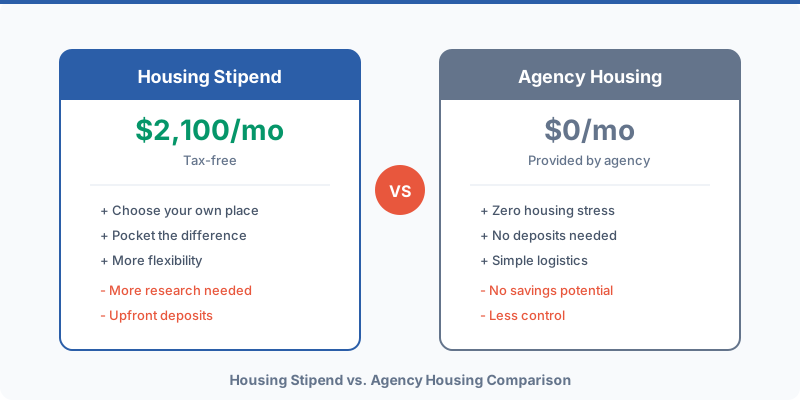
If you opt for agency-provided housing instead of taking the stipend, your agency may assign you a roommate. This removes the financial benefit of pocketing stipend savings but also eliminates the cost of housing entirely.
Know your rights. If your agency-assigned roommate situation becomes untenable (safety concerns, harassment, extreme lifestyle incompatibility), you have the right to escalate to your recruiter and request a change. Most agencies will accommodate reasonable requests, though it may take time to arrange.
Can you request a specific roommate? Sometimes. If you and another nurse at the same agency are heading to the same city, ask your recruiter to pair you together.
For more on the stipend vs. agency housing decision, see our housing stipend guide.
When to Skip the Roommate
Roommates are not the right choice in every situation. Consider going solo if:
- You work nights and sleep is already a challenge
- You need solitude to recharge after emotionally demanding shifts
- You are traveling with family or pets
- The cost savings in your market are minimal (under $300/month)
- You have consistently had negative roommate experiences
Solo living costs more, but the peace of mind, uninterrupted sleep, and personal space can be worth every dollar. Check out our housing guide for strategies to find affordable solo options.
Key Takeaways
- A roommate can save $700 to $1,500 per month depending on your market. Over 13 weeks, that is significant.
- Vet carefully. A video call and honest conversation about schedules, cleanliness, and deal-breakers takes 20 minutes and prevents weeks of conflict.
- Put agreements in writing. Rent split, quiet hours, cleaning, guests, and early departure terms.
- Communicate early and directly when issues arise. Small problems become big problems when left unaddressed.
- Solo living is a valid choice if the trade-offs outweigh the savings.
For the full guide with detailed vetting checklists, ground-rule templates, and strategies for night-shift compatibility, read our complete travel nurse roommate guide.
Find roommate-compatible housing on Furnished Finder .
Related Internal Links
- Travel Nurse Roommate Guide (comprehensive version)
- Travel Nurse Housing Guide
- How to Find Travel Nurse Housing
- Housing Stipend vs. Agency Housing
- Travel Nurse Budget & Save
- Cost of Living Tool
Affiliate Placement Notes
- Furnished Finder affiliate link in “Where to Find” section and key takeaways
- White noise machine affiliate link in the conflicts section
- Blackout curtain affiliate link in the conflicts section
