
Travel Nurse Per Diem Explained: What It Is and How It Works

Disclosure: Some links in this post are affiliate links. If you click through and make a purchase, we may earn a small commission at no extra cost to you. Learn more about how we make money.
Introduction: What Does “Per Diem” Mean for Travel Nurses?
Disclaimer: This guide is for educational purposes only and does not constitute tax advice. Consult a qualified CPA or tax professional for guidance on your specific situation.
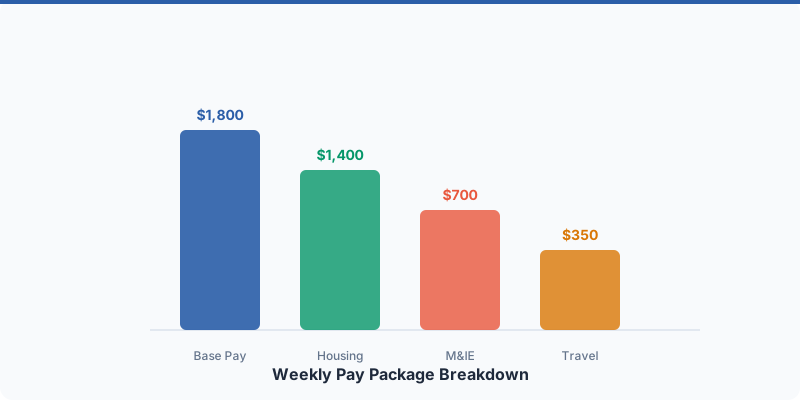
“Per diem” is Latin for “per day,” and in the travel nursing world, it refers to the daily reimbursement rate you receive to cover living expenses while working away from home. It is one of the most frequently used — and most frequently misunderstood — terms in travel nursing pay.
Here is where it gets confusing: “per diem” means two completely different things depending on the context. When you hear “per diem pay,” it refers to your daily tax-free reimbursement for housing, meals, and incidentals. When you hear “per diem nurse” or “per diem shifts,” it refers to a type of nursing employment where you work on an as-needed basis with no guaranteed hours. These are entirely separate concepts that happen to share the same name.
This article focuses on per diem pay — the daily reimbursement component of your travel nurse pay package. You will learn how GSA rates work, how per diem translates into your weekly stipend, the tax rules governing these payments, and how to evaluate per diem when comparing contracts. If you are looking for information about per diem shift work, we will touch on that briefly near the end.
GSA Per Diem Rates: The Foundation
The General Services Administration (GSA) is a federal agency that, among other things, sets per diem rates for government employees traveling within the United States. These rates establish maximum daily allowances for lodging and meals in every county in the country.
While GSA rates were designed for government travel, they have become the standard benchmark for travel nurse per diem payments. The IRS uses these rates as the threshold for determining whether per diem reimbursements can be paid tax-free. If your agency pays you at or below the GSA rate for your assignment location, the payment is generally non-taxable (assuming you have a qualifying tax home). If it exceeds the GSA rate, the excess may be taxable.
How GSA Rates Are Structured
GSA per diem rates have two components:
-
Lodging rate — The maximum daily amount for housing. This varies significantly by location. In 2026, the standard lodging rate for most areas is around $107 per day, but high-cost areas can reach $300 or more per day. Cities like San Francisco, New York, and Washington D.C. have some of the highest lodging per diem rates in the country.
-
Meals & Incidentals (M&IE) rate — The daily amount for food, tips, laundry, and small daily expenses. M&IE rates are tiered from approximately $59 to $79 per day depending on the cost of living in the area. Most locations fall within a narrow range, making M&IE less variable than lodging.
Together, these two components make up the total per diem rate for a given location.
How to Look Up GSA Rates
Looking up the GSA rate for any assignment location is straightforward:
- Visit the GSA per diem rates page at gsa.gov/travel/plan-book/per-diem-rates
- Enter the city and state (or zip code) of your assignment location
- Select the fiscal year (GSA fiscal years run from October 1 through September 30)
- Review the results, which will show both the lodging rate and the M&IE rate for that location
Make this a habit before every new contract. Knowing the GSA rate gives you a benchmark for evaluating whether your agency’s per diem offer is competitive and whether it falls within the tax-free threshold.
How Often Rates Change
GSA updates per diem rates annually, effective October 1. This means rates can change in the middle of a calendar year. If your contract spans the October 1 changeover, the applicable GSA rate may shift. In practice, most agencies set your per diem at the start of your contract and do not adjust mid-contract for GSA rate changes, but it is worth being aware of the timing.
How Per Diem Applies to Travel Nurse Pay
Housing Per Diem
The lodging component of the GSA per diem rate directly influences your housing stipend. Here is how it typically works:
Your agency looks up the GSA lodging rate for your assignment county. That rate represents the maximum daily amount they can reimburse you tax-free for housing. To calculate your weekly housing stipend, they multiply the daily rate by seven days.
For example, if the GSA lodging rate for your assignment location is $150 per day:
- Daily per diem: $150
- Weekly housing stipend: $150 x 7 = $1,050
- 13-week contract total: $1,050 x 13 = $13,650 (tax-free)
Some agencies pay the full GSA rate. Others pay a percentage of it and redirect the difference to other parts of your package (or keep it as margin). A few agencies occasionally offer amounts above the GSA rate — if this happens, be aware that the excess above the GSA threshold may be treated as taxable income.
Meals & Incidentals (M&IE) Per Diem
The M&IE per diem covers daily food costs, tips for service workers, laundry, dry cleaning, and other small incidental expenses. The GSA publishes M&IE rates in tiers:
| Tier | Daily M&IE Rate |
|---|---|
| 1 (Standard) | $59 |
| 2 | $64 |
| 3 | $69 |
| 4 | $74 |
| 5 (High cost) | $79 |
Most assignment locations fall into tiers 1 through 3. Major metro areas and high-cost destinations tend to be in tiers 4 and 5.
There is one nuance worth knowing: the GSA reduces M&IE on the first and last day of travel to 75% of the full daily rate. This reflects the assumption that you eat fewer meals on travel days. Most agencies do not bother with this distinction and pay the full daily rate for every day, which is actually slightly more generous than the strict GSA rules.
Agencies typically convert the daily M&IE rate into a weekly lump sum. At $59 per day, that is $413 per week. At $79 per day, it is $553 per week. This weekly amount shows up on your pay stub as “M&IE stipend,” “meal stipend,” “per diem,” or a similar label.
Per Diem vs. Stipend: Is There a Difference?
In practice, most travel nurse agencies and nurses use “per diem” and “stipend” interchangeably, and for good reason — they describe essentially the same thing from different angles.
Per diem is technically the daily rate — the amount you are entitled to receive for each day of your assignment. It is rooted in the GSA’s per-day methodology.
Stipend is the total payment you receive, usually expressed as a weekly or biweekly amount. It is the sum of your per diem rates over the pay period.
When your recruiter tells you your “housing stipend is $1,400 per week,” they have already done the math of converting the daily per diem rate into a weekly payment. When the GSA says the lodging per diem for Dallas is $120 per day, they are expressing the same concept as a daily figure.
The conversion is simple: Daily per diem x 7 = Weekly stipend.
From a tax perspective, the terms are identical. Whether your agency calls it “per diem” or “stipend” does not affect the tax treatment. What matters is the amount (is it at or below the GSA rate?), your tax home status (do you have one?), and whether the payments are made under an accountable plan.
For a deeper exploration of how stipends work, check out our travel nurse stipend explained guide.
Tax Rules for Per Diem Payments
The tax treatment of your per diem payments comes down to three factors:
1. Do you have a qualifying tax home? If yes, per diem payments at or below the GSA rate are non-taxable. If no, all per diem payments become taxable income regardless of amount. Your tax home is the single most important factor in determining whether your per diem is tax-free.
2. Are the payments within GSA limits? Payments at or below the published GSA rate for your assignment location are eligible for tax-free treatment. Amounts exceeding the GSA rate may be taxable. This is why checking the GSA rate for every assignment matters.
3. Is the plan accountable? The IRS requires that per diem payments be made under an “accountable plan,” which means the payments have a legitimate business purpose (reimbursing duplicated expenses), are connected to time spent away from your tax home, and are not a disguised form of additional compensation. Reputable agencies structure their payments to meet these requirements.
How per diem appears on your W-2: Non-taxable per diem payments do not show up on your W-2. Only your taxable wages (hourly base rate, overtime, shift differentials, and taxable bonuses) are reported on the W-2. This is why travel nurses often have W-2s that understate their actual earnings — the tax-free per diem simply is not included.
If your per diem is taxable (because you lack a tax home or the amounts exceed GSA rates), it should be included in your W-2 wages and have taxes withheld accordingly. If your agency is paying you per diem without withholding taxes and you do not have a tax home, you will owe those taxes plus potential penalties when you file your return.
Take the tax home quiz if you are unsure about your status.
How to Evaluate Per Diem in a Pay Package
When you receive a contract offer, here is how to evaluate the per diem component:
Step 1: Look up the GSA rate for your assignment location. Go to gsa.gov and find the lodging and M&IE rates for the specific county where you will be working.
Step 2: Compare the agency’s offered per diem to the GSA rate. Is the agency paying at, below, or above the GSA rate? If below, there may be room to negotiate. If above, understand that the excess may be taxable.
Step 3: Calculate the total weekly per diem value. Add the weekly housing per diem and weekly M&IE per diem together. This is your total weekly tax-free income (assuming you have a tax home).
Step 4: Factor per diem into your total compensation comparison. Per diem is just one part of your pay package. Use the pay calculator to see how it fits into the bigger picture alongside your taxable hourly rate, overtime potential, and bonuses. Two packages with identical per diem amounts can have very different total values depending on the base rate and other components.
Step 5: Consider the local housing market. A $1,400 weekly housing per diem in a city where a furnished room costs $800 per week means you pocket $600 tax-free. The same $1,400 in a city where the cheapest option is $1,500 per week means you are subsidizing your housing out of pocket. The per diem amount only tells half the story — actual housing costs tell the other half.
Per Diem Nursing Shifts vs. Per Diem Pay
To clear up the terminology once and for all: “per diem nursing” and “per diem pay” are two different things.
Per diem nursing shifts (also called PRN shifts) refer to a type of employment arrangement where you work on an as-needed basis. You are not guaranteed a set schedule. The facility calls you when they have staffing gaps, and you accept or decline shifts based on your availability. Per diem nurses can be staff employees of a single facility or they can work through a staffing agency.
Per diem pay is the daily reimbursement component of a travel nurse’s compensation package, as discussed throughout this article.
A per diem nurse may or may not receive per diem pay. If a per diem nurse lives in the same area as the facility and is not traveling away from home, there are no duplicated expenses to reimburse, so per diem pay does not apply. If a per diem nurse is traveling away from their tax home to pick up shifts, they may be eligible for per diem reimbursement depending on their employment arrangement.
Many travel nurses pick up per diem shifts at local hospitals when they are home between contracts. This serves two purposes: it generates additional income, and it can strengthen your tax home claim by demonstrating that you perform work in your tax home area (one of the three IRS factors for maintaining a tax home).
FAQ
Can I negotiate my per diem rate?
Yes. Per diem rates are not set in stone. If you know the GSA rate for your assignment location and the agency is offering significantly less, you have a data-driven basis for negotiation. Tell your recruiter you have looked up the GSA rate and ask whether they can bring the per diem closer to that threshold. Some agencies have more flexibility on stipends than on base rates, so this can be an effective negotiation lever. Just remember that the total per diem cannot exceed the GSA rate and remain tax-free.
What if my housing costs less than the per diem?
This is one of the best financial strategies in travel nursing. If your housing per diem is $1,200 per week and you find a comfortable room for $700 per week, you keep the $500 difference tax-free. There is no requirement to spend your entire per diem on housing. The per diem is calculated based on the GSA rate for the area, not your actual expenses. Many experienced travel nurses become skilled at finding affordable housing to maximize the gap between their per diem and their actual costs.
Does per diem change during my 13-week contract?
Generally, no. Your per diem amount is set when you sign your contract and remains fixed for the duration of the assignment, even if GSA rates change mid-contract. The only scenario where per diem might change is if you extend your contract and the agency adjusts the terms for the extension period. Always confirm the per diem amount for extensions in writing before agreeing to extend.
Is per diem the same in every city?
Absolutely not. GSA per diem rates vary significantly by location. The standard lodging rate for a rural county might be $107 per day, while a high-cost metro area like San Francisco could be $250 or more per day. M&IE rates also vary, though the range is narrower ($59 to $79 per day). This geographic variation is why contracts in major cities often come with higher stipends — the GSA rates are higher, which allows agencies to pay more tax-free. Always look up the specific GSA rate for your assignment location rather than assuming a standard amount.
Do I have to submit receipts for per diem?
Under the GSA’s simplified per diem method (which is how most travel nurse agencies structure their plans), you do not need to submit receipts for your daily housing or meal expenses. The per diem is a flat reimbursement amount based on the GSA rate, not a reimbursement of actual expenses. However, you should still keep records of your housing costs and tax home expenses for your own protection in case of an IRS audit. The audit is more likely to focus on whether you had a valid tax home than on whether you spent every dollar of your per diem on its intended purpose.
Key Takeaways
- Per diem is your daily reimbursement rate for living expenses while working away from home. It is based on GSA rates and has two components: lodging and M&IE.
- Per diem and stipend mean essentially the same thing — per diem is the daily rate, stipend is the weekly total. The tax treatment is identical.
- Tax-free status requires a valid tax home. Without one, your entire per diem becomes taxable income. Take the tax home quiz to check your status.
- Always check GSA rates for your assignment location before evaluating a contract offer. This gives you a benchmark for negotiation and ensures your per diem does not exceed tax-free limits.
- Use the pay calculator to see how your per diem fits into the total package and how it compares across competing offers.
Related Internal Links
- Travel Nurse Stipend Explained
- Travel Nurse Tax Home Guide
- Are Travel Nurse Stipends Taxable?
- How to Compare Travel Nurse Pay Packages
- Housing Stipend vs. Agency Housing
Affiliate Placement Notes
- Pay calculator CTA in “How to Evaluate Per Diem” and key takeaways
- Tax software affiliate in the tax rules section
- GSA rate lookup tool / bookmark recommendation
