
Open Enrollment Guide for Travel Nurses (2026)
Disclosure: Some links in this post are affiliate links. If you click through and make a purchase, we may earn a small commission at no extra cost to you. Learn more about how we make money.
Introduction: Open Enrollment Is Your Annual Insurance Reset
Open enrollment is the one time each year when you can sign up for, switch, or drop health insurance coverage without needing a qualifying life event. For travel nurses, it is the annual moment to step back, evaluate your coverage strategy, and make decisions that will protect your health and your wallet for the entire coming year.
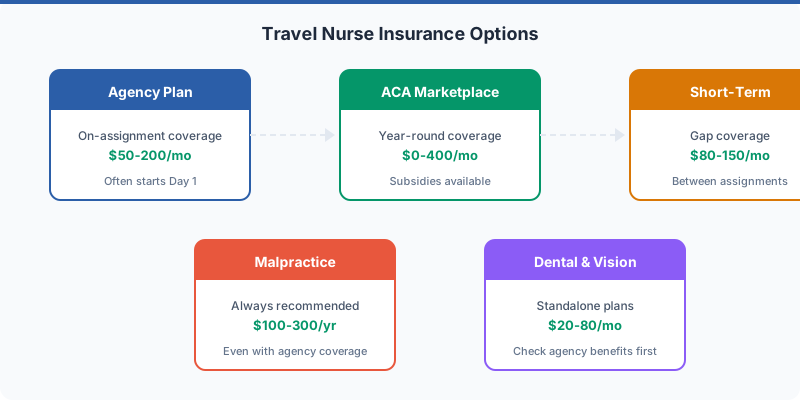
But open enrollment for travel nurses is far more complex than it is for staff nurses. You are not just picking Plan A or Plan B from a single employer’s menu. You are comparing agency-sponsored plans (which may change with every contract), ACA marketplace options (with subsidies that depend on your unique income structure), HSA and FSA elections, and dental and vision add-ons — all while trying to figure out what happens if you are between contracts when coverage starts.
Missing open enrollment or making the wrong decision can cost you thousands of dollars in premiums, leave you uninsured during a gap, or lock you into a plan that does not work across state lines. This guide walks through every decision you need to make, with specific guidance for 2026 deadlines, rules, and options.
This is educational content, not insurance or financial advice. Consult a licensed insurance professional for guidance specific to your situation.
2026 Open Enrollment Deadlines
The deadlines vary depending on which type of coverage you are considering.
ACA Marketplace (Healthcare.gov)
The federal marketplace open enrollment period for 2026 coverage typically runs from November 1, 2025, through January 15, 2026. Some states that operate their own exchanges (California, New York, Massachusetts, and others) may have slightly different deadlines.
Key dates:
- Enroll by December 15, 2025 for coverage starting January 1, 2026
- Enroll by January 15, 2026 for coverage starting February 1, 2026
If you miss open enrollment entirely, you generally cannot enroll in a marketplace plan until the next open enrollment period unless you experience a qualifying life event (more on that below).
Agency-Sponsored Plans
Each staffing agency sets its own open enrollment window for group health insurance. These dates vary by agency and typically do not align with the ACA marketplace dates. Contact your current agency’s benefits department to find out their specific open enrollment period.
Some agencies allow enrollment at any time (or after a short waiting period at the start of a contract). Others have a single annual enrollment window. Do not assume — ask directly.
Employer-Sponsored Plans (If You Have a Spouse’s Plan)
If you have the option to join a spouse or partner’s employer-sponsored plan, their open enrollment period is set by their employer, usually in October or November for January 1 coverage. This can be a strong option worth evaluating alongside your other choices.
Decision 1: Agency Insurance vs. ACA Marketplace
This is the biggest decision most travel nurses face during open enrollment, and it has significant financial implications.
Agency Insurance: Pros and Cons
How it works. Most large travel nursing agencies offer group health insurance plans. Enrollment typically happens at the start of a contract, sometimes with a waiting period of up to 30 days, though some agencies offer day-one coverage. Coverage usually lasts for the duration of your contract and may extend briefly (30 days or so) after a contract ends.
Pros:
- Convenient enrollment tied to your employment
- No income estimation required (unlike marketplace subsidies)
- Group rates may be competitive for nurses with higher incomes who do not qualify for marketplace subsidies
- Some agencies offer multiple plan options (HMO, PPO, HDHP)
Cons:
- Accepting agency insurance usually reduces your hourly rate or stipend, because the agency factors insurance costs into your total compensation package
- Coverage ends when your contract ends, creating gaps
- Plan networks may not extend to your assignment state, especially with HMO plans
- Switching agencies means switching insurance, losing continuity
- You have no control over plan changes year to year
Cost analysis: Ask your recruiter to show you the “with benefits” and “without benefits” pay rate. The difference is the true cost of agency insurance. Many travel nurses find they are paying $400 to $800 per month in reduced compensation for agency insurance — often more than a comparable marketplace plan would cost. For a detailed comparison, see our agency benefits comparison guide.
ACA Marketplace: Pros and Cons
How it works. You purchase an individual health insurance plan through healthcare.gov (or your state’s exchange). Coverage runs January 1 through December 31 and stays active regardless of your employment status.
Pros:
- Coverage is continuous — no gaps between contracts
- You control the plan selection and are not dependent on any agency
- Non-taxable stipends do not count toward MAGI, potentially qualifying you for substantial premium tax credits (subsidies)
- Plan stays the same even if you switch agencies
- PPO plans with national networks work across state lines
Cons:
- Requires accurate income estimation for subsidy calculation
- If you underestimate your income, you may owe money back at tax time
- You pay premiums directly (though subsidies can reduce them significantly)
- The enrollment process requires more effort than agency enrollment
The subsidy advantage. This is where the ACA marketplace often wins for travel nurses. Because your non-taxable stipends (housing, meals, incidentals) are excluded from your Modified Adjusted Gross Income, your subsidy-eligible income may be significantly lower than your total compensation. A travel nurse earning $100,000 in total comp with $35,000 in non-taxable stipends has a MAGI of approximately $65,000 — potentially qualifying for meaningful premium tax credits.
For a deep dive into marketplace plans, subsidies, and income estimation, see our ACA marketplace guide for travel nurses.
Which One Should You Choose?
Choose the ACA marketplace if:
- Your MAGI qualifies you for premium tax credits
- You want continuous coverage without gaps between contracts
- You work with multiple agencies throughout the year
- You value plan consistency and portability
- You can find a PPO plan with a national or broad network
Choose agency insurance if:
- Your income is too high for meaningful marketplace subsidies
- You plan to stay with one agency for the full year
- The agency offers a competitive PPO plan with good network coverage
- The pay reduction for agency insurance is less than what you would pay for an unsubsidized marketplace plan
Run the numbers. Get your agency’s “without benefits” pay rate, calculate the annual pay difference, then compare that to the net cost of a marketplace plan (premium minus subsidies). The option with the lower total cost — including out-of-pocket maximums, deductibles, and copays — is usually the right choice.
Decision 2: HSA vs. FSA
If you elect a High Deductible Health Plan (HDHP), you may be eligible for a Health Savings Account (HSA). If you elect a non-HDHP plan, you may have access to a Flexible Spending Account (FSA) through your agency. These are fundamentally different tools.
Health Savings Account (HSA)
Eligibility: You must be enrolled in an HDHP (minimum deductible of $1,650 for self-only coverage or $3,300 for family coverage in 2026) and cannot be covered by any non-HDHP plan, enrolled in Medicare, or claimed as a dependent.
2026 contribution limits: $4,300 for individual coverage, $8,550 for family coverage. If you are 55 or older, you can contribute an additional $1,000.
Why travel nurses should strongly consider an HSA:
- Triple tax advantage. Contributions are tax-deductible, growth is tax-free, and withdrawals for qualified medical expenses are tax-free. No other account offers all three.
- Portability. The HSA is yours — it does not belong to your agency. It stays with you when you switch contracts, switch agencies, or stop traveling entirely.
- Rollover. Unlike FSAs, HSA funds roll over indefinitely. There is no “use it or lose it” rule. You can accumulate money in your HSA for years and let it grow as an investment.
- Retirement tool. After age 65, you can withdraw HSA funds for any purpose (not just medical) without penalty, though non-medical withdrawals are taxed as ordinary income. This effectively makes it an additional retirement account.
For a full HSA strategy guide, see our HSA vs. FSA article.
Flexible Spending Account (FSA)
Eligibility: Offered through your employer (agency). Available with any plan type, not just HDHPs.
2026 contribution limit: Approximately $3,300 for healthcare FSA.
Key limitation: FSA funds generally must be used by the end of the plan year. Some plans offer a grace period (up to 2.5 extra months) or allow a small rollover (up to $640), but most of the money is “use it or lose it.” This is a significant risk for travel nurses who may switch agencies mid-year and lose access to their FSA balance.
The Recommendation
For most travel nurses, an HSA paired with an HDHP is the superior choice over an FSA. The portability, rollover, and investment growth potential make it a clear winner. The only scenario where an FSA might make sense is if you have predictable, high medical expenses during the plan year and want the tax benefit of pre-tax spending without the high deductible that comes with an HDHP.
Decision 3: Dental and Vision Coverage
Dental and vision insurance are separate from your medical plan and require their own enrollment decisions.
Dental Insurance
Agency dental plans typically cost $15 to $40 per month for individual coverage and cover preventive care (cleanings, exams, X-rays) at 100%, basic procedures (fillings) at 80%, and major procedures (crowns, root canals) at 50%. Annual maximums are usually $1,000 to $2,000.
Marketplace dental plans are available as standalone plans on healthcare.gov. Costs and coverage are comparable to agency plans.
Should you enroll? If you need any dental work done in the coming year, dental insurance almost always pays for itself. Two cleanings and an exam cost $300 to $500 out of pocket, which exceeds a year of dental premiums. If your teeth are healthy and you only need preventive care, it is still usually worth it. If you are considering skipping dental insurance, see our dental and vision insurance guide for a cost comparison.
Vision Insurance
Typical cost: $5 to $15 per month for individual coverage.
Typical coverage: One eye exam per year, allowance for frames or contact lenses (usually $100 to $200), and discounts on lens upgrades.
Should you enroll? If you wear glasses or contacts, vision insurance usually saves you money. If you have 20/20 vision and only need an annual exam, the math is closer to break-even. At $5 to $15 per month, the annual cost is $60 to $180, which is about what a routine eye exam costs out of pocket.
What to Do If You Are Between Contracts During Open Enrollment
This is a common and stressful situation for travel nurses: open enrollment is happening, but you do not currently have a contract and are not sure what your income or agency situation will look like next year.
Enroll in a Marketplace Plan
Being between contracts is actually the simplest time to enroll in a marketplace plan. You do not have to decide between agency and marketplace coverage because agency coverage is not currently an option. Enroll in a marketplace plan during open enrollment to ensure you have coverage starting January 1.
Estimate your income conservatively. If you are unsure what your income will be next year, estimate on the lower side. You can update your income estimate on the marketplace at any time during the year as your situation clarifies. If you end up earning more than estimated, you will owe back some of the subsidy at tax time, but the penalty is manageable and the coverage protection is worth it.
If You Start a New Contract After Enrolling in Marketplace
Starting a new contract that offers agency insurance is a qualifying life event that allows you to make changes. You have three options:
- Keep your marketplace plan and decline agency insurance. This is often the best choice for continuity and cost. You maintain the same plan all year.
- Drop your marketplace plan and take agency insurance. Contact the marketplace to cancel your plan effective the date your agency coverage begins.
- Keep both temporarily. This is generally not recommended due to cost, but it can make sense for a month during the transition if you want to ensure no gaps.
COBRA as a Bridge
If you recently ended a contract and lost agency health insurance, you are eligible for COBRA continuation coverage. COBRA lets you keep your agency plan for up to 18 months, but you pay the full premium (including the portion the agency previously subsidized), which is typically expensive — $500 to $1,500 per month or more.
COBRA is best used as a short-term bridge (one to two months) while you enroll in a marketplace plan or start a new contract. It is rarely cost-effective as a long-term solution. For a full analysis, see our COBRA guide for travel nurses.
Special Enrollment Periods: Your Year-Round Safety Net
Even if you miss open enrollment, travel nurses have a built-in advantage: losing employer-sponsored coverage (which happens at the end of every contract) triggers a 60-day Special Enrollment Period (SEP) on the ACA marketplace.
Qualifying events that trigger a SEP:
- Losing employer-sponsored coverage (end of contract)
- Moving to a new state (which may happen with a new assignment)
- Getting married or divorced
- Having or adopting a child
- Losing Medicaid or CHIP eligibility
How to use it: When your contract ends and your agency coverage terminates, you have 60 days to enroll in a marketplace plan. You will need documentation of your coverage loss (a letter from your agency or a termination notice). Keep these documents — the marketplace may ask for proof.
This is important: do not rely solely on SEPs as your insurance strategy. Enrolling during open enrollment gives you more plan choices, more time to compare options, and coverage that starts January 1 without gaps. SEPs are a safety net, not a primary strategy.
For more on navigating coverage gaps, see our gap insurance guide.
Open Enrollment Checklist for 2026
Use this checklist to make sure you cover every base during open enrollment.
Before enrollment:
- Calculate your estimated 2026 MAGI (taxable wages only, excluding non-taxable stipends)
- Get your agency’s “with benefits” and “without benefits” pay rates
- Review your current health plan usage (doctor visits, prescriptions, procedures) to inform plan selection
- Check if your current doctors and preferred providers are in-network for plans you are considering
Medical insurance:
- Compare agency plan costs (as reduced compensation) vs. marketplace plan costs (premium minus subsidies)
- Choose plan type (HMO, PPO, HDHP) based on your travel patterns and provider needs
- Verify network coverage in your likely assignment states
- Enroll by December 15 for January 1 marketplace coverage (or by January 15 for February 1 coverage)
HSA/FSA:
- Determine if you are enrolling in an HDHP (required for HSA eligibility)
- If HSA-eligible, open or fund your HSA account
- If not HSA-eligible, evaluate whether an FSA makes sense given your expected agency tenure
- Set contribution amounts based on expected medical expenses and tax benefit
Dental and vision:
- Evaluate dental plan cost vs. expected dental expenses
- Evaluate vision plan cost vs. expected vision expenses
- Enroll in dental and vision if the math supports it
Documentation:
- Save confirmation of enrollment for all plans
- Note plan start dates, ID numbers, and customer service contacts
- Set a calendar reminder to review coverage mid-year or when starting a new contract
- File all enrollment documents in your tax preparation folder
FAQ
Can I have both agency health insurance and an ACA marketplace plan at the same time?
Technically yes, but it is rarely a good idea. Having dual coverage means paying two premiums, and your marketplace subsidy may be affected. The marketplace asks whether you have access to employer-sponsored coverage that meets minimum value and affordability standards. If your agency plan qualifies, you may lose eligibility for marketplace subsidies. The better approach is to choose one or the other based on cost and coverage analysis.
What happens to my marketplace subsidy if I earn more than I estimated?
If your actual income exceeds your estimated income, you will need to repay some or all of the excess premium tax credit when you file your taxes. The repayment amount is capped based on your income level, ranging from $350 to $3,000 or more for higher incomes. To minimize surprises, update your income estimate on the marketplace whenever your situation changes significantly — new contract, higher-paying assignment, or significant overtime.
Should I choose an HMO or PPO as a travel nurse?
A PPO plan is almost always the better choice for travel nurses. PPO plans allow you to see providers outside the plan’s network (at higher cost), which is essential when you are working in a different state every 13 weeks. HMO plans restrict you to in-network providers, and the network is usually geographically limited. An HMO that works perfectly at your tax home may leave you with zero in-network options at your assignment location.
Can I use my HSA if I switch from an HDHP to a non-HDHP plan mid-year?
Yes. Your HSA funds are always yours and can be used for qualified medical expenses regardless of your current insurance plan. However, you can only contribute to your HSA during the months you are covered by an HDHP. If you switch to a non-HDHP mid-year, your contribution limit is prorated based on the number of months you had HDHP coverage.
What if I miss open enrollment and do not have a qualifying life event?
If you miss the ACA open enrollment period and do not experience a qualifying life event, you will not be able to enroll in a marketplace plan until the next open enrollment. Your options during this gap include short-term health insurance (available in most states, but with limited coverage), healthcare sharing ministries, or agency-sponsored insurance if you start a new contract. None of these are ideal long-term substitutes for comprehensive marketplace coverage, which is why enrolling during open enrollment is so important.
Key Takeaways
- ACA marketplace open enrollment for 2026 runs November 1, 2025 through January 15, 2026. Enroll by December 15 for January 1 coverage. Do not miss this window.
- Compare agency insurance to marketplace coverage by calculating the true cost of each. Many travel nurses save money on the marketplace because non-taxable stipends lower their MAGI and increase their subsidy eligibility.
- An HSA paired with an HDHP is usually the best tax-advantaged health savings tool for travel nurses due to its portability, rollover, and triple tax benefit.
- If you are between contracts during open enrollment, enroll in a marketplace plan. You can always adjust or cancel if your agency situation changes.
- Do not rely solely on Special Enrollment Periods. Open enrollment gives you the broadest plan selection and ensures continuous coverage from January 1.
- Document everything. Save enrollment confirmations, plan details, and coverage termination letters for your tax records and future SEP eligibility.
Open enrollment is not just an administrative chore — it is a financial decision that affects your healthcare costs, tax situation, and peace of mind for the entire year. Take it seriously, run the numbers, and make an informed choice. Your future self will thank you.
Related Internal Links
- ACA Marketplace Plans for Travel Nurses
- Travel Nurse Health Insurance Guide
- Agency Benefits Comparison
- Travel Nurse HSA vs. FSA
- Travel Nurse Dental and Vision Insurance
- COBRA for Travel Nurses
- Gap Insurance Between Assignments
Affiliate Placement Notes
- Health insurance comparison tool links in the agency vs. marketplace section
- HSA account provider affiliate links in the HSA section
- Insurance broker referral links where professional consultation is recommended
- Marketplace enrollment assistance links in the checklist section
