
Hospital Internal Travel vs. Agency Travel Nursing: Financial Comparison
Disclosure: Some links in this post are affiliate links. If you click through and make a purchase, we may earn a small commission at no extra cost to you. Learn more about how we make money.
Introduction: Two Paths to Travel Nursing, Very Different Financial Outcomes
When most people hear “travel nurse,” they think of agency travel nursing — working through a staffing company like Aya Healthcare, Medical Solutions, or Cross Country, moving to a new city every 13 weeks, and receiving a pay package with hourly wages plus tax-free stipends.
But there is another model that has grown significantly in recent years: hospital internal travel programs. These programs hire travel nurses as direct employees of the hospital system and assign them to facilities within that system, sometimes locally and sometimes across states.
The financial differences between these two models are substantial and not always obvious. Agency travel often pays more upfront, but internal travel may offer better benefits, more stability, and unique financial advantages that close the gap — or even tip the scales — depending on your circumstances.
This guide breaks down every financial dimension so you can make an informed choice based on your career stage, financial goals, and personal priorities.
This is educational content, not financial advice. Your specific pay and benefits will vary based on your employer, location, specialty, and experience.
What Is Internal Travel Nursing?
Internal travel nursing means you are employed directly by a hospital system (not a staffing agency) and work at various facilities within that system. Large health systems like HCA Healthcare, Kaiser Permanente, CommonSpirit Health, Ascension, and many regional systems run internal travel programs.
How it works:
- You apply directly to the hospital system’s internal travel or float pool program
- You are a W-2 employee of the hospital, not a staffing agency
- You are assigned to different facilities within the health system, which may be across a city, across a state, or across multiple states
- Assignment lengths vary — some are 13 weeks (like agency), some are 8 weeks, and some are more flexible
- You receive a pay package from the hospital system that may include base pay, stipends, and benefits
Key distinction: Your employer is the hospital system. With agency travel nursing, your employer is the staffing agency and the hospital is the client facility.
Pay Structure: How the Money Compares
This is the comparison everyone wants to see first. Let me break it down component by component.
Agency Travel Nurse Pay
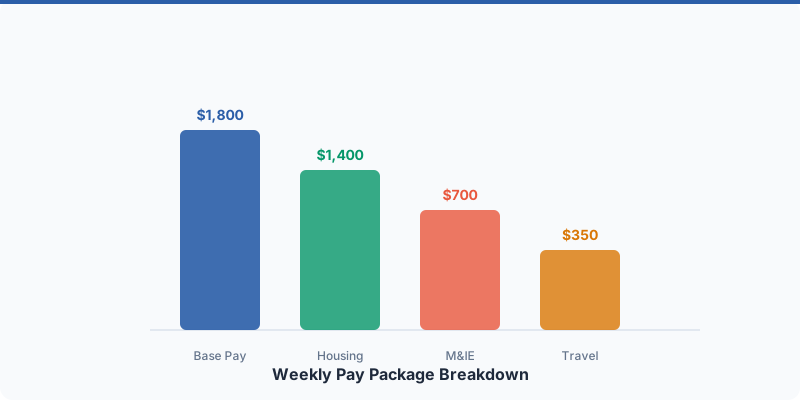
Agency travel nurse pay typically includes:
- Taxable hourly wage: $25 to $45/hour (varies by specialty, location, and market conditions)
- Tax-free housing stipend: $1,400 to $3,000/month (based on GSA rates for the assignment location)
- Tax-free meals and incidentals stipend: $400 to $1,000/month
- Travel reimbursement: $500 to $1,000 per assignment (varies by agency)
- Overtime: typically 1.5x your hourly rate after 40 hours/week
- Completion bonus: some contracts include a bonus ($500 to $2,000) for completing the full assignment
Total weekly pay range: $1,800 to $3,500+ depending on specialty, location, and market conditions. For a detailed breakdown of how to evaluate these packages, see our pay comparison guide.
The key financial advantage of agency travel is the tax-free stipend structure. When you maintain a valid tax home, a significant portion of your compensation is received tax-free, which dramatically increases your effective take-home pay.
Internal Travel Nurse Pay
Internal travel nurse pay structures vary significantly by health system, but generally include:
- Higher taxable base hourly rate: $40 to $70/hour (typically higher than agency base rates because there is less or no stipend component)
- Stipends: Some internal programs offer housing and M&IE stipends similar to agency programs. Others roll everything into the hourly rate with no separate stipend. This varies widely.
- Overtime: 1.5x or 2x base rate (some systems offer better overtime premiums than agencies)
- Shift differentials: night, weekend, and holiday differentials are often included (agencies may or may not offer these)
- No agency markup: Because there is no staffing agency taking a cut, the hospital can theoretically pass more money to you. However, this does not always happen in practice.
Total weekly pay range: $1,600 to $3,200+ depending on the system, specialty, and location.
The Real Comparison: A Side-by-Side Example
Let us compare a Med-Surg travel nurse in a mid-size city with two years of experience:
Agency Travel Nurse:
- Taxable hourly: $28/hour x 36 hours = $1,008/week
- Housing stipend: $1,800/month ($450/week)
- M&IE stipend: $700/month ($175/week)
- Total weekly: $1,633
- Taxes on $1,008/week (estimated 22% effective): -$222
- After-tax weekly income: $1,411
- Annual after-tax (48 working weeks): $67,728
Internal Travel Nurse:
- Taxable hourly: $52/hour x 36 hours = $1,872/week (no separate stipend)
- Total weekly: $1,872
- Taxes on $1,872/week (estimated 25% effective — higher bracket because all income is taxable): -$468
- After-tax weekly income: $1,404
- Annual after-tax (48 working weeks): $67,392
In this example, the after-tax income is remarkably similar even though the gross pay structures look very different. The agency nurse earns less in gross pay but keeps more because of tax-free stipends. The internal nurse earns more gross but pays more in taxes.
However, this calculation shifts if:
- The internal program also offers stipends (some do), making it clearly superior
- The agency nurse does not maintain a valid tax home (no stipend tax advantage)
- The internal program offers significantly better benefits that have real financial value
For help reading and comparing pay stubs, see our pay stub guide.
Benefits Comparison: Where Internal Travel Often Wins
Benefits are where internal travel programs frequently outshine agency arrangements. The value of superior benefits can be worth thousands of dollars per year.
Health Insurance
Agency: Most agencies offer health insurance, but plans vary widely in quality. Some have high premiums, high deductibles, or limited networks. Waiting periods of 30 to 60 days are common, meaning you may have coverage gaps between assignments. See our health insurance guide and agency benefits comparison for details.
Internal travel: Hospital systems typically offer the same health insurance available to their full-time staff. These are often PPO or HMO plans with lower premiums, lower deductibles, broader networks, and better coverage than what agencies provide. Coverage often begins on day one or within 30 days, and there are no gaps between assignments because you remain continuously employed.
Financial impact: The difference between a good employer health plan and a mediocre agency plan can be $2,000 to $5,000+ per year in premiums and out-of-pocket costs.
Retirement Benefits
Agency: Some agencies offer 401(k) plans, but they often have waiting periods (60 to 90 days), limited or no employer match, and vesting schedules that mean you may never keep the match money. See our 401(k) guide.
Internal travel: Hospital system 401(k) or 403(b) plans typically include employer matching (often 3-6% of salary), shorter vesting periods, and sometimes immediate eligibility. Because you remain employed continuously, you build up contributions and vesting consistently.
Financial impact: A 4% employer match on a $100,000 salary is $4,000 per year in free money. Over a 10-year career, that is $40,000 plus investment growth — a significant wealth-building advantage. See our retirement planning guide for the full picture.
Paid Time Off
Agency: Most agency travel nurses receive no PTO. When you are not working, you are not earning. Gaps between assignments are unpaid.
Internal travel: Many internal programs offer PTO accrual, sometimes at accelerated rates. Earning 3 to 4 weeks of paid time off per year adds significant financial value — equivalent to $3,000 to $8,000+ depending on your hourly rate.
Other Benefits
Agency may offer: referral bonuses, continuing education reimbursement (varies), travel reimbursement.
Internal travel may offer: tuition reimbursement or student loan repayment assistance, continuing education allowances, employee discounts, employee assistance programs (EAP), disability insurance, life insurance, and access to hospital system perks.
Quantifying the Benefits Gap
When you add up the potential value of superior health insurance ($3,000/year savings), retirement matching ($4,000/year), PTO ($5,000/year value), and other benefits ($1,000-$2,000/year), internal travel benefits can be worth $10,000 to $15,000 per year over a typical agency arrangement.
This does not mean internal travel always pays more overall. But it means that comparing only the headline pay rate is misleading. You must factor in the total compensation package.
Tax Implications: The Stipend Question
The tax treatment of your income is one of the most important financial differences between agency and internal travel nursing.
Agency Travel Tax Advantage
Agency travel nurses who maintain a valid tax home receive a significant portion of their compensation as tax-free stipends. This can save $8,000 to $15,000+ in taxes annually compared to receiving the same total compensation as fully taxable wages.
However, this advantage comes with strings attached:
- You must maintain a valid tax home with real duplicated expenses
- You must meet IRS criteria and keep documentation
- If audited and found to have an invalid tax home, you owe back taxes plus penalties and interest
- The cost of maintaining a tax home (rent/mortgage, utilities) reduces the net benefit
See our complete stipend tax guide for the full picture.
Internal Travel Tax Situation
This depends entirely on the specific internal program:
Programs with stipends: Some hospital internal travel programs offer tax-free stipends similar to agency programs. If you are traveling to facilities outside your tax home area and maintaining a valid tax home, these stipends receive the same tax-free treatment. This gives you the best of both worlds — hospital benefits plus tax-free stipend income.
Programs without stipends: If the internal program rolls everything into your hourly rate, all of your income is taxable. You pay more in taxes, but you also have no tax home maintenance costs and no risk of a tax home audit.
Local assignments: If the internal program primarily assigns you to facilities within commuting distance of your home, you would not qualify for tax-free stipends anyway (you are not duplicating living expenses). In this case, the tax comparison is irrelevant.
PSLF Qualification Advantage
Here is a significant financial advantage that many nurses overlook: if the hospital system is a non-profit (501(c)(3)) or government entity, your employment as an internal travel nurse qualifies for Public Service Loan Forgiveness. Agency travel nurse employment through a for-profit staffing agency does not qualify.
For a travel nurse with $100,000+ in student loans, PSLF qualification could be worth tens of thousands of dollars in loan forgiveness. This alone can make internal travel at a qualifying hospital system more financially advantageous than higher-paying agency work.
Career Growth and Stability
Agency Travel
Flexibility: You choose your assignments, locations, and schedule. Maximum control over your career path.
Variety: You experience different facilities, EMR systems, patient populations, and practice environments. This broadens your clinical skills.
Instability: Every 13 weeks, you may need to find a new assignment. Contract cancellations happen. There are gaps between assignments. No guaranteed employment continuity.
Career advancement: Limited. You are a contractor, not a team member. No promotions, no leadership roles, no internal career ladder at the facilities where you work.
Internal Travel
Stability: You are a permanent employee of the health system. Your employment continues between assignments. No gaps, no cancellations (or at least, much less common).
Consistency: You work within one health system, likely using the same EMR, following the same policies, and building relationships with the same leadership. This reduces the constant re-orientation stress of agency travel.
Career advancement: As an employee of the hospital system, you have access to internal career opportunities. Promotions to charge nurse, educator, or leadership roles may be available. Some systems allow internal travelers to transition to permanent positions at their preferred facility.
Less flexibility: You go where the system sends you. You may have some input on assignments, but you do not have the same level of choice as an agency traveler.
Which Is Better at Different Career Stages?
Early Career (1-3 Years of Travel Experience)
Internal travel may be better because:
- Consistent benefits from day one (health insurance, retirement matching)
- More support and orientation than agency assignments
- Stability while you build your financial foundation and emergency fund
- Easier transition from staff nursing — less administrative burden than managing multiple agencies
- If the system is a non-profit, you can start accumulating PSLF qualifying payments immediately
Agency may be better because:
- Higher potential pay if you are comfortable maximizing the stipend structure
- More variety to determine what specialty and setting you prefer
- Geographic flexibility to explore different parts of the country
Mid-Career (3-7 Years of Travel Experience)
This is the stage where agency travel often shines financially:
- You have the experience to command top pay rates
- You understand how to maintain a tax home and maximize stipend benefits
- You have built an emergency fund and can handle the instability
- You can negotiate stronger contracts
- You have the clinical confidence to hit the ground running at any facility
But internal travel is worth considering if:
- You want to focus on retirement savings with strong employer matching
- You are pursuing PSLF for large student loans
- You want work-life balance with guaranteed PTO
- You want to build toward a leadership position within a health system
Late Career (7+ Years, Approaching Retirement or Career Change)
Internal travel may be better because:
- Stable benefits and retirement contributions are more valuable as you approach retirement
- PTO allows you to take time off without income loss
- Career advancement opportunities within the system
- Less physical and emotional stress of constant transitions
- Health insurance stability is increasingly important as you age
Agency can still work if:
- You want maximum income in your final working years to boost retirement savings
- You enjoy the lifestyle and variety of agency travel
- You are pursuing FIRE and want to maximize your savings rate in your final working years
Making the Decision: A Framework
Ask yourself these questions:
-
What is my primary financial goal right now? If it is maximizing take-home pay, agency travel with a valid tax home likely wins. If it is building long-term wealth through benefits, internal travel may be better.
-
Do I have significant student loans? If yes, and the internal program is at a qualifying non-profit, the PSLF benefit could be worth more than any pay difference.
-
How much do I value stability? If contract cancellations and income gaps cause you significant stress, internal travel’s employment stability has real (if hard to quantify) value.
-
Am I disciplined about retirement savings? If you are the type who will invest consistently on your own, agency travel’s higher take-home pay works. If you benefit from employer auto-enrollment and matching, internal travel’s retirement benefits matter more.
-
Where in my career am I? Early career nurses benefit from internal travel’s structure. Mid-career nurses often maximize agency travel’s income. Late career nurses value internal travel’s stability and benefits.
-
What is my tax home situation? If you have a strong, well-documented tax home, agency travel’s tax-free stipends are a major advantage. If maintaining a tax home is burdensome or your situation is unclear, internal travel removes that complexity entirely.
The Hybrid Approach
You do not have to choose one model permanently. Many experienced travel nurses alternate between agency and internal travel based on their current priorities:
- Agency contracts when pay rates are high, during crisis periods, or when you want geographic flexibility
- Internal travel when you want stable benefits, PTO, or PSLF qualification
- Both simultaneously — some nurses maintain an internal travel position as their “home base” and take agency assignments during leaves or when internal assignment options are limited
The key is understanding the financial trade-offs of each model so you can choose strategically rather than defaulting to whatever you are most familiar with.
Key Takeaways
- Agency travel often provides higher take-home pay due to tax-free stipends, but only if you maintain a valid tax home
- Internal travel programs frequently offer superior benefits (health insurance, retirement matching, PTO) worth $10,000 to $15,000+ per year
- When you factor in benefits, the total compensation gap between agency and internal travel is often smaller than the headline pay rates suggest
- Internal travel at non-profit hospital systems qualifies for PSLF — agency travel through for-profit staffing agencies does not
- Internal travel provides employment stability with no gaps between assignments, reducing the need for a large emergency fund
- Agency travel offers maximum geographic flexibility and control over your assignment choices
- The best choice depends on your career stage, financial goals, student loan situation, and personal priorities
- Consider a hybrid approach: alternating between agency and internal travel based on your current priorities and market conditions
Frequently Asked Questions
Do internal travel nurses make less than agency travel nurses?
Not necessarily. While agency contracts may show higher total weekly pay, much of the difference disappears when you account for the tax advantage of stipends (which internal programs may also offer), the value of employer-paid benefits, retirement matching, PTO, and the absence of gaps between assignments. Run a total compensation comparison, not just an hourly rate comparison.
Can internal travel nurses receive tax-free stipends?
It depends on the program. Some hospital internal travel programs do offer tax-free housing and M&IE stipends when you are assigned to facilities outside your tax home area. Others incorporate everything into your hourly rate. Ask specifically about stipend structures before accepting a position with an internal program.
Is internal travel better for new travel nurses?
It can be. Internal travel offers more structure, consistent benefits, and employer support compared to the more independent agency model. New travel nurses benefit from working within a single health system while building their confidence and financial foundation. However, agency travel exposes you to more variety, which some new travelers prefer.
Can I switch between internal and agency travel?
Yes. There is no contractual or professional barrier to switching between models. Many experienced travel nurses alternate based on their current priorities. You can work an internal travel position for a year to build retirement savings and PSLF credits, then switch to agency travel for higher pay, and go back again whenever it makes sense.
Which type of travel nursing is better for retirement savings?
Internal travel programs with strong 401(k) or 403(b) matching and immediate vesting are generally better for retirement savings, because the employer match is essentially free money. However, a disciplined agency travel nurse who invests the higher take-home pay in a Roth IRA and taxable brokerage account can build wealth faster through sheer savings volume. The best approach depends on your discipline level and whether you will actually invest the difference.
Affiliate Placement Notes: Financial advisor referral for personalized total compensation comparison. High-yield savings account referral in the emergency fund and savings discussion. Investment platform referral in the retirement savings comparison section. Insurance comparison tool in the benefits section.
