
Travel Nurse Housing Guide: The Complete Handbook for 2026
Disclosure: Some links in this post are affiliate links. If you click through and make a purchase, we may earn a small commission at no extra cost to you. Learn more about how we make money.
Introduction: Housing Is the Biggest Challenge in Travel Nursing
Ask any experienced travel nurse what keeps them up at night between assignments, and the answer is almost always the same: finding housing. Not the clinical work. Not the credentialing. Housing.
It makes sense. You are trying to find a furnished, affordable, safe place to live in a city you may have never visited, on a timeline measured in weeks rather than months, all while wrapping up your current assignment or coordinating a cross-country move. The stakes are high, too. A bad housing situation can drain your stipend, add stress to your shifts, and turn what should be an exciting new chapter into a 13-week endurance test.
This guide is designed to fix that. Whether you are a first-time traveler trying to figure out where to even start, or a seasoned road warrior looking to sharpen your process, you will find everything you need here: the types of housing available, how to search efficiently, how to avoid scams, and how to set up a temporary home that actually feels livable.
Let us get into it.
Housing Stipend vs. Agency Housing: Which Is Right for You?
Before you start browsing listings, you need to make a fundamental decision: will you take your agency’s provided housing, or will you take the housing stipend and find your own place?
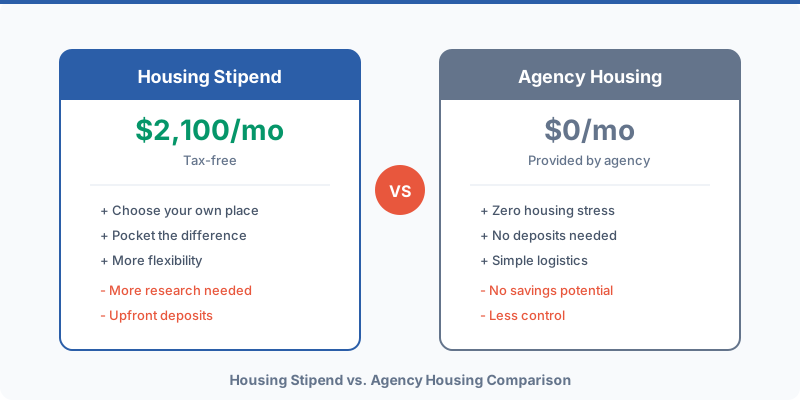
Agency housing means your staffing company finds and pays for your accommodation. You show up, and there is a place waiting for you. The trade-off is that you have little control over the location, quality, or roommate situation, and you miss out on the financial upside of pocketing the difference between a lower rent and a higher stipend.
Taking the stipend means you receive a tax-free housing allowance and find your own place. This is where most experienced travelers land because the savings can be substantial. If your stipend is $2,500 per month and you find housing for $1,500, you pocket $1,000 per month tax-free. Over a 13-week contract, that is roughly $3,250 in your pocket.
Agency housing often makes sense for your first assignment, in remote areas with limited rental inventory, or when you are starting on very short notice. But for most situations, taking the stipend and finding your own housing is the smarter financial play.
For a deeper breakdown of the math and strategy behind this decision, read our full guide on housing stipend vs. agency housing.
Types of Travel Nurse Housing
There is no single “best” type of housing for travel nurses. The right choice depends on your budget, your assignment location, your lifestyle preferences, and how much effort you want to put into the search. Here is an honest look at each option.
Furnished Apartments
Furnished apartments are the gold standard for many travel nurses. You get a real apartment with a full kitchen, a living space, a bedroom with a door, and in-unit or on-site laundry. It feels like home, which matters a lot when you are working 36 to 48 hours a week in a high-stress environment.
You can find furnished apartments through platforms like Furnished Finder , local property management companies, and sometimes through Facebook groups. Expect to pay anywhere from $1,200 to $2,800 per month depending on the city, with most mid-market assignments falling in the $1,400 to $2,000 range.
Pros: Home-like feel, full kitchen for meal prep, more space and privacy, often the best value for 13-week stays.
Cons: Availability varies by market, may require a lease agreement, furnishing quality can be inconsistent.
Extended-Stay Hotels
Extended-stay hotels are the easiest option. You book online or call the property, show up with your bags, and everything is handled: furniture, utilities, WiFi, housekeeping, parking. No lease, no utility setup, no landlord communication. It is a hotel, but with a kitchenette and a longer-term pricing model.
Popular chains include Extended Stay America, Residence Inn by Marriott, Homewood Suites by Hilton, Home2 Suites, and WoodSpring Suites. Monthly rates typically range from $1,800 to $3,500 depending on the brand and market.
Pros: Zero setup required, flexible cancellation, utilities and housekeeping included, loyalty points.
Cons: Smaller living space, kitchenettes can be limiting, more expensive than apartments in most markets, can feel impersonal for 13 weeks.
For a detailed breakdown of chains, rates, and how to negotiate the best price, see our extended stay hotel guide.
Airbnb and VRBO
Airbnb and VRBO offer a huge variety of furnished options, from private rooms to entire houses. The key for travel nurses is to filter for monthly stays, which unlocks significant discounts compared to nightly rates. Many hosts are accustomed to hosting healthcare workers and will negotiate further for a 13-week commitment.
Pros: Wide variety, fully furnished, many options in residential neighborhoods near hospitals, ability to read reviews.
Cons: Service fees and cleaning fees add up, host quality varies widely, cancellation policies can be strict, prices fluctuate with demand.
The trick with Airbnb is to always message the host before booking. Explain that you are a travel nurse on a 13-week assignment, ask about a monthly discount, and see if they will waive the cleaning fee for a long-term stay. You would be surprised how often they say yes.
For a head-to-head comparison, check out our Airbnb vs. extended stay hotel breakdown.
Furnished Finder
Furnished Finder is a housing platform built specifically for travel nurses and traveling healthcare professionals. Unlike Airbnb, there are no booking fees for tenants. You search by location, budget, and dates, then contact landlords directly. The landlords on this platform generally understand the 13-week lease model and are accustomed to working with healthcare travelers.
Pros: No booking fees for nurses, landlords understand travel nursing, flexible lease terms, growing inventory in most metro areas.
Cons: Limited listings in rural areas, no payment protection (you deal directly with landlords), quality varies.
We have a full Furnished Finder review with tips on how to use the platform effectively.
Room Rentals and Roommates
Sharing a house or apartment with another travel nurse is the most budget-friendly option. You can cut your housing costs by 40 to 60 percent, which means more of your stipend stays in your pocket. Many travel nurses find roommates through Facebook groups, Furnished Finder, or through their agency.
Pros: Cheapest housing option, built-in social connection in a new city, shared household responsibilities.
Cons: Less privacy, potential for lifestyle conflicts, need to vet your roommate carefully.
If you are considering this route, our travel nurse roommate guide covers how to find compatible roommates, set ground rules, and avoid common conflicts.
RV and Camper Living
A growing number of travel nurses are hitting the road in RVs, campers, and converted vans. The appeal is obvious: you take your home with you. No more housing searches, no more move-in days, no more adapting to someone else’s furniture. You just drive to your next assignment and plug in.
Pros: Eliminate the housing search entirely, consistent living environment, potential long-term savings, travel between assignments becomes an adventure.
Cons: Significant upfront investment ($15,000 to $80,000+), finding campgrounds or RV parks near hospitals can be difficult, maintenance and fuel costs, limited space.
If you are curious about the RV lifestyle, our RV travel nursing guide covers the practical details including costs, parking strategies, and how to find sites near medical facilities.
How to Search for Housing: Step-by-Step
Having a repeatable process takes the stress out of housing searches. Here is the approach experienced travelers use, assignment after assignment.
Step 1: Determine Your Budget
Start with your housing stipend amount and decide how much you want to spend versus how much you want to save. A common target is spending 50 to 70 percent of your stipend on housing and pocketing the rest. If your monthly stipend is $2,800, that means a housing budget of $1,400 to $1,960, with $840 to $1,400 going straight into savings each month.
Do not forget to account for utilities (if not included), parking, and renters insurance. Use our budget template to model different scenarios.
Step 2: Research the Assignment Area
Before you start browsing listings, get familiar with the area around your hospital. Use Google Maps to study neighborhoods within a 15 to 20-minute commute. Check crime statistics, read neighborhood reviews, and identify where the grocery stores, gyms, and parks are. Join local Facebook groups for insider knowledge, and ask in travel nurse forums whether anyone has worked at that facility before.
Use our cost of living tool to understand how far your stipend will stretch in different markets.
Step 3: Search Multiple Platforms Simultaneously
Do not rely on a single platform. Cast a wide net across Furnished Finder , Airbnb , VRBO , extended-stay hotel websites, Facebook housing groups, and Craigslist. Set up saved searches and alerts so you are notified when new listings match your criteria.
Step 4: Vet the Listing and Landlord
Every listing deserves verification before you send money. Do a reverse image search on listing photos, look up the address on Google Maps Street View, request a live video tour over FaceTime or Zoom, and check the landlord’s reviews. Our housing scams guide has a complete verification checklist.
Step 5: Negotiate the Rate
Monthly rates are almost always negotiable, especially for a 13-week commitment. Contact the landlord or host, explain you are a healthcare professional on a 3-month assignment, and ask for their best monthly rate. Ask whether utilities, WiFi, and parking can be included. If you are comparing multiple options, let them know you are considering alternatives.
Step 6: Secure the Housing
Once you have chosen your place, get a written agreement, even if it is informal. Understand the cancellation and early termination terms. Pay with a traceable method such as a credit card, check, or PayPal. Get a receipt for every payment.
Step 7: Document Everything Before Move-In
On your first day in the unit, take photos and video of every room, every piece of furniture, and any existing damage. Email this documentation to yourself and the landlord with a timestamp. This protects your security deposit and prevents disputes at move-out.
Timeline: Start your housing search four to six weeks before your start date. The best listings go fast, especially in competitive markets.
For the detailed version of this process, see our full article on how to find travel nurse housing.
What to Look for in Travel Nurse Housing
Not all furnished rentals are created equal. Here is a checklist of what matters most.
Proximity to your facility. Aim for a commute of 20 minutes or less. If you work night shifts, a shorter commute is even more important for safety and sleep quality.
Furnished with essentials. At minimum, you need a bed with clean linens, basic kitchen equipment (pots, pans, dishes, utensils), and access to laundry. Check whether towels and bedding are included, or if you need to bring your own.
Utilities included or estimated. “Utilities included” simplifies your budget. If utilities are separate, ask the landlord for an average monthly estimate so there are no surprises.
Reliable internet. You need decent WiFi for charting, telehealth, continuing education, and staying connected with family. Ask for a speed test result or the internet provider and plan details.
Parking. Confirm whether parking is included, and whether it is secure. If you work night shifts, well-lit parking matters.
Pet policy. If you travel with pets, confirm the pet policy and any associated fees upfront. See our pet-friendly housing guide for more options.
Cancellation terms. Contracts get cancelled. Assignments get shortened. Make sure you understand what happens to your lease if your contract falls through, and negotiate a healthcare-worker cancellation clause if possible.
Safety. Research the neighborhood. Check reviews, look at the area on Google Street View, and trust your instincts during a video tour.
For a printable version, grab our travel nurse housing checklist.
Avoiding Housing Scams
Travel nurses are prime targets for housing scams. You are searching remotely, on a tight timeline, and often willing to pay deposits without seeing the property in person. Scammers know this and exploit it.
The most common scams include fake listings with stolen photos, phantom landlords who do not actually own the property, and bait-and-switch setups where the actual unit looks nothing like the listing.
Key red flags:
- Price is significantly below market rate
- Landlord cannot do a live video tour
- Pressure to send money immediately
- Payment requested via wire transfer, cryptocurrency, or gift cards
- Listing photos that look too professional or do not match the neighborhood
Protect yourself: Always verify listings through reverse image searches and Google Street View. Request a live video tour. Never send money via untraceable methods. Use platforms like Furnished Finder that have landlord review systems.
For the full breakdown of scam types, verification steps, and what to do if you have been scammed, read our complete travel nurse housing scams guide.
Setting Up Your Temporary Home
Once you have secured your housing, it is time to make a temporary space feel livable. You do not need to fully decorate a 13-week rental, but a few small investments make a significant difference in your quality of life.
Bring from home: Your own pillow, a cozy blanket, photos or small items that feel personal, your preferred coffee setup, and basic toiletries and kitchen staples.
Consider investing in: A quality mattress topper (you will reuse it every assignment), blackout curtains for shift work sleep, a white noise machine , and a few portable organization solutions like over-the-door hooks and collapsible storage bins.
For a comprehensive packing and setup guide, see what to bring to a furnished rental and our portable furniture guide.
Housing Between Contracts
One of the trickiest logistics in travel nursing is what to do with your housing when one contract ends and the next begins. If your contracts overlap geographically, the transition is simple. But if you are moving across the country with a gap in between, you need a plan.
Overlapping contracts: If your next assignment starts within a week of your current one ending, you may have a few days of overlap where you are paying for two places. Budget for this and consider short-term options like an Airbnb or hotel for the transition days.
Gaps between contracts: If you take time off between assignments, you need somewhere to land. Many travel nurses maintain a tax home (a permanent residence they return to) that serves as their home base between contracts. Others stay with family or use the time to travel.
Storage: If you accumulate belongings beyond what fits in your car, consider a small storage unit in a central location or at your tax home. Monthly storage units run $50 to $150 depending on size and location.
Month-to-month leases are always preferable to fixed-term leases for travel nurses. They give you flexibility to leave when your contract ends without breaking a lease.
FAQ
How far in advance should I look for housing? Start four to six weeks before your assignment start date. In competitive markets like San Francisco, New York, or Boston, start even earlier. If you are assigned last-minute, focus on extended-stay hotels and Airbnb for the first week while you search for longer-term options locally.
Should I visit the housing before committing? In-person visits are ideal but rarely practical. A live video tour over FaceTime or Zoom is the next best thing. If the landlord refuses to do a video tour, that is a red flag.
What if my contract gets cancelled — am I stuck with a lease? This depends on your lease terms. Always negotiate a healthcare-worker cancellation clause that allows you to terminate with reasonable notice (14 to 30 days) if your contract is cancelled. Get this in writing before you sign.
How much of my stipend should I spend on housing? Aim to spend 50 to 70 percent of your housing stipend on actual housing costs. This allows you to pocket meaningful savings while still living comfortably. Use our budget guide to model your specific numbers.
Can I bring my family? Absolutely. Many travel nurses bring spouses, partners, children, and pets. You will need larger housing (two-bedroom apartments or houses), which costs more but is often still covered by your stipend in mid-range and lower-cost markets. Plan for school enrollment, childcare, and activities in the new city.
Key Takeaways
- Start your housing search early — four to six weeks before your assignment start date.
- Use multiple platforms to find the best option: Furnished Finder , Airbnb, VRBO, extended-stay hotels, and Facebook groups.
- Vet every listing with reverse image searches, video tours, and landlord reviews to avoid scams.
- Taking the stipend usually saves you money compared to agency-provided housing for most assignments.
- Negotiate — monthly rates are rarely the final price, especially for a 13-week commitment.
- Document everything at move-in with photos and video to protect your deposit.
Ready to start your search? Browse listings on Furnished Finder to find travel-nurse-friendly housing for your next assignment.
Related Internal Links
- Housing Stipend vs. Agency Housing
- Furnished Finder Review
- Airbnb vs. Extended Stay
- Travel Nurse Housing Scams
- What to Bring to a Furnished Rental
- How to Find Travel Nurse Housing
- Travel Nurse Roommate Guide
- Travel Nurse Housing Checklist
- Travel Nurse Budget & Save
- Cost of Living Tool
Affiliate Placement Notes
- Furnished Finder affiliate link in “Furnished Finder” section, Step 3, scams section, and key takeaways
- Extended stay hotel affiliate links in the hotel section
- Airbnb/VRBO referral link in the Airbnb section and Step 3
- Portable furniture/blackout curtain/white noise machine affiliate links in “Setting Up Your Temporary Home” section
