
Holiday Contract Pay for Travel Nurses: What to Expect and How to Negotiate
Disclosure: Some links in this post are affiliate links. If you click through and make a purchase, we may earn a small commission at no extra cost to you. Learn more about how we make money.
Introduction: The Holiday Pay Puzzle
Working holidays is one of the most financially lucrative decisions a travel nurse can make — if you know what to ask for, what to expect, and how to keep the IRS from taking a bigger bite than necessary. Holiday contracts routinely offer premium pay rates, completion bonuses, and shift differentials that can turn a single 13-week assignment into a windfall worth thousands of extra dollars.
But holiday pay for travel nurses is not as straightforward as time-and-a-half on Christmas Day. The structures vary wildly between agencies, between facilities, and between contract types. Some agencies build holiday premiums into your base rate. Others offer separate holiday bonuses. Some facilities pay double-time for the actual holiday shift and nothing extra the rest of the week. And the tax treatment of these various bonuses can catch you off guard if you are not prepared.
This guide breaks down exactly how holiday pay works for travel nurses, which holidays command the highest premiums, how to negotiate the best deal, and what the tax implications look like when that bigger paycheck arrives.
Disclaimer: This guide is for educational purposes only and does not constitute tax or financial advice. Consult a qualified CPA or tax professional for guidance on your specific situation.
How Holiday Pay Works for Travel Nurses
Holiday pay for travel nurses operates differently than it does for staff nurses. As a staff nurse, you typically have a clear holiday rotation policy, a defined premium rate in your union contract or employee handbook, and consistent expectations year to year. As a travel nurse, everything is negotiable and nothing is guaranteed unless it is written into your contract.
The Three Main Holiday Pay Structures
Structure 1: Holiday premium built into the contract rate. Some agencies offer “holiday contracts” that run during peak holiday periods (typically mid-November through early January, or around other major holidays). These contracts feature an inflated base hourly rate that already accounts for the fact that you will be working holidays. The advantage is simplicity — your pay rate is consistent across all shifts. The disadvantage is that you may not know exactly how much of your rate is “holiday premium” versus your standard rate, which makes comparison shopping between agencies harder.
Structure 2: Separate holiday shift differential. Many contracts pay your standard hourly rate for regular shifts and add a premium for actual holiday shifts. This premium might be time-and-a-half (1.5x your base rate), double-time (2x), or a flat dollar amount added per hour (commonly $10 to $25 per hour on top of your base). This structure is more transparent and allows you to calculate exactly what each holiday shift is worth.
Structure 3: Holiday completion bonus. Some agencies offer a lump-sum bonus for completing a contract that spans a holiday period. These bonuses typically range from $500 to $3,000 and are paid at the end of the contract contingent on working all scheduled holiday shifts. The bonus is appealing, but make sure you understand the conditions — missing even one required holiday shift can forfeit the entire bonus.
What “Working a Holiday” Actually Means
This is where confusion often arises. Different facilities and agencies define “working a holiday” differently.
The actual holiday day. Most commonly, holiday pay applies to the calendar date of the holiday itself. If Christmas falls on a Wednesday, you get premium pay for shifts worked on December 25.
The holiday window. Some facilities define a broader holiday period. For example, “Christmas holiday” might cover December 24 at 7:00 PM through December 26 at 7:00 AM. Any shift that falls partly or entirely within this window receives holiday pay. Always ask your recruiter or read your contract to understand the exact window definition.
Holiday observed vs. actual holiday. When a holiday falls on a weekend, the “observed” holiday shifts to Friday or Monday. Some contracts pay premium rates on the observed day, while others pay on the actual calendar date. A few pay on both. Clarify this before you sign.
Which Holidays Pay the Most?
Not all holidays are created equal when it comes to premium pay. Here is a general ranking based on typical travel nurse contract premiums, from highest to lowest.
Tier 1: Maximum Premium Holidays
Christmas Day (December 25) and New Year’s Day (January 1) consistently command the highest premiums. Holiday contract rates for assignments covering Christmas and New Year’s often run 20 to 40 percent higher than comparable non-holiday contracts. Crisis rates during acute holiday staffing shortages can push hourly rates even higher. It is not uncommon to see base rates of $60 to $80 per hour (or more in high-demand specialties like ICU and ER) for holiday assignments, compared to $45 to $55 for the same facility during non-holiday periods.
Thanksgiving (fourth Thursday in November) ranks alongside Christmas for premium pay. Many nurses are unwilling to work Thanksgiving, which drives rates up. Additionally, the Thanksgiving window often includes Black Friday, adding another premium shift opportunity.
Tier 2: Strong Premium Holidays
Christmas Eve (December 24) typically pays a premium, though usually slightly less than Christmas Day itself. New Year’s Eve (December 31) is similar — strong premium, but usually a step below New Year’s Day.
Labor Day, Memorial Day, and the Fourth of July offer solid premiums, typically time-and-a-half. These summer and early fall holidays are popular vacation times for staff nurses, which creates travel nurse demand. The premium is meaningful but generally lower than the winter holiday season.
Tier 3: Moderate Premium Holidays
Easter, Martin Luther King Jr. Day, Presidents’ Day, Veterans Day, and Columbus Day may or may not carry a premium depending on the facility and contract. Many hospitals treat these as “minor” holidays with smaller differentials or no additional pay. However, if staffing is tight at a particular facility, even these holidays can carry a bump.
The “Holiday Season” Premium
The real financial opportunity is not any single holiday — it is the entire November-through-January period. Many agencies offer “holiday contracts” or “winter contracts” that cover this entire stretch at elevated rates. The premium compensates for the expectation that you will work multiple holidays during the assignment. A well-negotiated holiday season contract can earn you $5,000 to $15,000 more than a comparable non-holiday contract over the same 13 weeks.
How to Negotiate Better Holiday Pay
Negotiation is where most travel nurses leave money on the table. Agencies expect you to negotiate, and the initial offer is rarely the best they can do — especially for holiday assignments when they are under pressure to fill positions.
Know Your Leverage
Your leverage is highest when the facility is desperate for holiday coverage and the assignment start date is approaching. Facilities typically begin filling holiday positions 8 to 12 weeks in advance. The closer you are to the holiday, the more urgency the facility feels and the more willing the agency is to improve the offer. However, waiting too long is risky — the position could be filled by someone else or cancelled entirely.
Specialty matters. ICU, ER, labor and delivery, and operating room nurses have the strongest negotiating positions for holiday assignments because these units cannot reduce staffing for holidays. Med-surg and telemetry nurses have more competition but also more volume of available positions.
Specific Negotiation Tactics
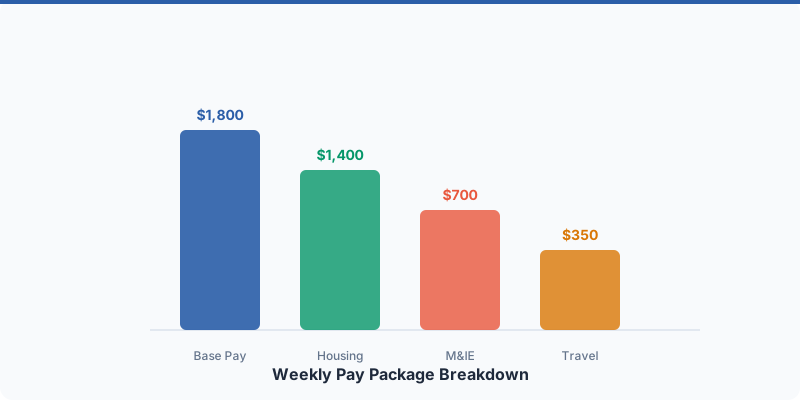
Ask for an itemized pay breakdown. Before negotiating, you need to see exactly how the holiday pay is structured. Request a breakdown showing base hourly rate, housing stipend, meals and incidentals stipend, travel reimbursement, holiday shift differential (if separate), and any completion bonuses. Without this breakdown, you cannot negotiate effectively. For more on reading pay packages, see our guide to comparing travel nurse pay packages.
Negotiate the base rate and the holiday differential separately. If the agency presents a blended rate, ask them to separate the components. Then push on each one individually. You might not get a higher base rate but could secure a better holiday differential, or vice versa.
Ask about holiday completion bonuses. Even if the initial offer does not include a completion bonus, ask if one is available. Many agencies have discretionary bonus budgets that they deploy when a nurse asks. A $1,000 to $2,500 completion bonus can be added to almost any contract if the agency wants to close the deal.
Use competing offers as leverage. If you have holiday contract offers from multiple agencies (which you should — always shop around), use them. You do not need to share specific numbers, but you can say, “I have a competing offer that is more competitive on the holiday differential. Can you match or improve on that?” Agencies expect this. For broader negotiation strategies, see our contract negotiation guide.
Negotiate guaranteed hours. Some holiday contracts come with reduced guaranteed hours (for example, 32 hours instead of 36) because the facility assumes census will drop around the holidays. Push for 36 guaranteed hours or, better yet, ask for overtime opportunities. Holiday overtime at time-and-a-half on top of an already elevated holiday rate is where the serious money is. Review our overtime pay guide for the details.
Request a specific holiday schedule in writing. Do not leave holiday assignments to chance. If you are accepting the contract specifically because of holiday premiums, get the holidays you are expected to work (and the premium rate for each) written into the contract. Verbal promises from recruiters do not hold up when schedules change.
What a Strong Holiday Contract Looks Like
Here is an example of a well-negotiated holiday season ICU contract (November through January):
- Base hourly rate: $55/hour (compared to $48/hour for non-holiday contracts at the same facility)
- Housing stipend: $2,200/week (non-taxable, assuming valid tax home)
- Meals and incidentals: $476/week (non-taxable)
- Holiday shift differential: Additional $20/hour for Thanksgiving, Christmas Eve, Christmas Day, New Year’s Eve, and New Year’s Day
- Completion bonus: $2,000 paid at contract completion
- Guaranteed hours: 36 per week
On this contract, a single Christmas Day 12-hour shift pays $75/hour ($55 base + $20 holiday), totaling $900 for the day before stipends. Over the full 13-week contract, the total compensation including stipends, holiday differentials, and completion bonus would be approximately $48,000 to $52,000.
Tax Implications of Holiday Pay and Bonuses
Higher holiday pay means a higher tax bill, and certain holiday pay structures have specific tax consequences you need to understand.
Holiday Differentials and Premium Pay
Holiday shift differentials and premium hourly rates are treated as regular taxable wages. They appear on your W-2 in Box 1 along with your standard hourly pay. There is no special tax treatment — it is simply more taxable income.
The catch: holiday premiums can push your weekly earnings into a higher withholding bracket. Your agency’s payroll system calculates withholding based on each pay period, and a week with significant holiday premium pay may be withheld at a higher rate than a normal week. This does not necessarily mean you owe more tax for the year (your annual tax liability is based on total annual income), but it can make your holiday paycheck look smaller than expected after withholding.
Holiday Completion Bonuses
Completion bonuses are classified as supplemental wages by the IRS. Employers can withhold federal income tax on supplemental wages at a flat 22 percent rate (for amounts under $1 million). This means your $2,000 completion bonus might arrive as approximately $1,560 after federal withholding, before state taxes and FICA.
Supplemental wage withholding is often different from your regular withholding rate. If your effective tax rate is lower than 22 percent, you will get the difference back when you file your return. If your effective rate is higher, you may owe additional tax. Work with a travel-nurse-savvy CPA to run the numbers before you spend the entire bonus.
Stipends Remain Non-Taxable
Here is the good news: your non-taxable stipends (housing, meals, incidentals) do not change during a holiday contract, assuming you continue to meet the tax home requirements. The holiday premium applies to your taxable hourly rate only. Your stipends remain tax-free regardless of what day you work.
Estimated Tax Payments
If your holiday earnings significantly increase your annual income, you may need to adjust your estimated tax payments to avoid underpayment penalties. Travel nurses who work multiple holiday contracts in a year should review their withholding and estimated payments in the fourth quarter. Our year-end tax planning guide covers this in detail.
State Tax Considerations
Holiday pay is taxed by the state where you physically performed the work. If your holiday assignment is in a state with high income tax (California, New York, New Jersey), your premium pay carries a proportionally higher state tax burden. Conversely, holiday assignments in states with no income tax (Texas, Florida, Nevada, Washington, Tennessee) let you keep more of that premium. This is worth factoring into your decision about where to work holidays.
Holiday Contract Red Flags
Not every holiday contract is a good deal. Watch for these warning signs.
Vague holiday pay language. If the contract does not specify exactly which holidays qualify for premium pay, the rate for each, and the hours that constitute the “holiday window,” get clarification in writing before signing.
Unrealistic guaranteed hours. Some facilities reduce staffing around holidays and offer contracts with 24 or 32 guaranteed hours. If you accepted the contract expecting 36-hour weeks, you could earn significantly less than projected.
All-or-nothing completion bonuses with strict conditions. A $3,000 completion bonus is great, but not if calling out sick for one shift forfeits the entire amount. Read the forfeiture conditions carefully.
Holiday contracts that extend well beyond the holiday period. A 13-week contract that starts in mid-October and ends in mid-January covers the holidays, but 8 of those 13 weeks are non-holiday weeks. Make sure the base rate compensates you fairly for the entire contract, not just the holiday weeks.
Verbal promises about holiday scheduling. If your recruiter says “you will probably only work two of the three major holidays,” that is not a guarantee. Get your holiday schedule in the contract or at minimum in a written addendum.
FAQ
Do all travel nurse agencies offer holiday pay?
Most agencies provide some form of holiday compensation, but the structure varies significantly. Some build it into the hourly rate for holiday-period contracts, others offer separate shift differentials, and some provide completion bonuses. Always ask for the specific holiday pay policy in writing before accepting a contract. Not all agencies are equally generous — compare offers from multiple agencies for the same facility to see the range.
Can I refuse to work a specific holiday on my travel nurse contract?
This depends on your contract terms. If your contract specifies that you will work certain holidays, refusing could be considered a breach of contract. However, most contracts require you to work “as scheduled by the facility,” which means the facility determines your holiday assignments. If working (or not working) a specific holiday is critical to you, negotiate it into the contract before signing. Once the contract is signed, your flexibility is limited.
Is holiday pay taxed differently than regular pay?
Holiday premium pay (higher hourly rates and shift differentials) is taxed as regular wages. Completion bonuses are classified as supplemental wages and may be withheld at the flat 22 percent federal supplemental rate. Your actual tax liability depends on your total annual income and tax bracket — the withholding rate is just an estimate. You may owe more or receive a refund when you file, depending on your full-year income picture.
When should I start looking for holiday contracts?
Start researching and contacting agencies about holiday contracts 10 to 14 weeks before the holiday season (late August to early September for Thanksgiving through New Year’s assignments). The best-paying holiday positions fill early. However, last-minute openings (2 to 4 weeks before the holiday) can sometimes offer even higher rates due to urgency. The trade-off is less choice in location and facility.
Are holiday contracts worth it financially?
For most travel nurses, yes. A well-negotiated holiday season contract can earn $5,000 to $15,000 more than a comparable non-holiday contract over the same period. The financial upside is clear. The trade-off is personal — working holidays means time away from family and friends during celebrations. Many travel nurses find that working one holiday season per year at premium rates funds significant financial goals while leaving future holidays free.
Key Takeaways
- Holiday pay structures vary widely between agencies and facilities. Always request an itemized breakdown showing base rate, holiday differential, stipends, and any completion bonuses before comparing offers.
- Christmas, New Year’s, and Thanksgiving consistently command the highest premiums, with holiday contract rates running 20 to 40 percent above non-holiday assignments.
- Negotiate aggressively for holiday contracts. Ask for higher base rates, separate holiday differentials, completion bonuses, guaranteed hours, and a written holiday schedule. Use competing offers as leverage.
- Understand the tax implications. Holiday premiums are taxed as regular wages, completion bonuses may be withheld at 22 percent, and your stipends remain non-taxable. Adjust estimated tax payments if holiday earnings significantly increase your annual income.
- Start early but stay flexible. Begin holiday contract searches 10 to 14 weeks out for the best selection, but know that last-minute openings can offer premium crisis rates.
Holiday contracts represent one of the clearest financial opportunities in travel nursing. With the right negotiation strategy and a clear understanding of how the pay and taxes work, you can turn the holiday season into a significant wealth-building period. Pair this with solid financial planning and smart budgeting, and those holiday premiums can fund your emergency fund, accelerate your retirement contributions, or pay down student loans faster than you thought possible.
Related Internal Links
- How to Compare Travel Nurse Pay Packages
- How to Negotiate a Travel Nurse Contract
- Travel Nurse Overtime Pay
- Travel Nurse Tax Home Guide
- Travel Nurse Tax Deductions
- Finding a Travel Nurse CPA
Affiliate Placement Notes
- Tax software affiliate links in the tax implications section
- CPA referral links where tax professional consultation is recommended
- Financial planning tool links in the key takeaways and closing section
- Pay calculator tool link in the negotiation example section
