
Travel Nurse Health Insurance: Complete Guide
Disclosure: Some links in this post are affiliate links. If you click through and make a purchase, we may earn a small commission at no extra cost to you. Learn more about how we make money.
Introduction
Health insurance is one of the most confusing parts of travel nursing. Unlike staff nurses who enroll in a single employer-sponsored plan and forget about it, travel nurses face a patchwork of coverage options that can change with every 13-week contract. Agency plans, ACA marketplace policies, short-term coverage, COBRA, health care sharing ministries — the list goes on, and the stakes are high. One serious illness or unexpected ER visit without coverage can wipe out months of hard-earned travel nurse pay.
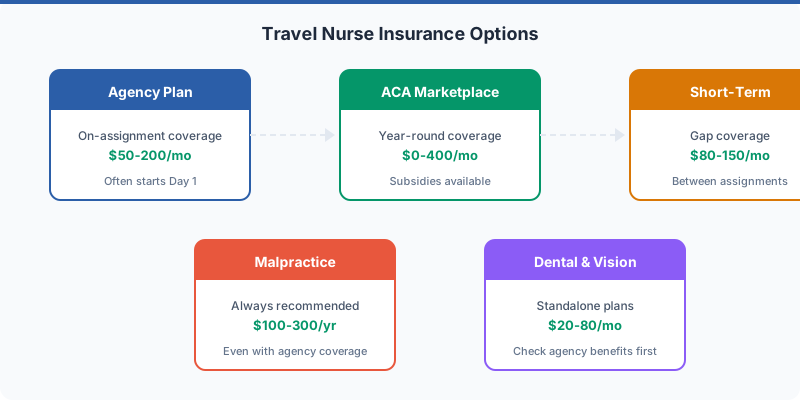
This guide breaks down every health insurance avenue available to travel nurses so you can pick the right coverage without overpaying. Whether you are just starting your first contract or you are a seasoned traveler rethinking your benefits strategy, you will find actionable information here.
This is educational content, not insurance or financial advice. Consult a licensed insurance professional for guidance specific to your situation.
Why Health Insurance Is Different for Travel Nurses
Staff nurses walk into HR on day one, pick a plan, and move on with their lives. Travel nurses do not have that luxury. Several factors make health insurance uniquely challenging for travelers.
Contract-based employment creates gaps. Most travel nurse contracts run 13 weeks. Between assignments, you may face days, weeks, or even months without employer-sponsored coverage. Each gap is a period of vulnerability that requires its own coverage strategy.
Agency plans come with trade-offs. Many agencies offer group health insurance, but taking it often means accepting a lower hourly rate. The agency factors insurance costs into your overall compensation package, so what looks like a “free” benefit is really coming out of your paycheck indirectly.
State residency gets complicated. When you work in three different states in a single year, figuring out which state’s marketplace to use, which provider networks apply, and how your tax home factors in requires careful planning. Your insurance needs to follow you across state lines.
Variable income affects subsidies. Travel nurse income fluctuates with contract availability, overtime, and stipend structures. Estimating your annual income for ACA subsidy purposes can be tricky, and getting it wrong means either leaving money on the table or owing money back at tax time.
Agency-Sponsored Health Insurance Plans
The most straightforward option for many travel nurses is the group health plan offered by their staffing agency. Here is what you need to know.
How agency plans work. Large staffing agencies — think AMN Healthcare, Aya Healthcare, CrossCountry Nurses, and similar companies — offer group health insurance to their travel nurses. Eligibility typically begins after a short waiting period, often on the first day of your assignment or after 30 days. Some agencies offer day-one coverage with no waiting period, which is a significant advantage.
What you will pay. Agency health insurance premiums for travel nurses typically range from $50 to $200 per week for individual coverage, depending on the plan tier and how much the agency subsidizes. Family coverage can run $200 to $500 per week. Keep in mind that many agencies present these as “low-cost” plans, but the real cost is partially embedded in your overall pay package.
Plan types. Most agencies offer a mix of HMO, PPO, and High Deductible Health Plans (HDHPs). PPO plans are generally the best choice for travel nurses because they offer out-of-network coverage, which matters when you are working in a different state every quarter. HMO plans can leave you stuck with a narrow network that does not extend to your assignment location.
The pay trade-off. This is the big decision every travel nurse faces. Agencies calculate your total compensation as a package. When you elect to take agency insurance, they reduce your hourly rate or stipend to cover their cost of providing that benefit. Some agencies are transparent about this, showing you a “with benefits” and “without benefits” pay rate. Others are less upfront. Always ask your recruiter to show you the difference so you can make an informed comparison.
Pros of agency insurance: Convenient enrollment, group rates, no medical underwriting, coverage starts quickly. Cons: Reduced pay, limited network portability, coverage ends when your contract ends, plan options may be limited.
ACA Marketplace Plans
For many travel nurses, an Affordable Care Act marketplace plan is the smartest financial move. Here is why.
Subsidy potential is significant. Travel nurse pay structures often include non-taxable stipends for housing and meals. Since ACA subsidies are based on your Modified Adjusted Gross Income (MAGI), and non-taxable stipends do not count toward MAGI, many travel nurses qualify for substantial premium tax credits. A nurse earning $100,000 in total compensation might have a MAGI of $60,000 to $70,000, putting them in a favorable subsidy range.
Open enrollment and Special Enrollment Periods. The annual open enrollment period for 2026 plans typically runs from November through mid-January. However, travel nurses have an additional enrollment pathway: losing agency-sponsored health coverage at the end of a contract triggers a Special Enrollment Period (SEP), giving you 60 days to enroll in a marketplace plan outside of open enrollment.
Choosing a plan state. You enroll through the marketplace for the state where you have your permanent tax home address. This keeps things consistent even as you travel. The key is choosing a PPO plan with a broad or national network so you can access providers in your assignment states. For a deeper dive, see our ACA Marketplace Plans for Travel Nurses guide.
Network matters most. When evaluating marketplace plans, network breadth is the single most important factor for travel nurses. A cheap HMO plan is worthless if none of its providers are in the state where you are actually working. Look for PPO plans, and verify that major hospital systems in your likely assignment areas are in-network.
Short-Term Health Insurance
Short-term health insurance plans are designed to fill temporary gaps in coverage. They can be useful for travel nurses in specific situations.
When short-term plans make sense. If you have a planned two-to-four-week break between contracts and you do not want to pay for a full ACA plan, a short-term plan can provide basic coverage at a fraction of the cost. Monthly premiums typically run $100 to $250 for individual coverage.
What they do not cover. Short-term plans are not required to cover ACA essential health benefits. That means they may exclude pre-existing conditions, prescription drugs, mental health services, and preventive care. They are catastrophic coverage — designed to protect you from a major accident or sudden illness, not to be your primary health plan.
State restrictions. Not every state allows short-term health insurance, and those that do may limit the duration. Some states cap short-term plans at three months, while others allow up to 12 months with renewal options. Check your state’s regulations before counting on this option.
Cost comparison. Short-term plans are typically 50 to 80 percent cheaper than COBRA and 30 to 60 percent cheaper than unsubsidized ACA plans. However, the lower cost reflects the limited coverage. For nurses with ongoing health needs or prescriptions, the savings may not be worth the risk.
Health Care Sharing Ministries
Health care sharing ministries are not insurance in the traditional sense. They are membership organizations where participants share each other’s medical costs.
How they work. Members pay a monthly “share” amount (typically $200 to $500 per month) into a pool. When a member has a medical need, other members’ shares are directed to help cover the cost. Popular ministries include Medishare, Christian Healthcare Ministries, and Samaritan Ministries.
Why some travel nurses choose them. The monthly cost is often lower than traditional insurance premiums, and some nurses appreciate the community aspect. There are no network restrictions, which is appealing for travelers.
Critical limitations. Sharing ministries can deny sharing for pre-existing conditions, may have annual or lifetime caps on coverage, and are not regulated like insurance. They do not guarantee payment of claims, and they typically exclude coverage for mental health, substance abuse, and sometimes maternity care. They also no longer satisfy the ACA individual mandate in states that still enforce one.
The bottom line. Sharing ministries can work for young, healthy travel nurses with minimal healthcare needs and an emergency fund to cover unexpected costs. But they carry real risk, and most financial advisors recommend traditional insurance when it is affordable.
COBRA Coverage for Travelers
COBRA allows you to continue your agency’s group health plan after your contract ends. It is a well-known option, but it is rarely the best one for travel nurses.
How COBRA works for travel nurses. When your agency contract ends and you lose your group health coverage, you have 60 days to elect COBRA continuation. This keeps you on the exact same plan with the same providers and network, but you pay the full premium (your share plus the agency’s share) plus a 2 percent administrative fee.
The cost reality. COBRA premiums for travel nurses typically range from $500 to $800 per month for individual coverage and $1,400 to $2,200 for family coverage. That is a steep price for gap coverage, especially when ACA marketplace plans with subsidies may cost a fraction of that amount.
The retroactive strategy. One smart approach: you have 60 days to elect COBRA and an additional 45 days to make your first payment. If you have a medical emergency during a gap, you can retroactively elect COBRA to cover the expense. This costs nothing if you stay healthy but provides a safety net if something goes wrong.
For a complete breakdown, see our COBRA for Travel Nurses guide.
Choosing the Right Plan: Decision Framework
With so many options, here is a practical framework for choosing the right health insurance.
Step 1: Assess your healthcare usage. Are you generally healthy with minimal prescriptions and doctor visits? Or do you have ongoing conditions, regular prescriptions, or planned procedures? Your expected usage drives which plan type makes financial sense.
Step 2: Model total annual cost. Do not compare monthly premiums alone. Calculate the total annual cost: (monthly premium x 12) + expected deductible cost + copays for anticipated visits. A plan with a $300 monthly premium and $1,500 deductible might cost less overall than a $150 plan with a $7,000 deductible if you use healthcare regularly.
Step 3: Verify network access. Whatever plan you choose, confirm that providers in both your tax home state and your anticipated assignment states are in-network. Call the insurance company directly — do not rely solely on online provider directories, which are often outdated.
Step 4: Factor in tax advantages. If you pair an HDHP with a Health Savings Account (HSA), you get a triple tax advantage: tax-deductible contributions, tax-free growth, and tax-free withdrawals for qualified medical expenses. For more on this, see our HSA vs. FSA guide for travel nurses.
Step 5: Consider your assignment pattern. If you take back-to-back contracts with minimal gaps, agency insurance may work fine. If you take extended breaks or work with multiple agencies, a personal ACA marketplace plan gives you uninterrupted coverage regardless of your employment status.
Frequently Asked Questions
What is the best health insurance option for travel nurses?
There is no single best option because it depends on your health needs, income, and assignment pattern. However, many experienced travel nurses find that a personal ACA marketplace PPO plan offers the best combination of affordability, continuity, and flexibility. With non-taxable stipends excluded from your MAGI, you may qualify for substantial premium tax credits that make marketplace plans very affordable. A personal plan stays active between contracts, eliminates enrollment gaps, and lets you negotiate a higher hourly rate by declining agency insurance.
Should I take my agency’s health insurance or buy my own?
Ask your recruiter to show you the pay difference with and without agency benefits. If declining agency insurance adds $3 to $5 per hour to your rate, multiply that by your expected hours to see the annual value. Compare that extra income to the cost of a personal ACA marketplace plan with subsidies. For many travel nurses, the higher pay from declining agency insurance more than covers the cost of a personal plan, and you gain continuity of coverage between contracts. However, if you have significant ongoing medical needs and the agency plan has excellent providers in your area, it may be worth taking.
How do I avoid health insurance gaps between travel nurse contracts?
Several strategies exist for every gap length and budget. Loss of agency coverage triggers a 60-day ACA Special Enrollment Period, so you can enroll in a marketplace plan at any time during the year. The COBRA retroactive enrollment strategy lets you hold the election notice as a free safety net and only pay if you need medical care during the gap. Short-term health plans cover planned breaks at $100 to $250 per month. The simplest approach is maintaining your own year-round ACA plan and declining agency insurance entirely.
Does travel nurse health insurance work across state lines?
It depends on your plan type. PPO plans allow you to see out-of-network providers at a higher cost, making them functional across state lines. HMO plans typically provide no out-of-network coverage except for emergencies, making them impractical for travel nurses. When buying a marketplace plan, choose a PPO with a broad or national network, ideally through carriers like Blue Cross Blue Shield, Cigna, or Aetna that have nationwide provider networks. Always verify provider access in your likely assignment states before enrolling.
Are health care sharing ministries a good alternative to traditional insurance for travel nurses?
Health care sharing ministries can work for young, healthy travel nurses with minimal healthcare needs and a solid emergency fund, but they carry significant risks. These programs are not insurance, are not regulated like insurance, and do not guarantee payment of claims. They commonly exclude pre-existing conditions, mental health services, maternity care, and prescription drugs. Most financial advisors recommend traditional insurance when it is affordable. Given that many travel nurses qualify for ACA subsidies that make marketplace plans very affordable, traditional insurance is usually the better choice.
Frequently Asked Questions
What is the best health insurance option for travel nurses?
There is no single best option because the right choice depends on your health needs, income, and assignment pattern. However, many experienced travel nurses find that a personal ACA marketplace PPO plan offers the best combination of affordability, flexibility, and continuity. Marketplace plans with subsidies can cost significantly less than agency insurance, they work across state lines, and they stay active between assignments. If you are generally healthy and want to maximize savings, pairing a Bronze HDHP with a Health Savings Account adds a powerful tax advantage on top of your coverage.
Should I take my agency’s health insurance or buy my own?
Ask your recruiter to show you the difference in hourly rate with and without health insurance. If declining agency coverage adds three to five dollars per hour to your rate, multiply that by your expected hours over the contract to see the annual value. Then compare that to the cost of a personal ACA marketplace plan, especially if you qualify for premium tax credits based on your MAGI. Many travel nurses find that declining agency insurance and purchasing their own plan results in higher take-home pay, better continuity of care, and fewer enrollment headaches between contracts.
How do travel nurses get health insurance between assignments?
Several affordable options exist for gap coverage. Losing agency insurance triggers a 60-day Special Enrollment Period on the ACA marketplace, allowing you to enroll in a comprehensive plan at any time of year. The COBRA retroactive enrollment strategy lets you hold your election notice as a free safety net and only elect coverage if a medical issue arises. Short-term health insurance plans provide basic catastrophic coverage for $100 to $250 per month. If you maintain a year-round personal ACA plan and decline agency insurance, gaps become a non-issue entirely.
Do I need a PPO or HMO plan as a travel nurse?
For travel nurses, a PPO plan is almost always the right choice. PPO plans allow you to see out-of-network providers at a higher cost but still with some coverage, which is critical when you are working in a different state every 13 weeks. HMO plans typically provide no out-of-network coverage outside of emergencies, meaning you could be paying premiums for a plan you cannot practically use at your assignment location. When shopping for plans, filter for PPOs and look for carriers with national networks like Blue Cross Blue Shield to ensure provider access wherever you travel.
Can travel nurses get health insurance through the ACA marketplace with subsidies?
Yes, and many travel nurses qualify for substantial premium tax credits. ACA subsidies are based on your Modified Adjusted Gross Income, which includes only your taxable wages and not your non-taxable stipends for housing, meals, and incidentals. A nurse earning $100,000 in total compensation might have a MAGI of $60,000 to $70,000, putting them in a favorable subsidy range. This can reduce a marketplace premium from $400 to $500 per month down to $50 to $200 per month, making ACA plans one of the most affordable coverage options available to travel nurses.
Key Takeaways
- Agency plans are convenient but may cost you in reduced pay. Always ask your recruiter to show you the pay difference with and without benefits.
- ACA marketplace plans offer subsidies that can dramatically lower costs. Your stipend structure may make you eligible for significant premium tax credits.
- Short-term plans work for gaps but are not comprehensive coverage. Use them for planned short breaks, not as your primary insurance.
- Always compare total annual cost, not just monthly premiums. Factor in deductibles, copays, and out-of-pocket maximums.
- Your best option depends on health needs, income, and assignment pattern. There is no single right answer — the best plan is the one that matches your specific situation.
- Never go uninsured. The financial risk of a single uninsured medical event far outweighs the cost of maintaining coverage. See our guide on covering insurance gaps between assignments for strategies.
Related Resources
- ACA Marketplace Plans for Travel Nurses (2026 Guide)
- COBRA for Travel Nurses: Is It Worth the Cost?
- HSA vs. FSA for Travel Nurses: Which One Works?
- How to Cover Insurance Gaps Between Assignments
- Travel Nurse Agency Benefits Comparison Guide
- How to Become a Travel Nurse
- Travel Nurse Tax Deductions
Affiliate Placement Notes
- Health insurance comparison tool widget after ACA Marketplace section
- Short-term health insurance provider links in Short-Term section
- Insurance broker/enrollment assistance CTA after Decision Framework
- Sidebar widget for insurance quote comparison tool
