
Travel Nurse Financial Planning: A Complete Money Roadmap

Disclosure: Some links in this post are affiliate links. If you click through and make a purchase, we may earn a small commission at no extra cost to you. Learn more about how we make money.
Introduction: Why Financial Planning Is Different for Travel Nurses
Travel nursing offers higher income potential than most staff positions, but it also introduces financial complexity that staff nurses rarely face. Variable income that changes every 13 weeks, tax-free stipends that come with strict compliance requirements, working across multiple states with different tax rules, and the absence of long-term employer benefits like pensions and consistent 401(k) matches — all of these factors mean you cannot just follow generic personal finance advice and expect good results.
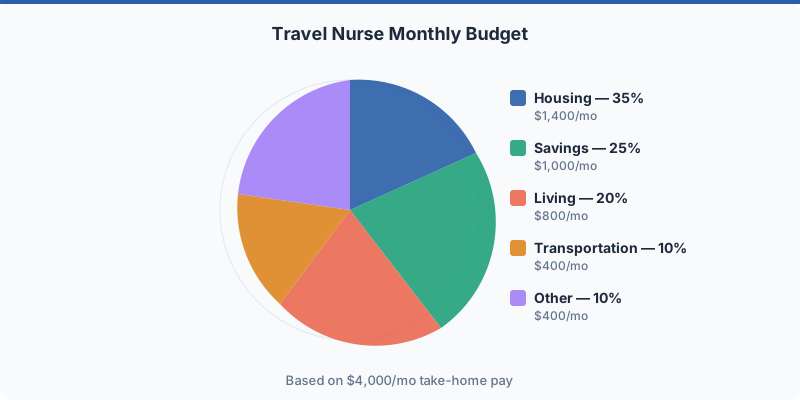
The travel nurses who build lasting wealth are the ones who treat their finances with the same professionalism they bring to patient care: systematically, proactively, and with a clear plan. The ones who struggle are often earning great money but flying blind — no budget, no tax strategy, no retirement plan, and no idea where the money goes each month.
This guide is your complete financial roadmap. It covers every major area of personal finance as it applies specifically to travel nurses, from the absolute basics (emergency fund, budget) through intermediate steps (debt payoff, retirement) to advanced strategies (investing, tax optimization). Follow the steps in order, starting with wherever you currently stand, and you will build a financial foundation that supports you throughout your career and beyond.
The Travel Nurse Financial Priority Ladder
Financial priorities should be tackled in a specific order. Each level builds on the one below it. Trying to invest before you have an emergency fund, or optimize taxes before you have a budget, is like building a house from the roof down. Here is the recommended sequence:
Level 1: Build a $1,000 starter emergency fund. This is your first buffer against unexpected expenses. It prevents a single car repair or medical bill from derailing your finances. Save this as fast as possible, even before addressing other goals.
Level 2: Set up your tax home properly. Your tax home is the foundation of your non-taxable stipend eligibility. Getting this wrong can result in thousands of dollars in unexpected tax liability. This is a compliance issue, not an optimization one — get it right immediately.
Level 3: Establish a budget and track spending. Without a budget, you have no idea whether you are making progress. Use our travel nurse budget guide to build a framework that accounts for your variable income and changing expenses.
Level 4: Build a full emergency fund of 3 to 6 months of expenses. Travel nursing carries more income volatility than staff positions. Contracts get cancelled, assignments end early, and gaps between contracts happen. A full emergency fund of $10,000 to $20,000 gives you the freedom to make career decisions without financial panic.
Level 5: Pay off high-interest debt. Credit card balances, personal loans, and any debt with interest rates above 8% to 10% should be eliminated aggressively. The guaranteed return of eliminating a 22% interest rate beats any investment.
Level 6: Start retirement savings. Open a Roth IRA, contribute to your agency’s 401(k) if it offers a match, and establish a consistent retirement contribution habit.
Level 7: Invest beyond retirement accounts. Once your retirement is on track, begin building a taxable investment portfolio for mid-term goals and additional wealth accumulation.
Level 8: Advanced strategies. LLC formation, real estate investing, passive income streams, and sophisticated tax optimization. These make sense only after the foundation is solid.
Follow this order because each level protects the levels above it. An emergency fund protects your debt payoff plan from derailment. A budget ensures your savings rate is sustainable. A proper tax home prevents surprise liabilities from eating into your investments.
Step 1: Get Your Tax Situation Right
Taxes are the single most consequential financial topic for travel nurses, and getting them wrong is expensive. Your non-taxable stipends for housing, meals, and incidentals are only non-taxable if you meet specific IRS requirements for maintaining a tax home.
Establish and maintain a tax home. A tax home is the general area of your main place of business or employment. For travel nurses, this typically means maintaining a permanent residence that you return to between assignments and where you incur real expenses (rent/mortgage, utilities). You need to demonstrate that you have a reason to travel away from this home for work, that you incur duplicate living expenses while on assignment, and that you return to your tax home regularly.
Understand taxable versus non-taxable income. Your hourly wage is always taxable. Your stipends (housing, meals, incidentals) are non-taxable if you have a legitimate tax home and are working temporarily away from it. If you do not have a proper tax home, these stipends become taxable income, and you could owe thousands in back taxes plus penalties.
Find a travel-nurse-savvy CPA. Generic tax preparers often do not understand travel nurse tax rules. A CPA who specializes in travel healthcare workers knows the specific documentation requirements, deduction opportunities, and compliance rules. This is not an area to economize — paying $300 to $500 for a knowledgeable CPA can save you thousands in properly claimed deductions and avoided mistakes.
Set up documentation systems. Keep records that support your tax home: lease or mortgage statements, utility bills at your permanent address, records of trips back to your tax home, and a log of the business reasons for your travel assignments. Maintain these throughout the year, not scrambled together at tax time.
Step 2: Build Your Budget
A budget tells your money where to go so you do not wonder where it went. For travel nurses, this means a flexible system that adapts to changing income and location-specific costs.
Use the three-bucket framework from our budget guide: fixed expenses (same every month), variable expenses (change by assignment location), and assignment-specific expenses (transition costs). Set a savings rate target of 20% to 30% of take-home pay, and track spending weekly rather than monthly.
The key budgeting insight for travel nurses is that your stipend creates a built-in savings opportunity. If your housing stipend is $2,000 per month and you find housing for $1,200, the $800 difference is money you can save or invest without changing your lifestyle. Multiplied across four assignments per year, that stipend gap alone can generate $9,600 in annual savings.
Use a budgeting app like YNAB for zero-based budgeting, or set up a simple spreadsheet. The tool matters less than the habit of checking it weekly and adjusting as needed.
Step 3: Emergency Fund and Safety Net
Your emergency fund is the financial shock absorber that keeps everything else on track. Without it, one unexpected expense — a car breakdown, a medical bill, a cancelled contract — forces you onto credit cards or into a bad assignment just to pay the bills.
Calculate your target. Add up three to six months of your essential expenses (housing, food, transportation, insurance, debt minimums). For most travel nurses, this is $10,000 to $20,000. If you have dependents or a mortgage, lean toward six months.
Where to keep it. A high-yield savings account earning 4% to 5% APY. Not invested in stocks, not locked in a CD, not sitting in a checking account earning nothing. Your emergency fund needs to be immediately accessible and completely safe from market fluctuations. See our best banks for travel nurses guide for account recommendations.
Build it fast with the stipend-saver strategy. If you are earning non-taxable stipends, route a significant portion of your stipend directly to your emergency fund savings account via automatic transfer. Since the stipend is often “bonus” money above your base wage, saving it feels less painful than saving from your taxable hourly pay.
Do not invest your emergency fund. This money exists for emergencies, and emergencies do not wait for the market to recover. Keep it in cash (or cash equivalent) where it is safe and liquid.
Step 4: Manage and Eliminate Debt
List every debt you have: student loans, car loans, credit card balances, personal loans, medical debt. For each one, note the balance, interest rate, and minimum monthly payment. This clarity alone is progress — many people carry debt they have not fully examined.
The avalanche method prioritizes paying off the highest-interest debt first while making minimums on everything else. This is mathematically optimal because it minimizes total interest paid.
The snowball method prioritizes paying off the smallest balance first, regardless of interest rate, to build momentum through quick wins. This is psychologically optimal because small victories keep you motivated.
Both methods work. Choose whichever one you will actually stick with. The worst debt payoff strategy is the one you abandon after two months.
Travel nurse income accelerates debt payoff. If you are earning more than you would as a staff nurse, direct the income difference toward debt. A travel nurse earning $1,500 per week more than a comparable staff position can throw $6,000 per month at student loans, eliminating $50,000 in debt in under a year. That math is life-changing.
When to refinance or consolidate. Refinancing makes sense when you can lower your interest rate by at least 1% to 2% without extending the repayment term. Be cautious about refinancing federal student loans into private loans — you lose access to income-driven repayment plans, Public Service Loan Forgiveness, and other federal protections. Only refinance federal loans if you are certain you will not need those options.
Step 5: Insurance and Protection
Insurance is not exciting, but it protects everything else in your financial plan from catastrophic loss.
Health insurance. Many agencies offer health insurance, but not all plans are equal. Compare your agency’s plan against marketplace options and your spouse’s plan (if applicable). Consider premiums, deductibles, network coverage in your assignment area, and prescription drug coverage.
Malpractice insurance. Most agencies carry malpractice coverage, but it protects the agency’s interests, not necessarily yours. A personal malpractice policy ($100 to $300 per year) provides dedicated coverage with your interests as the priority. This is a small cost for significant peace of mind.
Renter’s insurance. At $15 to $30 per month, renter’s insurance covers your personal belongings in your temporary housing. If your laptop, medical equipment, or personal items are stolen or damaged, this policy pays for replacement. Many policies also include liability coverage if someone is injured in your rental.
Auto insurance. Make sure your policy covers you in every state where you travel and that your coverage limits are adequate. Liability minimums in most states are dangerously low. Aim for at least $100,000/$300,000 in bodily injury coverage and $100,000 in property damage.
Disability insurance. This is the most overlooked insurance for nurses. Your ability to work is your most valuable financial asset. If an injury or illness prevents you from nursing, disability insurance replaces a portion of your income. Long-term disability policies are available individually or sometimes through your agency.
Step 6: Retirement Planning
Travel nurses face a unique retirement challenge: most agency 401(k) plans have limited or no employer match, and you may switch agencies multiple times throughout your career. This makes self-directed retirement savings essential.
Open a Roth IRA. This is the single best first retirement step for most travel nurses. Contributions are made with after-tax dollars, growth is tax-free, and withdrawals in retirement are tax-free. The annual contribution limit is $7,000 (2025-2026). A Roth IRA gives you a tax-free bucket that complements your current tax-free stipends.
Evaluate your agency’s 401(k). If your agency offers a 401(k) with an employer match, contribute at least enough to get the full match — it is free money. If there is no match, a Roth IRA or traditional IRA may be a better first option due to lower fees and more investment choices.
Contribution targets by age. A common guideline is to have one year’s salary saved for retirement by age 30, three times by 40, six times by 50, and eight to ten times by 60. If you are behind, travel nursing’s higher income gives you the opportunity to catch up faster than most professions.
Consolidate old 401(k) accounts. If you have 401(k) accounts scattered across multiple former employers or agencies, consolidate them into a single IRA for easier management and typically lower fees.
Step 7: Investing Beyond Retirement
Once your emergency fund is full, high-interest debt is eliminated, and retirement contributions are on track, it is time to invest additional money in a taxable brokerage account.
When to start. If you have completed Levels 1 through 6 of the priority ladder and still have money left over each month, you are ready for taxable investing.
Index fund investing. For most travel nurses, a simple portfolio of broad-market index funds (a total stock market fund and a total bond market fund, allocated based on your age and risk tolerance) provides diversified growth with minimal fees and minimal effort. You do not need to pick individual stocks or time the market.
Real estate considerations. Some travel nurses use their higher income to invest in rental properties, either at their tax home location or in affordable markets. Real estate can provide passive income and tax advantages, but it also requires capital, management effort, and tolerance for illiquidity. Consider this once you have a solid financial foundation, not before.
How to invest with variable income. Invest a fixed dollar amount each pay period (dollar-cost averaging) rather than trying to time lump-sum investments around contract cycles. Consistency matters more than timing.
Step 8: Advanced Financial Strategies
These strategies are for travel nurses with a solid financial foundation who want to optimize further.
LLC and S-Corp considerations. Some travel nurses explore forming an LLC or S-Corp for tax benefits. This can reduce self-employment taxes in certain situations, but the benefits depend heavily on your specific income, state of residence, and agency structure. Consult a CPA who specializes in travel healthcare before pursuing this. The setup and maintenance costs ($500 to $2,000 per year) only make sense if the tax savings exceed them.
Real estate investing while traveling. Managing rental properties remotely is possible with a good property manager. Some travel nurses buy properties at their tax home and rent them out while on assignment, building equity and passive income simultaneously. Others invest in real estate investment trusts (REITs) through their brokerage account for real estate exposure without the management burden.
Building passive income streams. Beyond real estate, consider side ventures that can generate income without your direct hourly labor: online courses for nursing students, per diem consulting, medical writing, or content creation about travel nursing. These take time to build but can diversify your income away from 100% W-2 nursing wages.
Working with a financial advisor. A fee-only financial advisor (one who charges a flat fee or hourly rate rather than earning commissions on products they sell you) can help you optimize your complete financial picture. Look for an advisor experienced with variable-income healthcare professionals. Expect to pay $200 to $500 per hour or $1,000 to $3,000 for a comprehensive financial plan.
Banking and Credit Optimization
Your banking setup and credit profile are the infrastructure that supports everything else in your financial plan.
Choose a travel-nurse-friendly bank. You need a bank with no ATM fees (or fee reimbursement), excellent mobile banking, and no issues with frequent address or state changes. Online banks generally serve travel nurses better than traditional local banks. See our best banks for travel nurses guide for specific recommendations.
Optimize credit card rewards. Your spending on gas, groceries, dining, and housing generates significant credit card rewards when channeled through the right cards. See our credit card guide for travel nurses and our guide on earning 100K+ points per year.
Maintain good credit. Pay every bill on time, keep credit utilization below 30% (ideally below 10%), and check your credit report annually for errors. Good credit (750+) saves you money on insurance, apartment approvals, and future loan rates.
Use a multiple bank account strategy. One checking account for daily spending, one high-yield savings for your emergency fund, one savings for your transition fund, and one for each major savings goal. This “envelope” approach to banking keeps your money organized and purpose-driven.
Financial Planning by Career Stage
First-Year Travel Nurse
Your priority: build an emergency fund, establish your tax home properly, and create a budget you actually follow. Do not try to optimize everything in year one. Focus on building the foundation — good financial habits formed now will compound for decades.
Common first-year mistakes: spending the entire stipend on housing (leaving nothing to save), not setting aside money for taxes, and failing to establish a real tax home before taking the first assignment.
Financial goal for year one: emergency fund fully funded, budget system in place, and retirement contributions started (even if modest).
2 to 5 Year Travel Nurse
Your priority: eliminate remaining debt, ramp up retirement savings, and begin investing beyond retirement accounts. You have established your financial systems and should be seeing real momentum in your savings and net worth.
This is the stage where career and financial diversification becomes important. Consider whether you want to travel long-term, transition to a staff role eventually, or pivot to a different nursing specialty. Each path has financial implications worth planning for.
Experienced Travel Nurse (5+ Years)
Your priority: advanced tax strategies, real estate or passive income, and potentially transition planning. If you plan to continue traveling, focus on maximizing your earnings and investment returns. If you are considering transitioning to a staff role or retiring, begin planning for the income change at least one to two years in advance.
Estate planning basics (will, healthcare directive, beneficiary designations) become important as your wealth grows. These documents ensure your assets are distributed according to your wishes and that someone you trust can make decisions on your behalf if you are unable to.
Annual Financial Checkup Checklist
Once per year, ideally in January or during a break between assignments, run through this checklist:
- Review tax home status. Confirm that your tax home is properly maintained and documented.
- Update your budget. Adjust for any changes in fixed costs, savings goals, or lifestyle choices.
- Rebalance your investment portfolio. Ensure your asset allocation still matches your age and risk tolerance.
- Review insurance coverage. Confirm that health, malpractice, renters, auto, and disability coverage are current and adequate.
- Check your credit report. Pull your free annual reports from all three bureaus and dispute any errors.
- Meet with your CPA for tax planning. Do not wait until April. Proactive tax planning in January can save you money and reduce stress.
- Evaluate retirement savings progress. Are you on track for your retirement targets? If not, increase contributions.
- Set financial goals for the coming year. Specific, measurable targets give you something to work toward.
FAQ
Where should I start if I have never done financial planning?
Start with Level 1 of the priority ladder: save $1,000 in a starter emergency fund. This can be done in a few weeks by setting aside a portion of each paycheck. Then move to Level 2 — ensure your tax home is properly established. Then create a budget using the framework in our budget guide. These three steps take a few hours of setup and provide the foundation for everything else. Do not try to tackle investing, tax optimization, or retirement planning until these basics are in place. A solid foundation built in weeks will serve you far better than a complicated plan you never follow through on.
How do I plan financially with income that changes every 13 weeks?
Budget based on your lowest expected contract rate, not your highest or average. This ensures you live within your means during any assignment. When higher-paying contracts come along, send the difference straight to savings or debt payoff rather than inflating your lifestyle. Maintain a “gap fund” (part of your emergency fund) that covers expenses during breaks between assignments. Some travel nurses take one to two weeks off between contracts, and having money set aside for those gap periods removes the pressure to accept the first contract offered regardless of pay or location. Use our pay calculator to evaluate each contract offer accurately before comparing it to your budget.
Do I need a financial advisor?
Most travel nurses can handle Levels 1 through 6 of the priority ladder on their own with the guidance in this article and our related guides. A financial advisor becomes most valuable at Levels 7 and 8, when you are investing significant amounts, considering an LLC or S-Corp, or managing complex tax situations across multiple states. If you do hire an advisor, choose a fee-only fiduciary — someone legally required to act in your best interest and who charges transparent fees rather than earning commissions on financial products. Expect to pay $200 to $500 per hour for quality advice. A one-time comprehensive financial plan ($1,000 to $3,000) can provide a roadmap you follow for years.
How much should I save versus enjoy life?
This is ultimately a personal question, but a useful framework is the 70/20/10 split: 70% of take-home pay for living expenses (including fun and entertainment), 20% for savings and debt payoff, and 10% for giving or additional goals. If you can stretch to a 60/30/10 split, your wealth will grow significantly faster. The key is to budget for enjoyment intentionally rather than accidentally. Build dining, travel, entertainment, and experiences into your budget as real line items. Cutting all discretionary spending is a recipe for burnout and budget abandonment. The nurses who sustain long-term savings habits are the ones who budget for both financial goals and lifestyle satisfaction.
What is the biggest financial mistake travel nurses make?
Failing to maintain a legitimate tax home. If the IRS determines that you do not have a proper tax home, all of your non-taxable stipends become taxable income. On a typical travel nurse contract, stipends can total $20,000 to $30,000 or more per year. If reclassified as taxable, that could mean an additional $5,000 to $10,000 in federal and state taxes, plus penalties and interest. This single mistake can wipe out the financial advantage of travel nursing entirely. Establish your tax home before your first assignment, maintain it throughout your career, and keep thorough documentation. A travel-nurse-savvy CPA is worth every penny for guidance on this issue.
Key Takeaways
Follow the financial priority ladder in order. Each level builds on the one below it, and skipping steps creates a fragile financial structure. Tax home and budget are the non-negotiable foundation — get these right before worrying about anything else.
Build your emergency fund before investing. Automate your savings so you are paying yourself first on every paycheck. Review your financial plan annually and adjust as your career evolves, your income changes, and your goals shift.
The best time to start financial planning was the day you began travel nursing. The second best time is today. Pick the first level on the priority ladder that you have not completed, and start there.
Related Internal Links
- Travel Nurse Budget Guide
- Best Banks for Travel Nurses
- Best Credit Cards for Travel Nurses
- How to Earn 100K+ Points as a Travel Nurse
- Pay Calculator
Affiliate Placement Notes
- Financial advisor referral link in Step 8 and FAQ
- Budgeting app affiliate links in Step 2
- Investment platform affiliate links in Steps 6 and 7
- High-yield savings affiliate link in Step 3
- Credit card affiliate links in banking optimization section
