
Travel Nurse Financial Checklist: Before Your First Assignment

Disclosure: Some links in this post are affiliate links. If you click through and make a purchase, we may earn a small commission at no extra cost to you. Learn more about how we make money.
Get Your Finances Right Before Day One
Your first travel nursing assignment is exciting. New city, new hospital, bigger paychecks, and the kind of professional freedom most nurses only dream about. But here is what separates the travel nurses who build real wealth from the ones who earn great money and have nothing to show for it: financial preparation before the assignment starts.
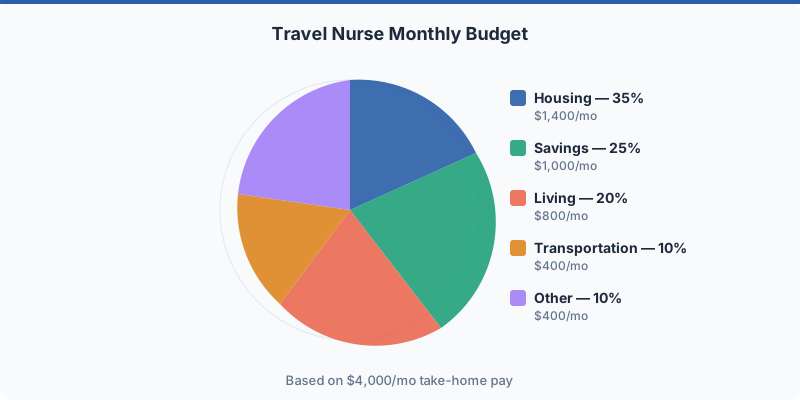
The financial setup you do in the weeks before your first contract determines everything — whether your stipends are structured correctly, whether your banking works seamlessly on the road, whether you are maximizing your tax advantages, and whether you are actually saving the money that makes travel nursing worth the lifestyle trade-offs.
This checklist is designed for your first assignment, but seasoned travel nurses should revisit it before every new contract. Your circumstances change, your assignment locations change, and the financial details that matter shift accordingly. Bookmark this page and come back to it every 13 weeks.
4 to 6 Weeks Before Your Start Date
This is the foundation phase. The tasks here take the longest to complete and have the biggest impact on your financial health throughout the assignment.
Banking Setup
Open a no-fee checking account with nationwide ATM access. If your current bank charges fees for out-of-network ATMs or has limited branch access, switch to one that works everywhere. Online banks like those featured in our best banks for travel nurses guide typically offer free ATM access nationwide, no monthly fees, and excellent mobile apps. You will be relying heavily on mobile banking, so app quality matters.
Open a high-yield savings account for your emergency fund. This should be at a different institution than your checking account. The slight friction of transferring money between banks helps you resist the urge to dip into savings for non-essentials. Current high-yield accounts offer 4% to 5% APY — read our high-yield savings guide for top picks.
Set up mobile deposit and verify it works. Do a test deposit before you leave. The last thing you want on your first week in a new city is to discover your bank’s mobile deposit is not functioning.
Consider a separate account for stipend tracking. Some travel nurses find it helpful to have their stipends deposited into a separate account from their taxable wages. This makes tax time simpler and helps you track whether you are spending your stipends on their intended purposes (housing, meals, and incidentals). Your CPA will thank you.
Credit Card Strategy
Apply for a rewards credit card. If you do not already have a strong rewards card, now is the time to apply. Your relocation spending — gas for the drive, furnishing your new place, stocking the kitchen, buying work supplies — makes it easy to hit sign-up bonus spending thresholds. A well-timed application before a new assignment can net you $500 to $1,000 in bonus rewards. See our best credit cards for travel nurses for current top picks.
Set up autopay on all existing credit cards. At minimum, set autopay for the minimum payment. This guarantees you never miss a payment during the chaos of relocating. You can always pay more manually, but autopay is your safety net for your credit score.
Check your credit score and dispute any errors. Pull your free credit report at annualcreditreport.com and review it for inaccuracies. Landlords and property managers will check your credit when you apply for housing, so you want your report clean before you start apartment hunting.
Insurance Review
Confirm health insurance coverage. Verify whether your agency provides health insurance and when coverage begins. Some agencies have waiting periods of 30 to 90 days. If there is a gap, look into short-term health insurance or ACA marketplace plans. Make sure your coverage works nationwide, not just in your home state — this catches a lot of new travel nurses off guard. Our health insurance guide breaks down all your options.
Set up or review renter’s insurance. Most furnished rentals and extended stay hotels do not cover your personal belongings. A renter’s insurance policy costs $15 to $30 per month and protects your laptop, nursing gear, and personal items. Some policies are portable and follow you from assignment to assignment.
Review auto insurance. Contact your auto insurance provider and let them know you will be living in a new state. Your rates may change based on the assignment location, and some states require different coverage minimums. Also update your commute distance if it changes significantly.
Consider disability and life insurance. If your agency does not provide these, they are worth considering on your own. As someone whose income depends entirely on your ability to work, disability insurance is arguably more important than any other type of coverage.
2 to 4 Weeks Before Your Start Date
With the foundational accounts set up, it is time to focus on tax strategy, budgeting, and retirement.
Tax Preparation
Understand tax home rules. This is the single most important tax concept for travel nurses. Maintaining a legitimate tax home is what allows your housing and meals stipends to be tax-free. If you do not maintain a tax home, those stipends become taxable income, and your effective pay drops significantly. Read our tax home guide and strongly consider working with a CPA who specializes in travel nursing.
Research state income tax in your assignment state. Some states have no income tax (Texas, Florida, Nevada, Washington, and a few others). Others have high income taxes that will reduce your take-home pay. This should factor into your contract decisions. Our pay calculator accounts for state tax differences.
Set up a system for tracking deductible expenses. Mileage between your tax home and assignment locations, licensing fees, continuing education costs, professional memberships, scrubs, and stethoscopes may all be deductible. Start a simple spreadsheet, use a mileage tracking app, or create a dedicated folder (physical or digital) for receipts. The nurses who save the most on taxes are the ones who track everything from day one.
Determine whether you need to make estimated tax payments. Depending on your pay structure and withholdings, you may need to make quarterly estimated tax payments to the IRS to avoid underpayment penalties. Your CPA can advise on this, but it is better to set it up proactively than to get hit with a penalty at tax time.
Budget Planning
Calculate your expected take-home pay. Break down your contract offer into its components: taxable hourly rate, housing stipend, meals and incidentals stipend, travel reimbursement, and any overtime or bonus potential. Use our pay calculator to see your actual take-home numbers after taxes. Many travel nurses overestimate their take-home pay because they do not account for taxes on the hourly rate portion.
Research costs in your assignment city. Housing costs vary wildly between assignment locations. So do groceries, gas, and general cost of living. Spend 30 minutes researching what you will actually spend in your new city before you build your budget. Our cheapest cities guide can help with this research.
Build a contract-specific budget. Do not use the same budget from your last assignment. Every contract has different pay, different housing costs, and different cost-of-living factors. Download our travel nurse budget template and fill it out specifically for this contract.
Set savings goals for this assignment. Be specific. “I want to save money” is not a goal. “I will save $4,000 toward my emergency fund and contribute $1,500 to my Roth IRA during this 13-week contract” is a goal. Write it down and track your progress weekly.
Retirement and Savings
Open or fund a Roth IRA. If you do not have a Roth IRA, open one before your first assignment. Travel nurse income is ideal for Roth contributions because you can take advantage of high earning years to make after-tax contributions that grow tax-free forever. The 2026 contribution limit is worth maxing out if you can afford it. Our retirement planning guide covers this in detail.
Check if your agency offers a 401(k). Some agencies offer 401(k) plans, though vesting schedules and match percentages vary significantly. Understand the terms before you contribute — if you are likely to leave the agency before vesting, the match may not actually benefit you.
Set up automatic retirement contributions. Whether it is a Roth IRA or a 401(k), automate your contributions so they happen every pay period without requiring a decision. Even $100 per paycheck adds up to $2,600 per year, and compound growth does the heavy lifting over time.
Review your emergency fund. Is it at your target amount? If not, building it should be a priority during this contract. Read our emergency fund guide for strategies to build it fast.
1 Week Before Your Start Date
The final week is about logistics and making sure nothing slips through the cracks.
Final Financial Setup
Update your address with your bank, credit cards, and insurance. Even if you are keeping your tax home address as your primary, make sure your financial institutions know how to reach you. Some banks flag transactions in unfamiliar states as fraud, so calling ahead prevents your card from being declined during your first grocery run.
Notify your bank of travel to the new state. This is a quick phone call or app setting that prevents fraud holds on your cards. Tell them the state, the dates, and that you will be there for approximately 13 weeks.
Set up direct deposit with your agency. Confirm the routing and account numbers are correct and ask when you can expect your first paycheck. Some agencies pay weekly; others pay biweekly. Know the schedule so you can plan your cash flow.
Download cashback apps for the new city. Coverage varies by location. Set up Ibotta, Rakuten, and gas rewards apps before you start spending in the new city so you capture rewards from day one.
Expense Tracking
Start a mileage log for the drive to your new assignment. If you are driving from your tax home to your assignment location, that mileage may be deductible. Log it from the moment you leave. Use a mileage tracking app or simply note the odometer reading.
Save receipts for all moving and travel expenses. Gas, tolls, hotels during the drive, meals on the road — save everything. Some of these may be deductible, and your travel reimbursement may not cover all of them.
Set up a simple expense tracking system. Whether you prefer an app, a spreadsheet, or a notebook, pick one method and use it consistently. The system that works is the one you actually use. Review your spending weekly for the first month until you have a clear picture of your new cost structure.
Ongoing Financial Maintenance During Your Contract
Financial setup is not a one-time event. Build these habits into your routine throughout every assignment.
Review your budget weekly for the first month, then biweekly. Your initial budget is an estimate. Real spending data will reveal where you over- or under-estimated. Adjust accordingly.
Check credit card statements monthly for errors or fraud. Travel nurses are slightly higher targets for fraud due to frequent location changes and online transactions. A quick monthly review catches problems early.
Monitor your credit score quarterly. Use Credit Karma or your bank’s free score tracker. Watch for unexpected changes that could indicate errors or identity theft.
Adjust savings contributions if your income changes. Overtime, bonuses, and shift differentials can significantly change your take-home pay. When income goes up, increase your savings rate rather than your spending.
Start researching your next assignment’s financial picture 4 weeks before your current contract ends. Look at housing costs, state income tax, and cost of living in potential next locations. Run the numbers through our pay calculator before accepting a contract.
Before Your Contract Ends
Review your lease and move-out requirements. Know your exact end date, any cleaning requirements, and the timeline for getting your security deposit back.
Calculate your total savings and earnings for this assignment. Compare your actual numbers to your goals. Did you hit your savings target? Where did you overspend? This review makes your next assignment’s budget more accurate.
Update your budget template for the next contract. Carry forward what you learned. If you consistently overspent on dining, adjust that category. If you spent less on gas than expected, revise downward.
Roll over or consolidate retirement accounts if switching agencies. If you are leaving an agency with a 401(k), decide whether to roll it into an IRA or leave it in place. Do not cash it out — the penalties and tax hit are not worth it.
Key Takeaways
- Financial preparation before your first assignment saves stress and money. The nurses who struggle financially are almost always the ones who skipped the setup phase.
- Set up banking, insurance, and taxes 4 to 6 weeks before your start date. These take time and cannot be rushed.
- Build a contract-specific budget and savings plan for every assignment. No two contracts have the same financial profile.
- Track all expenses and receipts for tax deductions. What you do not track, you cannot deduct.
- Review and refine your financial system after each contract. Your finances should get more efficient with every assignment.
Print this checklist, save it to your phone, or bookmark this page. Come back to it before every new assignment. The 30 minutes you spend on financial preparation will save you hours of stress and potentially thousands of dollars over the course of your travel nursing career.
Related Internal Links
- Travel Nurse Budget Template
- Best Banks for Travel Nurses
- Best Credit Cards for Travel Nurses
- Travel Nurse Emergency Fund
- Travel Nurse Retirement Plan
- Travel Nurse Tax Home Guide
Affiliate Placement Notes
- Banking affiliate links in the banking setup section
- Credit card referral links in the credit card strategy section
- High-yield savings links in the savings setup section
- Budgeting app links in the budget planning and expense tracking sections
