
How Travel Nurses Can Earn 100K+ Reward Points Per Year
Disclosure: Some links in this post are affiliate links. If you click through and make a purchase, we may earn a small commission at no extra cost to you. Learn more about how we make money.
Introduction: 100K Points Is Easier Than You Think
Most travel nurses can earn 100,000 or more credit card reward points in their first year with the right strategy. That is not a number reserved for finance professionals or credit card obsessives — it is achievable through a straightforward plan that takes advantage of spending patterns you already have.
What does 100K points actually get you? Depending on how you redeem them, 100,000 flexible points are worth roughly $1,000 to $2,000 in travel. That can mean two to four domestic round-trip flights, five to ten hotel nights at mid-range properties, one international economy ticket, or even a business class flight to Europe or Asia if you catch the right availability. Your work expenses, translated through a smart rewards strategy, become your vacation fund.
Travel nurses have a unique structural advantage in the points game. Your lifestyle involves exactly the kinds of spending that credit cards reward most: relocating every 13 weeks (high-spend transition periods that help you meet sign-up bonuses), consistent gas and grocery spending, hotel stays that earn both loyalty points and credit card points, and the financial discipline that comes with managing a contract-based career. This guide gives you the step-by-step blueprint to turn those advantages into 100K or more points per year.
Why Travel Nurses Earn Points Faster
Before we get into the strategy, it is worth understanding why travel nurses earn rewards faster than the average cardholder.
High spending during assignment transitions. Every time you start a new assignment, you spend money. Housing deposits, furniture or household items, kitchen supplies, new scrubs if the facility has specific requirements, and various setup costs. A single assignment transition can involve $2,000 to $5,000 in spending over two to three weeks. Most sign-up bonuses require $3,000 to $4,000 in spending within three months — you can hit that naturally just by starting a new assignment.
Consistent gas and grocery spending. Travel nurses spend more on gas than most people due to relocations and commuting in unfamiliar areas. Grocery spending is also consistent since eating out for every meal on a 13-week assignment gets expensive fast. These are both high-earning credit card categories (3x to 6x at many cards), making them significant point generators.
Extended-stay hotel spending. If you stay at chain hotels, you earn loyalty points from the hotel program and credit card points from your payment method simultaneously. A 13-week stay at $100 per night generates $9,100 in credit card spend and potentially 100,000 or more hotel loyalty points. See our hotel credit card guide for the full breakdown.
Multiple high-spend periods per year. Staff nurses have relatively stable, predictable spending. Travel nurses have three to four mini spending surges per year around assignment transitions. Each surge is an opportunity to meet a sign-up bonus or hit a spending threshold for additional rewards.
The 100K Points Blueprint
Step 1: Earn 60K to 80K From Sign-Up Bonuses
Sign-up bonuses are the single most efficient way to earn points. One card application, one period of spending you were going to do anyway, and you receive a lump sum of 60,000 to 80,000 points (or more). This single step gets you 60% to 80% of the way to your 100K goal.
Choose one to two cards with strong sign-up bonuses. Look for flexible points cards offering 60,000 to 80,000 points after spending $3,000 to $4,000 in the first three months. Premium cards sometimes offer 100,000 to 150,000 points with higher spending requirements ($5,000 to $6,000). For most travel nurses, one card with a 60K to 80K bonus is enough to anchor your first-year strategy.
Time your application with an assignment transition. Apply for the card two to four weeks before you relocate to a new assignment. Your moving expenses, housing setup costs, and early-assignment spending will naturally push you past the minimum spend threshold. This is the key move — you are not spending extra money, you are channeling spending you would do anyway through a card that rewards you for it.
Meet minimum spend through natural relocation expenses. Housing deposit or first month’s rent ($1,000 to $2,500), furniture or household items ($200 to $800), kitchen supplies and groceries ($200 to $400), gas for the relocation drive ($100 to $400), and miscellaneous setup costs ($200 to $500). That is $1,700 to $4,600 in natural spending, often enough to meet the bonus requirement in the first month alone.
For detailed card comparisons, see our guide on the best travel rewards cards for nurses.
Step 2: Earn 15K to 25K From Category Spending
After the sign-up bonus, your ongoing category spending keeps the points accumulating. The strategy here is simple: use the right card for each category to earn the highest possible rate.
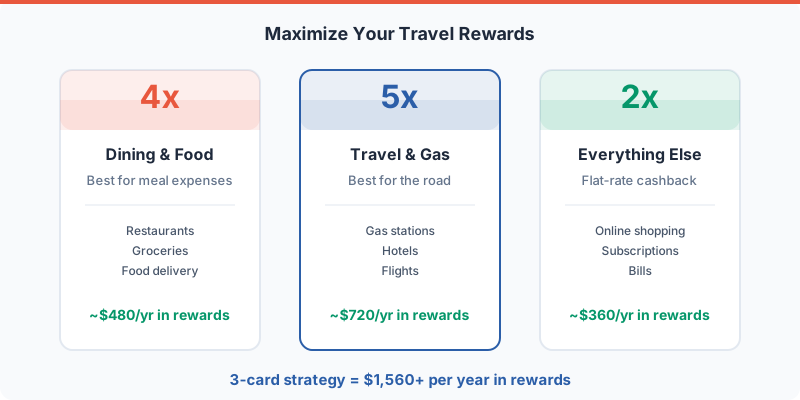
Gas: $4,000 to $6,000 per year at 3x to 5x = 12,000 to 30,000 points. Use a dedicated gas credit card at the pump every single time. At 5x on $5,000 in annual gas spending, that is 25,000 points from gas alone.
Groceries: $3,000 to $5,000 per year at 3x to 6x = 9,000 to 30,000 points. Many flexible points cards and cash back cards offer elevated earning on groceries. If your travel card earns 3x on groceries and you spend $4,000 annually, that is 12,000 points. Some cards offer 6x on groceries, doubling that haul.
Dining: $2,000 to $3,000 per year at 3x to 4x = 6,000 to 12,000 points. Most travel rewards cards earn at least 3x on dining. Even modest restaurant and takeout spending generates a meaningful point total over the year.
The combined total from these three categories alone is 27,000 to 72,000 points per year. At the midpoint, expect roughly 15,000 to 25,000 points from category spending after subtracting any overlap with the sign-up bonus spending period.
Step 3: Earn 10K to 20K From Hotel Loyalty Stacking
If you stay at chain hotels for your assignments, you have an additional high-powered earning channel. Hotel loyalty programs award base points on every dollar spent on your room. With a co-branded hotel credit card, you earn additional points on top of your loyalty earnings.
A 13-week stay at $100 per night generates roughly 91,000 base loyalty points (at 10 points per dollar). With elite status bonuses (25% to 75% more), that climbs to 114,000 to 159,000 loyalty points per assignment. Credit card bonus points add another 45,000 to 55,000 on top.
Even if you count only the credit card points (since loyalty points are in a different currency), the hotel stay is adding 10,000 to 20,000 or more flexible or co-branded points to your annual total. For the full hotel strategy, read our hotel credit card guide.
Step 4: Earn 5K to 10K From Everyday Spending
Everything else you buy — subscriptions, online shopping, clothing, household items, bills — earns points at your card’s base rate, typically 1x to 2x. On $10,000 to $15,000 in annual miscellaneous spending, that is 10,000 to 30,000 base points.
This is the least exciting earning channel, but it adds up. Autopay your recurring bills (phone, streaming services, insurance) through your rewards card, and you earn points passively without thinking about it.
The total across all four steps: 90,000 to 140,000 points per year. Most travel nurses land comfortably above the 100K mark.
What 100K Points Can Get You
Here is what 100,000 flexible points look like when redeemed strategically:
Domestic round-trip flights: 2 to 4 trips. Economy flights typically cost 15,000 to 25,000 points one-way through airline transfer partners, putting round trips at 30,000 to 50,000 points. At 100K points, you have two to three domestic round trips.
International flights: 1 to 2 trips (economy). International economy flights range from 30,000 to 60,000 points one-way depending on the destination and airline partner. You can reach Europe, the Caribbean, or Central America for 50,000 to 70,000 round trip through the right partner.
International business class: 1 trip. This is where points truly shine. A business class ticket to Europe that costs $3,000 to $5,000 in cash can be booked for 60,000 to 100,000 points through certain airline partners. That is 3 to 5 cents per point in value — far more than any cash back card can offer.
Hotel nights: 5 to 10 nights. Mid-range hotel redemptions run 15,000 to 30,000 points per night through hotel transfer partners or card travel portals. Your 100K points translate to roughly a week of free accommodation.
Cash back equivalent: $1,000 to $1,500. Redeeming for cash or statement credits yields 1 to 1.5 cents per point. This is the lowest-value option but provides maximum flexibility. Consider this your floor — you can always do at least this well.
The Annual Points Calendar for Travel Nurses
Timing matters. Here is how to structure your points earning across the year:
January through March: Apply for your primary card and start earning. If you are starting a new assignment in Q1, this is the perfect time to apply for a new travel card. Use the assignment transition spending to meet the sign-up bonus. Set up category spending (gas card at the pump, grocery card at the store) and activate any quarterly bonus categories.
April through June: Meet your sign-up bonus and maximize category spend. By now, you should have met the sign-up bonus threshold and be earning steadily on category spending. Check that all quarterly bonuses are activated. If your sign-up bonus has posted, evaluate whether a second card application makes sense for the fall.
July through September: Evaluate your card portfolio. Mid-year is a good time to assess your earning rate. Are you using the right card for each category? Have you been tracking quarterly bonuses? If you are considering a second card, apply in advance of your next assignment transition. Also evaluate whether any annual fees are coming up on existing cards and whether those cards still deliver enough value to keep.
October through December: Holiday spending and vacation planning. Holiday purchases and year-end spending provide a final push toward your points goal. This is also the ideal time to plan your points redemption — book award flights and hotel stays for your next vacation during shoulder season (early spring or fall) for the best availability and value.
Advanced Strategies
Once you have the basics down, these tactics can accelerate your earning further:
Strategic card applications. Space applications at least three to six months apart to minimize credit score impact. Each application creates a hard inquiry (which drops your score temporarily by 5 to 10 points) and lowers your average account age. However, the long-term effect is minimal if you space applications responsibly and always pay on time. For most travel nurses, two to three new applications per year is a sustainable pace.
Referral bonuses. Many rewards cards offer 10,000 to 25,000 bonus points when you refer a friend or colleague who is approved. Travel nurses work alongside other travel nurses — if your coworkers are interested in rewards cards, your referral links can generate meaningful bonus points. Always disclose that you earn a bonus from the referral.
Cashback apps for double-dipping. Rakuten, Ibotta, and similar apps offer cash back on purchases from hundreds of retailers. Use the app in conjunction with your rewards credit card to earn points and cash back on the same purchase. Rakuten also offers a credit card that earns in a major flexible points currency, creating a triple-dip on qualifying purchases.
Shopping portals. Card issuer shopping portals offer bonus points (2x to 15x) when you click through to a retailer before purchasing. Amazon, Target, Walmart, and hundreds of other retailers participate. Bookmark the portal and check it before any online purchase.
Points transfer optimization. When transferring flexible points to airline partners, look for transfer bonuses. Periodically, airlines offer 20% to 40% bonus miles on transfers, meaning your 100K flexible points become 120K to 140K airline miles. These promotions are not always available, but when they align with your redemption plans, they provide exceptional value.
Common Mistakes That Slow Your Points Earning
Spreading spending across too many cards. Using five or six cards means none of them gets enough spending to maximize bonuses. Two to three cards, each with a clear purpose, is the sweet spot.
Missing category bonus activations. Rotating category cards require you to activate the bonus each quarter. Miss the activation, and you earn 1% instead of 5%. Set calendar reminders for the first of each quarter.
Carrying a balance. This is the single most damaging mistake. Credit card interest rates of 20% to 29% will obliterate any rewards you earn. If you cannot pay your statement balance in full every month, do not pursue a rewards strategy — focus on budgeting and debt elimination first.
Letting sign-up bonus deadlines lapse. Most sign-up bonuses require you to spend $3,000 to $4,000 within three months. If you apply at the wrong time and do not hit the threshold, you lose the most valuable part of the card. Time applications with high-spend periods.
Not tracking spending across categories. You should know roughly how much you spend on gas, groceries, dining, and other categories each month. Without this knowledge, you cannot optimize which card to use where. A simple spreadsheet or budgeting app solves this.
Ignoring hotel loyalty programs. If you stay at chain hotels, enrolling in the loyalty program is free and can generate hundreds of thousands of points per year. There is no reason to leave these points on the table.
FAQ
Is it hard to earn 100K points?
It is not hard, but it does require intentionality. The strategy itself is simple: get a card with a good sign-up bonus, use the right card for each spending category, and stack loyalty programs where possible. The effort involved is minimal — maybe 30 minutes of setup and a few minutes per month to verify you are using the right cards. The biggest hurdle is the initial research to choose the right cards, which is exactly what this guide and our travel rewards card comparison are designed to handle for you. Once the system is in place, points accumulate automatically from spending you are doing anyway.
Will this hurt my credit score?
Applying for a new credit card creates a hard inquiry on your credit report, which temporarily reduces your score by 5 to 10 points. The effect fades within a few months and disappears entirely after one year. Opening a new account also lowers your average account age, which can have a small negative impact. However, the new credit line increases your total available credit, which can improve your credit utilization ratio — often the net effect on your score is neutral or positive within a few months. The key is to always pay on time and in full, never use more than 30% of your available credit, and space applications at least three to six months apart. Responsible rewards card usage builds credit over time, not the reverse.
How long does it take to earn 100K points?
Most travel nurses can earn 100K points within 6 to 12 months. The sign-up bonus (60K to 80K points) typically posts within three to four months after meeting the minimum spend. Category spending and hotel loyalty stacking fill in the remaining 20K to 40K over the following months. If you open a card with an 80K sign-up bonus and earn 3x to 5x on gas and groceries, you could hit 100K within four to five months. A more conservative approach with a single 60K bonus card and moderate category spending gets you there in eight to ten months.
Are points worth more than cash back?
When redeemed optimally, yes. Flexible points transferred to airline partners typically yield 1.5 to 2.5 cents per point in value, with premium cabin bookings sometimes reaching 4 to 8 cents per point. A flat 2% cash back card returns exactly 2 cents per dollar — a known, guaranteed value. The advantage of points is their upside: they can be worth significantly more than cash when redeemed for travel, but only if you actually redeem them for travel. If you prefer simplicity and do not want to learn transfer partners, a high-rate cash back card is perfectly respectable. But if you are willing to invest a small amount of time in learning redemptions, points outperform cash back for most travel nurses.
Can I earn 100K points with just one card?
It is possible but uncommon. A single card with a 75K to 100K sign-up bonus gets you most of the way there, and ongoing spending can fill the gap within the year. However, using two to three cards (each optimized for a different spending category) typically gets you to 100K faster and with more annual earning beyond the first year. The one-card approach is simpler, while the multi-card approach earns more. If you are just starting out, begin with one card, learn the system, and add a second card six months later.
Key Takeaways
Earning 100K points in a year is achievable for most travel nurses with a straightforward four-step strategy: anchor your earning with a strong sign-up bonus, optimize category spending with the right cards, stack hotel loyalty points when applicable, and let everyday spending fill in the rest.
The most important rule: never carry a balance. Interest charges at 20% to 29% will wipe out any rewards value instantly. This strategy only works when you pay your full statement balance every month.
Start with Step 1 — choose a card with a strong sign-up bonus and time your application with your next assignment transition. The sooner you start, the sooner your everyday spending begins working toward your next free vacation.
Related Internal Links
- Best Credit Cards for Travel Nurses
- Best Hotel Credit Cards for Travel Nurses
- Best Gas Credit Cards for Travel Nurses
- Best Travel Rewards Cards for Nurses
- Travel Nurse Budget Guide
- Pay Calculator
Affiliate Placement Notes
- Credit card referral links in Step 1 and throughout card recommendation sections
- Cashback app referral links (Rakuten, Ibotta) in advanced strategies section
- Shopping portal links where mentioned
