
Travel Nurse Budget Template (Free Download)

Disclosure: Some links in this post are affiliate links. If you click through and make a purchase, we may earn a small commission at no extra cost to you. Learn more about how we make money.
The Difference Between Earning Great Money and Keeping It
Travel nurses are some of the highest-earning nurses in the country. Between competitive hourly rates, housing stipends, meals and incidentals stipends, travel reimbursements, overtime, and completion bonuses, a single 13-week contract can generate $25,000 to $40,000 or more in total compensation. That is real, life-changing money.
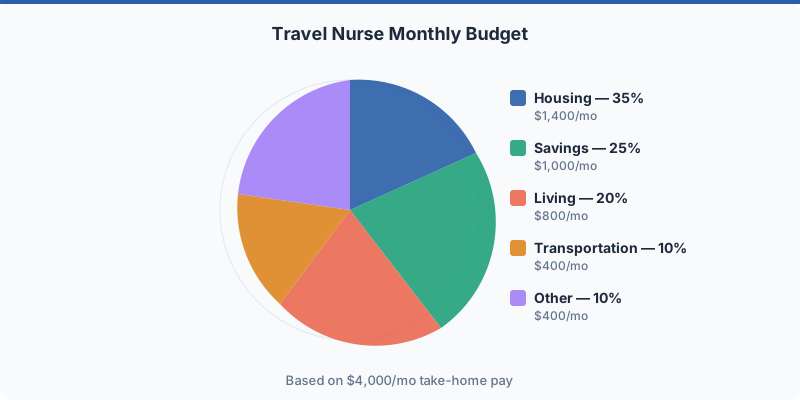
And yet, an alarming number of travel nurses finish an assignment and wonder where it all went. The paycheck was big, but the bank account does not reflect it. Sound familiar?
The problem is almost never income. The problem is that travel nursing creates a uniquely complex spending environment — variable pay structures, recurring relocation costs, duplicate expenses, different cost-of-living in every city — and without a system to manage it, money leaks out in a hundred small ways that are invisible until you look back at the end of a contract.
A budget template fixes this. Not a restrictive, guilt-inducing spreadsheet that makes you feel bad for buying coffee. A practical, travel-nurse-specific planning tool that shows you exactly where your money goes and ensures you are saving the amount you intended. This guide walks you through every category in the template, explains how to use it, and gives you the framework to take control of your finances on every assignment.
Understanding Your Travel Nurse Pay Breakdown
Before you can budget effectively, you need to understand what you are actually earning. Travel nurse compensation is not a single number — it is a collection of components, each with different tax implications.
Taxable hourly rate. This is the portion of your pay subject to federal and state income taxes, Social Security, and Medicare. Your net take-home from this component is significantly less than the gross amount. A $30/hour taxable rate does not mean $30 hits your bank account — after taxes, it might be closer to $22 to $25 depending on your tax bracket and assignment state.
Housing stipend. This is intended to cover your housing costs at the assignment location. If you maintain a legitimate tax home, this stipend is tax-free. If you do not, it becomes taxable income. The amount varies by assignment location and agency, but $1,500 to $3,000 per week is common in many markets.
Meals and incidentals stipend (M&IE). This covers food and incidental expenses at your assignment location. Like the housing stipend, it is tax-free if you maintain a tax home. Typical amounts range from $200 to $500 per week.
Travel reimbursement. A one-time payment to cover your travel costs to the assignment. This is usually a flat amount ranging from $500 to $1,500.
To budget accurately, you need to know each of these components separately. Use our pay calculator to break down your contract offer into actual take-home numbers. If you are comparing multiple contract offers, this breakdown is essential for determining which one actually pays the most after expenses.
The Budget Template: Categories Explained
Fixed Expenses
These are costs that stay roughly the same regardless of your assignment location. They are your financial baseline — the spending you cannot avoid.
Housing at your tax home. If you maintain a tax home (and you should, to protect your tax-free stipends), you have housing costs there even when you are on assignment. This might be a mortgage, rent, or the costs of maintaining a room in a family member’s home. Include property taxes, HOA fees, and homeowner’s or renter’s insurance.
Vehicle costs. Car payment, auto insurance, and registration. These do not change when you relocate, though your insurance rate might adjust slightly based on your assignment state.
Health insurance. If your agency provides coverage, this might be deducted from your paycheck. If you carry your own plan through the ACA marketplace or a private insurer, include the premium here.
Phone and internet. Your cell phone bill is consistent across locations. If you need a mobile hotspot for reliable internet at certain assignments, include that cost.
Subscriptions. Streaming services, gym memberships (especially national chains that work everywhere), professional memberships, nursing journal access, and any other recurring charges. This is also the best category to audit for waste — most people are paying for at least one subscription they forgot about.
Student loan payments. If you have student loans, your minimum payment belongs here. If you are aggressively paying them down, put the minimum in fixed expenses and any extra payments in your savings/debt payoff category.
Variable Expenses
These change with every assignment based on the local cost of living and your lifestyle choices. Estimate them before each contract and track them weekly to stay on target.
Groceries and meal prep. Budget $250 to $400 per month for one person, depending on the city and your eating habits. Meal prepping significantly reduces this cost compared to buying convenience foods or eating out. Use cashback apps on every grocery trip to shave another 5% to 10% off.
Gas and transportation. Your commute distance and local gas prices drive this number. Use GasBuddy to estimate fuel costs in your new city before you arrive. If you are in a city with good public transit, this cost might drop significantly.
Dining out and entertainment. Be honest with yourself here. If you eat out twice a week and go out on weekends, budget for it rather than pretending you will not. A realistic budget you actually follow beats an aspirational budget you abandon by week three.
Personal care and household items. Toiletries, cleaning supplies, over-the-counter medications, haircuts, and the random household items you need to buy when you move into a new place. Budget $50 to $100 per month.
Pet care. If you travel with a pet, include food, any pet rent or deposits, vet visits, and pet insurance.
Travel Nurse-Specific Expenses
These are the costs that staff nurses never deal with and that generic budget templates miss entirely. They are often the biggest source of budget surprises for travel nurses.
Licensing fees for new states. If your assignment requires a state license that you do not already hold, the application and processing fees can range from $50 to $400. Compact license holders have a significant advantage here, but even compact states sometimes require additional steps.
Continuing education (CEU) costs. Many states require CEUs for license renewal. Budget for online courses, conference fees, or study materials. Check out our guide to the cheapest CE credits to keep this cost down.
Scrubs, stethoscope, and work supplies. Some assignments require specific scrub colors or styles. If you need to buy new scrubs, badge accessories, or replace worn equipment, include it here.
Travel costs between assignments. Gas for a long drive, a hotel night or two en route, meals on the road, and any moving supplies. For nurses who drive between assignments, this can run $200 to $800 per transition depending on distance.
Duplicate expenses. This is the hidden cost of travel nursing that catches many nurses off guard. You may be paying for a storage unit, mail forwarding, maintaining utilities at your tax home, and similar costs that exist specifically because you live in two places. Track these separately so you know exactly what your travel nursing lifestyle costs above and beyond your assignment expenses.
Savings and Investments
This is not a “leftover” category — it is a priority category. The money you allocate here should be treated as non-negotiable, just like rent.
Emergency fund contribution. If your emergency fund is not yet at your target (three to six months of essential expenses), this is your top savings priority. Automate a transfer to your high-yield savings account on every payday.
Retirement contributions. Roth IRA, 401(k), or both. Even modest contributions grow significantly over time thanks to compound interest. Our retirement planning guide helps you determine the right contribution level for your age and goals.
Short-term savings goals. Vacation fund, home down payment, new car, or debt payoff above minimum payments. Give each goal a specific dollar amount and a target date so you know how much to contribute per paycheck.
How to Use the Template
Step 1: Enter your contract pay details. List your taxable hourly rate, estimated weekly hours, housing stipend, M&IE stipend, travel reimbursement, and any anticipated overtime. Use our pay calculator to convert these into actual take-home pay. This is your income for the contract.
Step 2: Fill in fixed expenses. These stay consistent from contract to contract, so after your first time filling this out, you can copy them forward with minimal changes.
Step 3: Estimate variable expenses based on the assignment city. Research housing costs (check Furnished Finder, Zillow, and local rental listings), gas prices (GasBuddy), and grocery costs. If you have taken an assignment in a similar cost-of-living city before, use those numbers as a baseline.
Step 4: Set your savings target. Aim to save 20% to 30% of your gross pay each contract. If that feels aggressive, start at 15% and increase by 2% to 3% each contract until you reach 20%. The key is having a specific number, not a vague intention.
Step 5: Track actual spending weekly and adjust. Your budget is a plan, not a prophecy. Reality will differ from your estimates, especially during your first contract in a new city. Track your actual spending weekly (a five-minute review is enough) and adjust your estimates as you learn your real spending patterns. By the second month of a contract, your budget should closely match reality.
Budgeting Tips Specific to Travel Nurses
Budget per contract, not per year. Every 13-week assignment has different pay, different housing costs, and a different cost structure. A budget that worked beautifully in Boise might be way off in San Francisco. Build a new budget for every contract.
Build in a buffer for assignment gaps. If you take two weeks between contracts, that is two weeks of expenses with no income. Account for this in your savings plan. Ideally, you are not touching your emergency fund for planned gaps — budget a separate “gap fund” of $1,000 to $2,000 that covers transition periods.
Track stipend spending separately. Your housing and M&IE stipends are tax-free because they are intended to cover specific expenses. Keeping receipts and records of how you spend your stipends protects you in the unlikely event of an audit. A simple separate spreadsheet tab or bank account makes this painless.
Use budgeting tools that work for you. Some nurses love YNAB (You Need A Budget) for its zero-based budgeting approach. Others prefer a simple Google Sheet. Some use the free version of Mint or their bank’s built-in budgeting tools. The best tool is the one you will actually use consistently. If a spreadsheet feels like homework and you abandon it after two weeks, try an app. If apps feel intrusive, try a weekly 10-minute spreadsheet check-in.
Review and adjust after every contract. At the end of each 13-week assignment, spend 30 minutes reviewing your budget versus actual spending. What surprised you? Where did you overspend? Where did you have room to spare? Feed these insights into your next contract’s budget. Your financial picture should get clearer and more accurate with every assignment.
Download the Free Template
We have built a budget template specifically for travel nurses that includes all the categories above, pre-built formulas for calculating take-home pay, and a contract-by-contract tracking system.
Google Sheets version: Make a copy to your own Google Drive and customize it for your situation. Access it from any device, anywhere.
Excel version: Download the .xlsx file for offline use. Ideal if you prefer working in Excel or want to keep your financial data local.
To use either version: make a copy, fill in your contract details, and start tracking. The template is pre-formatted so you can start entering numbers immediately without building anything from scratch.
Key Takeaways
- A budget template turns financial chaos into a clear plan. You earn too much money as a travel nurse to not know where it goes.
- Track taxable pay and stipends separately for tax purposes. This protects your tax-free stipend status and simplifies filing.
- Aim to save 20% to 30% of your gross pay each contract. Start lower if you need to, but increase over time.
- Budget per assignment, not per month. Costs change with every move, and your budget should reflect that.
- Download the template and fill it out before your next assignment starts. Thirty minutes of planning saves thousands of dollars over the course of a year.
Pair this budget template with our financial checklist for a complete pre-assignment financial setup, and use our pay calculator to make sure your income estimates are accurate.
Related Internal Links
- Travel Nurse Financial Checklist
- Travel Nurse Emergency Fund
- Best Banks for Travel Nurses
- Cheapest Cities for Travel Nursing
- Travel Nurse Budget Guide
- Cashback Apps for Travel Nurses
Affiliate Placement Notes
- Budgeting app affiliate links in the budgeting tips section (YNAB, etc.)
- Banking affiliate links when discussing stipend tracking accounts
- Cashback app links in the variable expenses grocery section
- Pay calculator internal link throughout
