
Travel Nurse Budget Guide: How to Save More on Every Assignment

Disclosure: Some links in this post are affiliate links. If you click through and make a purchase, we may earn a small commission at no extra cost to you. Learn more about how we make money.
Introduction: Making the Most of Your Travel Nurse Income
Travel nursing can be one of the highest-paying career paths in nursing, but high income does not automatically mean high savings. Lifestyle inflation, hidden costs, and the sheer complexity of managing finances across multiple states can erode even a generous paycheck faster than you would expect. The nurses who build real wealth from travel nursing are not necessarily the ones earning the most — they are the ones with a plan.
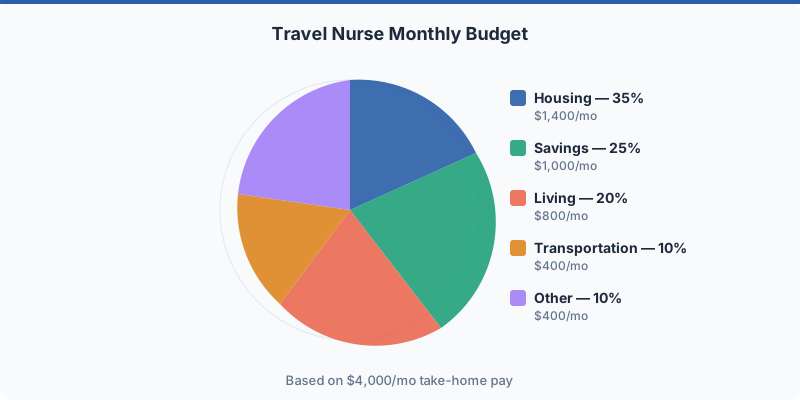
Budgeting as a travel nurse is fundamentally different from budgeting as a staff nurse. Your income can change every 13 weeks. Your rent, grocery costs, gas prices, and lifestyle expenses shift with every new assignment location. You have costs that staff nurses never think about: relocation expenses, duplicate housing, state licensing fees, and the constant churn of setting up a new life in a new city. Without a system to manage all of this, money slips through the cracks.
This guide gives you a practical, adaptable budgeting framework built specifically for the travel nurse lifestyle. Whether you are on your first contract or your fifteenth, the strategies here will help you take control of your finances, save more on every assignment, and build toward the financial goals that matter to you.
The Travel Nurse Budget Framework
A good budget for travel nurses needs to be flexible enough to adapt to changing locations and income levels while structured enough to keep you on track. Here is the five-step framework.
Step 1: Know your actual take-home pay. Before you budget a single dollar, understand exactly what hits your bank account. This includes your taxable hourly wage, non-taxable stipends (housing, meals, incidentals), overtime pay, and any bonuses. Use our pay calculator to break down your contract offer and see your true weekly and monthly take-home. Many travel nurses overestimate their income because they look at the gross weekly rate without accounting for taxes, insurance premiums, or retirement contributions.
Step 2: Categorize your expenses. Divide your spending into three buckets: fixed expenses (the same every month regardless of location), variable expenses (change based on your assignment city), and assignment-specific expenses (one-time costs associated with each contract transition). This three-bucket system is the key to budgeting successfully with a lifestyle that changes every quarter.
Step 3: Set savings targets. Decide how much you want to save before you start spending. The “pay yourself first” approach means your savings come off the top, not whatever is left at the end of the month. A target of 20% to 30% of take-home pay is realistic for most travel nurses, especially those taking stipends and finding housing below the stipend amount.
Step 4: Track spending weekly. Monthly tracking is too infrequent for travel nurses. Because your costs shift with each assignment, a weekly check-in catches overspending early and lets you adjust before a small problem becomes a big one. Set a recurring 15-minute calendar block each Sunday to review the past week.
Step 5: Adjust each assignment based on local costs. A budget that works in rural Texas will not work in San Francisco. Before each assignment, research local grocery prices, gas costs, entertainment options, and housing rates. Adjust your variable expense estimates accordingly. This five-minute exercise before each contract prevents the shock of discovering mid-assignment that your budget does not fit the local cost of living.
Fixed Expenses (These Stay the Same)
Fixed expenses are the foundation of your budget because they do not change when you relocate. These include:
Tax home costs. If you maintain a tax home (and you should — see our financial planning guide for why), your mortgage or rent, utilities, and homeowner’s or renter’s insurance at your permanent address are fixed costs. These continue whether you are home or on assignment.
Car payment and insurance. Your vehicle costs stay consistent across assignments. If you are driving between assignments frequently, make sure your auto insurance covers you in all states where you travel. Some insurers require notification when you spend extended time in a different state.
Student loan payments. These are predictable monthly obligations. If you are on an income-driven repayment plan, your payment may adjust annually based on your income, but it remains fixed within each year.
Health insurance premiums. Whether through your agency, the marketplace, or a private plan, your monthly premium is a fixed cost. Review your coverage during each open enrollment period to make sure you are not overpaying.
Phone and subscriptions. Cell phone, streaming services, gym memberships you keep year-round, and any other recurring subscriptions. Audit these quarterly — most people are paying for at least one or two services they no longer use.
The goal with fixed expenses is to keep them as low as reasonably possible, since you pay them regardless of where you are or how much you earn. Every dollar you reduce in fixed costs creates permanent breathing room in your budget.
Variable Expenses (These Change by Assignment)
Variable expenses are where your budget needs the most flexibility. They shift based on your assignment city, the cost of living, and your personal choices.
Housing at your assignment location. This is typically your largest variable expense and also your biggest opportunity to save. If your agency offers a housing stipend, finding housing below the stipend amount puts the difference directly into your savings. The gap between stipend and actual housing cost can be $500 to $1,500 per month in affordable markets.
Groceries and dining. Food costs vary significantly by region. Budget $250 to $400 per month for groceries depending on the market, and set a separate dining-out budget that you are comfortable with. Meal prepping saves hundreds per month compared to eating out regularly.
Gas and transportation. Gas prices vary by state, and your commute distance changes with each assignment. Budget based on your actual expected commute and local gas prices. Using a gas rewards credit card reduces this cost further.
Entertainment and social activities. Exploring your new city is part of what makes travel nursing enjoyable. Set a realistic entertainment budget rather than trying to cut it to zero — deprivation budgets do not last. Just make it intentional rather than accidental.
Gym memberships. If your home gym membership does not transfer nationally, you may need a local membership at each assignment. Some nurses use national chains with locations everywhere, while others use hotel gyms or outdoor exercise to avoid this cost entirely.
Before accepting a new contract, research the local cost of living and plug updated estimates into your budget. A 15-minute search on cost-of-living comparison sites gives you a realistic picture of what grocery, gas, and entertainment spending will look like in your new city.
Assignment-Specific Costs (Often Overlooked)
These are the costs that catch many travel nurses off guard because they do not recur monthly — they hit during transitions between assignments. Over the course of a year with three to four moves, they add up significantly.
Moving costs. Gas for the drive (potentially $100 to $500 depending on distance), hotels during the move if it is a multi-day trip ($100 to $300), meals on the road, and wear and tear on your vehicle. Budget $300 to $800 per move.
Housing deposits and first/last month payments. Many landlords require a security deposit plus first month’s rent upfront. Even if you get the deposit back at the end, you need the cash available at the start. Budget $1,000 to $3,000 in float for each assignment transition.
Licensing fees for new states. Compact nursing license states reduce this cost, but non-compact states can charge $100 to $400 for a new license. Some agencies reimburse this, but not all, and reimbursement may not come until weeks into your assignment.
Uniform and supply purchases. Different facilities have different requirements for scrub colors, shoes, and equipment. Budget $100 to $300 per assignment for any new gear you need.
Orientation period costs. Some contracts have unpaid orientation days or reduced-pay training periods at the start. Know this before you arrive so it does not surprise your first paycheck.
The solution is a dedicated “transition fund” — a separate savings account holding $2,000 to $4,000 that you draw from during each move and replenish during the assignment. This prevents transition costs from disrupting your regular monthly budget.
How Much Should Travel Nurses Save?
The short answer: aim to save 20% to 30% of your take-home pay. Here is how to think about it across different savings goals.
Emergency fund: 3 to 6 months of expenses. This is your top priority if you do not already have one. Travel nursing carries more income uncertainty than staff positions — contracts can be cancelled, extended, or changed. An emergency fund of $10,000 to $20,000 (depending on your monthly expenses) provides a safety net that lets you make career decisions from a position of strength rather than desperation.
Retirement savings. Contribute at least enough to get any employer match if your agency offers a 401(k). Beyond that, a Roth IRA ($7,000 per year contribution limit) is an excellent vehicle for travel nurses. Target 15% of income going toward retirement by age 30, with catch-up contributions if you started later. See our financial planning guide for retirement specifics.
Short-term savings goals. Whether it is a vacation fund, a down payment for a house, a new car, or debt payoff, give each goal a dollar amount and a timeline, then work backward to a monthly savings target. Keeping these in separate savings accounts (or sub-accounts) prevents the money from blending into your general checking and getting spent accidentally.
Balancing saving with living. The point of earning good money as a travel nurse is not to hoard every penny. Build savings and fun spending into your budget intentionally. A budget that includes a reasonable entertainment and travel fund is more sustainable than one that tries to eliminate all discretionary spending.
Money-Saving Strategies for Every Assignment
Housing
Take the housing stipend rather than agency-provided housing whenever possible. The stipend gives you control and the opportunity to pocket the difference between the stipend and your actual rent. Use platforms dedicated to travel nurse housing to find furnished rentals below your stipend amount. In many markets, you can find a furnished room or apartment for $800 to $1,500 per month while receiving a stipend of $1,500 to $2,500 or more.
Consider splitting housing costs with another travel nurse. Many assignment cities have multiple travel nurses at the same hospital, and sharing a two-bedroom apartment can cut your housing cost in half.
For extended-stay hotels, ask about weekly and monthly rates — they are almost always lower than the nightly rate. Some properties negotiate further for 13-week commitments.
Food
Meal prepping is the single most effective food savings strategy. Spending two to three hours on your days off preparing meals for the week keeps you out of restaurants and drive-throughs during busy shifts. Budget $50 to $75 per week for groceries and aim to keep dining out to once or twice per week.
Use grocery cashback apps to save an additional 3% to 5% on your food bill. Bring portable kitchen essentials (Instant Pot, good knives, a few versatile pans) so you can cook real meals even in minimally equipped temporary kitchens.
Transportation
Use a gas rewards credit card at every fill-up and stack it with gas station loyalty programs. Use GasBuddy to find the cheapest gas along your commute. Carpool with co-workers when shifts align — this saves gas and provides companionship during the transition to a new city.
Keep up with vehicle maintenance on schedule. An oil change costs $50; an engine repair from neglected maintenance costs $3,000. Preventive maintenance is a budget strategy, not just a car care strategy.
Entertainment
Every assignment city has free attractions: parks, hiking trails, beaches, community events, festivals, and museums with free admission days. Make a list in your first week and use it as your default entertainment plan.
Get a local library card — most libraries issue them free with proof of a local address, even a temporary one. Libraries offer free books, movies, music, WiFi, and community programming.
Check whether your hospital offers employee discounts on local attractions, restaurants, gyms, or services. Many do, and these discounts often extend to travel staff.
Budgeting Tools and Apps
YNAB (You Need a Budget) is the best budgeting app for travel nurses because it uses a zero-based budgeting system that assigns every dollar a job. This approach works well with variable income because it forces you to budget based on money you actually have, not money you expect to earn. The learning curve is moderate, and the $14.99 per month cost pays for itself many times over in savings awareness.
Mint (or its successor app) offers free budget tracking, bill monitoring, and spending categorization. It is less proactive than YNAB but provides a useful dashboard view of where your money is going. Best for nurses who want basic tracking without a subscription.
EveryDollar provides a simple, clean zero-based budgeting experience. The free version covers basic budgeting; the premium version connects to your bank accounts for automatic transaction tracking.
Spreadsheet templates work well for nurses who prefer hands-on control. A simple spreadsheet with columns for category, budgeted amount, actual spending, and difference gives you full visibility without any app learning curve. Create a new tab for each assignment to track how costs shift across locations.
To set up any of these tools for travel nursing’s variable income, use your lowest expected monthly income as your budgeting baseline. Any income above that baseline goes straight to savings or debt payoff. This conservative approach ensures you never overspend during a lower-paying assignment.
The “Pay Yourself First” Strategy
The most effective savings strategy for travel nurses is automatic: set up transfers that move money to savings before you have a chance to spend it.
On each payday, automate a transfer of your target savings percentage to a high-yield savings account. If your take-home is $2,000 per week and your savings target is 25%, set up a $500 automatic transfer every payday. The money leaves your checking account before you budget your spending, which means you naturally adjust your lifestyle to fit what remains.
Keep your emergency fund in a high-yield savings account earning 4% to 5% APY rather than sitting idle in a checking account at 0.01%. On a $15,000 emergency fund, the difference is $600 to $750 per year in interest — free money for doing nothing more than choosing the right account. For bank recommendations, see our guide on the best banks for travel nurses.
Use separate savings accounts (or sub-accounts) for different goals: emergency fund, vacation fund, transition fund, down payment fund. When money is earmarked for a specific purpose, you are far less likely to raid it for impulse purchases.
Tracking Your Net Worth as a Travel Nurse
Income is what you earn. Net worth is what you keep. Tracking your net worth — total assets minus total debts — gives you the clearest picture of whether your financial life is moving in the right direction.
To calculate your net worth, add up everything you own (checking and savings accounts, investment accounts, retirement accounts, property value, vehicle value) and subtract everything you owe (student loans, car loans, credit card balances, mortgage). The resulting number is your net worth.
Free tools like Personal Capital (now Empower), Mint, or a simple spreadsheet make tracking straightforward. Update your net worth monthly or quarterly. Over time, watching this number grow becomes its own motivation.
Set annual net worth growth targets based on your savings rate. A travel nurse saving $25,000 to $40,000 per year (achievable at a 25% to 30% savings rate on a strong travel nurse salary) should expect their net worth to increase by roughly that amount plus investment returns minus any debt reduction.
Celebrate financial milestones. Paying off a student loan, reaching a $50,000 net worth, or fully funding your emergency fund are accomplishments worth acknowledging. Financial progress is a marathon, and recognizing waypoints keeps you motivated.
Common Budgeting Mistakes
Not accounting for assignment transition costs. If you move three to four times per year and spend $500 to $800 per move without budgeting for it, that is $1,500 to $3,200 in unplanned spending annually. Build transition costs into your budget as a predictable line item.
Lifestyle inflation when pay increases. Landing a higher-paying contract is exciting, but if your spending increases by the same amount as your income, your savings rate stays flat. When your pay goes up, increase your automatic savings transfer before adjusting your spending budget.
Not having an emergency fund before starting travel nursing. The first few weeks of travel nursing involve heavy upfront spending (deposits, setup costs, licensing) before your first full paycheck arrives. Without savings to float this period, nurses sometimes turn to credit cards and start their travel career in a hole.
Ignoring tax obligations. Non-taxable stipends are a major perk of travel nursing, but they come with tax home requirements. If your tax home is not properly maintained and the IRS reclassifies your stipends as taxable income, you could owe thousands in back taxes. Budget for taxes conservatively and set aside money for potential tax liabilities.
Comparing your spending to social media instead of your goals. Other travel nurses posting about lavish apartments, expensive dinners, and weekly adventures may or may not be managing their money well. Your budget should reflect your goals, not someone else’s highlight reel.
FAQ
How much should I budget per week?
This depends heavily on your assignment location and personal situation, but a reasonable starting framework for a travel nurse earning $2,000 to $2,500 per week in take-home pay looks like this: $500 to $625 to savings (25%), $250 to $400 for housing (if taking the stipend and finding affordable options), $75 to $100 for groceries, $50 to $75 for gas, $50 to $100 for dining and entertainment, and the remainder for fixed expenses and miscellaneous costs. The exact numbers shift based on your income, location, and goals, but this framework gives you a workable starting point. Adjust after your first two weeks on assignment once you have real local cost data.
Should I save more or pay off debt first?
Build a starter emergency fund of $1,000 to $2,000 first — you need this safety net regardless. After that, the answer depends on the interest rates on your debt. If you have high-interest debt (credit cards at 20% or more, personal loans at 10% or more), focus aggressively on paying it off because no savings account or investment reliably outearns those interest rates. For lower-interest debt (federal student loans at 5% to 7%, car loans at 4% to 6%), a balanced approach works well: split your extra money between debt payments and building your full emergency fund and retirement savings. For a complete debt and savings priority framework, see our financial planning guide.
How do I budget with inconsistent pay?
Budget based on your lowest expected paycheck, not your highest. If your base weekly take-home is $1,800 but you sometimes earn $2,200 with overtime, budget on $1,800. When higher paychecks arrive, send the difference straight to savings. This approach ensures you never overspend during a lean week and accelerates your savings during high-earning periods. Between assignments, if you have a gap period with no income, your emergency fund and transition fund cover expenses without disrupting your financial plan.
What is a reasonable amount to spend on dining out?
A sustainable dining budget for most travel nurses is $150 to $300 per month, or roughly $35 to $70 per week. This allows one to two restaurant meals per week while keeping groceries as your primary food source. Some nurses spend more and cut elsewhere; others cook almost exclusively and keep dining under $100 per month. The key is to make it intentional. Unplanned dining spending — grabbing takeout because you are tired after a shift, ordering delivery out of convenience — is what blows food budgets. Plan your restaurant meals and treat them as a line item, not an afterthought.
How do I stay on budget in expensive cities?
Expensive assignment cities (San Francisco, New York, Seattle, Boston) require adjustments but do not have to wreck your finances. First, negotiate a higher pay rate or stipend that reflects the local cost of living — agencies expect to pay more in high-cost markets. Second, get creative with housing: a room in a shared house, a studio further from the city center, or an extended-stay hotel with a negotiated monthly rate. Third, lean into the free attractions these cities offer — world-class parks, beaches, museums with free days, and public events. Fourth, adjust your savings rate expectations. If your normal savings rate is 25% and an expensive city drops it to 15% for one assignment, that is acceptable as long as you are aware and intentional about it. One lower-savings assignment will not derail your long-term plan.
Key Takeaways
A budget is not optional for travel nurses — it is the difference between building wealth and just earning a high income. Variable income, changing costs, and recurring relocation expenses require more financial awareness than a typical staff nursing position.
Aim to save 20% to 30% of your take-home pay. Automate your savings on payday so the money moves before you have a chance to spend it. Track your spending weekly, not monthly, and adjust your budget for each new assignment location.
The assignment-specific costs that come with every move — deposits, licensing, setup, and moving expenses — are the most commonly overlooked budget category. A dedicated transition fund prevents these costs from disrupting your monthly budget.
Start today: calculate your real take-home pay with our pay calculator, set up a budgeting tool, and automate your first savings transfer. Your future self will thank you.
Related Internal Links
- Travel Nurse Financial Planning Guide
- Best Credit Cards for Travel Nurses
- Best Gas Credit Cards for Travel Nurses
- Best Banks for Travel Nurses
- Pay Calculator
Affiliate Placement Notes
- Budgeting app affiliate links (YNAB) in the tools section
- High-yield savings account affiliate link in “Pay Yourself First” section
- Cashback app links (Rakuten, Ibotta) in money-saving strategies
- Grocery delivery service affiliate link in food section
