
How to Find Travel Nurse Housing: A Step-by-Step Search Process
Disclosure: Some links in this post are affiliate links. If you click through and make a purchase, we may earn a small commission at no extra cost to you. Learn more about how we make money.
Introduction: The Housing Search Does Not Have to Be Stressful
Finding housing for a travel nurse assignment can feel overwhelming. You are trying to secure a furnished, affordable place in a city you may have never visited, on a deadline that does not care about your stress levels. And unlike a normal apartment search where you can drive around, tour properties, and take your time, you are often doing this entirely from a different state while finishing up your current contract.
But here is the truth: once you have a repeatable process, the housing search becomes manageable. Even routine. Experienced travel nurses will tell you that by their third or fourth assignment, they have their system dialed in and can lock down housing in a few days rather than a few weeks of anxious scrolling.
This guide gives you that system. Follow these seven steps for every assignment, and you will find quality housing faster, at a better price, with less stress.
When to Start Your Housing Search
The sweet spot is four to six weeks before your start date. This gives you enough time to research the area, compare options across multiple platforms, verify listings, and negotiate rates without feeling rushed.
Starting earlier than six weeks can be counterproductive. Many landlords and Airbnb hosts do not have availability posted that far out, and you risk locking in housing only to have your contract details change. Starting later than four weeks is workable but puts you at a disadvantage: the best listings in popular markets get claimed quickly.
If you are assigned last-minute (two weeks or less): Do not panic. Extended-stay hotels are your best friend in this situation. You can book one in minutes, check in with no lease or deposit hassle, and use it as a landing pad while you search for longer-term housing locally. An Airbnb booked for the first week or two is another solid option. The goal is to get a roof over your head immediately and then find better, cheaper housing once you are on the ground.
Balancing early search with contract uncertainty: If your contract is not fully confirmed yet, start your research but hold off on committing financially. Begin steps 1 and 2 below (budgeting and area research) while you wait for final contract confirmation. Once confirmed, move immediately to steps 3 through 7.
Step 1: Set Your Budget
Your housing budget starts with your stipend. Most travel nurse contracts include a tax-free housing stipend that typically ranges from $1,800 to $3,500 per month depending on the assignment location (high-cost cities pay more).
The recommended approach: Spend 50 to 70 percent of your housing stipend on actual housing costs and pocket the difference as savings. This is one of the biggest financial advantages of travel nursing, so do not give it all back by overspending on housing.
Here is what the math looks like:
| Monthly Stipend | 50% Budget | 70% Budget | Savings Range |
|---|---|---|---|
| $2,000 | $1,000 | $1,400 | $600 - $1,000/month |
| $2,500 | $1,250 | $1,750 | $750 - $1,250/month |
| $3,000 | $1,500 | $2,100 | $900 - $1,500/month |
| $3,500 | $1,750 | $2,450 | $1,050 - $1,750/month |
Do not forget hidden costs. If utilities are not included in your rent, budget an additional $100 to $200 per month for electricity, gas, water, and internet. Factor in parking costs if applicable. And consider renters insurance , which typically costs $15 to $30 per month and protects your belongings.
Use our budget template to model your specific numbers, and check the cost of living tool to understand how far your stipend stretches in different markets.
Step 2: Research the Assignment Area
Before you open a single housing platform, spend 30 minutes learning about the area around your hospital. This upfront research will save you hours of browsing irrelevant listings and help you avoid neighborhoods that look fine online but feel unsafe or inconvenient in person.
Map your commute zone. Open Google Maps, enter your hospital’s address, and identify neighborhoods within a 15 to 20-minute drive. For night-shift nurses, prioritize locations with a shorter commute — you do not want a 30-minute highway drive when you are exhausted at 7:30 AM.
Check neighborhood safety. Use tools like CrimeMapping.com, SpotCrime, or the local police department’s crime map to identify areas with lower incident rates. While no tool is perfect, significant crime clusters near a potential listing are a legitimate concern.
Identify daily-life amenities. Where are the grocery stores, gyms, parks, coffee shops, and restaurants relative to your housing options? Having a grocery store within a 10-minute drive makes your life measurably easier.
Tap the community. Search Facebook for travel nurse groups specific to the city or facility. Post a question like “Any recommendations for housing near [Hospital Name]?” Experienced travelers who have worked there before are usually happy to share neighborhood tips and landlord recommendations. Reddit’s r/TravelNursing community is another good source.
Ask your recruiter. Your agency recruiter may have placed other nurses at the same facility and can sometimes share housing tips or put you in touch with nurses who are currently there.
Step 3: Search Multiple Platforms
Do not put all your eggs in one basket. The best option might be on any of these platforms, and searching all of them takes less time than you think.
Furnished Finder
Furnished Finder should be your first stop. It is built for travel nurses, there are no booking fees for tenants, and landlords understand short-term healthcare housing. Search by your hospital’s city or zip code, set your budget range and dates, and enable saved search alerts for new listings.
Pro tip: Contact your top five or six landlords simultaneously rather than waiting for one to respond before reaching out to another. This creates a competitive dynamic and speeds up the process.
For a detailed walkthrough of the platform, see our Furnished Finder review.
Airbnb and VRBO
Filter for monthly stays to unlock discounted rates. On Airbnb , set your dates to span at least 28 days to trigger monthly pricing. Message hosts before booking: introduce yourself as a healthcare worker, ask about a long-term discount, and inquire about waiving the cleaning fee for a 13-week stay.
VRBO has a similar monthly-stay filter and sometimes has listings not found on Airbnb. Check both platforms.
Extended-Stay Hotels
Search the websites of Extended Stay America, Residence Inn, Homewood Suites, Home2 Suites, WoodSpring Suites, TownePlace Suites, and Staybridge Suites for monthly rates at properties near your hospital. Then call the property directly — front desk managers can often beat online rates, especially if you mention you are a healthcare worker booking for 13 weeks.
For a complete chain-by-chain breakdown, see our extended stay hotel guide.
Facebook Groups
Search Facebook for groups like “Travel Nurse Housing,” “Travel Nurse Housing [City Name],” and “Travel Nurses in [City Name].” These groups are goldmines for housing leads posted by landlords, outgoing travel nurses with remaining leases, and nurses looking for roommates.
Be cautious with Facebook listings from unknown landlords. The verification steps in Step 5 are especially important for listings found through social media. See our housing scams guide for details.
Craigslist
Craigslist can have hidden gems, especially in smaller markets where other platforms have limited inventory. Filter for furnished rentals and short-term leases. However, Craigslist also has the highest concentration of scam listings, so extra verification is mandatory. Never send money to a Craigslist landlord without completing every verification step.
Other Platforms
Zillow and Apartments.com occasionally have furnished or short-term rental listings. Filter for these features if the platform supports it.
Local property management companies sometimes offer furnished short-term rentals that are not listed on national platforms. A quick Google search for “[City Name] furnished short-term rental” can surface these.
Hospital housing boards. Some medical facilities maintain a list of landlords and housing options for traveling staff. Ask your recruiter or the facility’s HR department whether this resource exists.
Step 4: Evaluate and Compare Options
Once you have gathered your options, it is time to narrow down. Create a simple comparison spreadsheet (a notes app or even a paper list works fine) with these columns:
- Listing name and platform
- Monthly cost (including all fees and utilities)
- Distance to hospital (check the drive time on Google Maps for your shift time)
- Amenities (full kitchen, laundry, parking, WiFi, pet-friendly)
- Cancellation/termination terms
- Landlord reviews or ratings
- Your gut feeling (after seeing photos and reading the description)
Score each option on your top three priorities. For most travel nurses, those priorities are cost, proximity to the hospital, and quality or comfort of the space. Narrow your list to the top three options before moving to verification.
Step 5: Verify the Listing
This step is non-negotiable. Every listing deserves verification before you send money, regardless of the platform.
Reverse image search the photos. Right-click a listing photo and search with Google Images or use TinEye.com. If the photos appear on other listings, real estate sites, or different Airbnb profiles, the listing may be fraudulent.
Check Google Maps Street View. Enter the listing address and use Street View to verify the building exists, the neighborhood matches the description, and the exterior looks consistent with the listing photos.
Request a live video tour. Ask the landlord for a FaceTime or Zoom walkthrough. Ask them to show the kitchen, the bedroom, the bathroom, the view from the windows, and the parking situation. A legitimate landlord will accommodate this request. A scammer will make excuses.
Check landlord reviews. Search the landlord’s name on Google, Furnished Finder, and Facebook travel nurse groups. Prior tenants’ experiences are the strongest indicator of what your experience will be.
Verify property ownership. Look up the property address on your county assessor’s website or on Zillow to confirm the landlord’s name matches the registered owner. If they use an LLC or property management company, verify that entity exists.
For the complete verification checklist, including what to do if you have been scammed, read our housing scams guide.
Step 6: Negotiate the Rate
Here is something many travel nurses learn too late: monthly rates are almost always negotiable. You have leverage. A landlord would rather have a reliable healthcare professional locked in for 13 weeks than deal with turnover and vacancy.
For Furnished Finder and private landlords: “I am a travel nurse on a 13-week assignment at [Hospital Name]. I am interested in your property. Would you be able to offer a monthly rate for a 3-month stay? I am comparing a few options and my budget is [amount].” This straightforward approach works more often than you would expect.
For Airbnb hosts: “Hi, I am a travel nurse working a 13-week contract nearby. I would be a quiet, low-maintenance guest working long shifts. Would you consider a monthly rate of [amount] for the full 13 weeks? I would also appreciate it if we could waive the cleaning fee given the length of the stay.”
For extended-stay hotels: Call the front desk and ask for the manager. “I am looking for a 13-week stay for a healthcare assignment. What is your best monthly rate? Do you have a healthcare worker discount or a corporate rate through [your agency name]?”
Know when to walk away. If a landlord is not willing to negotiate at all, that is fine. There are always other options. But do not leave money on the table by accepting the first listed price without asking.
Ask about bundling. Can utilities, WiFi, and parking be included in the monthly rate? Bundling these into one payment simplifies your budget and sometimes reduces the total cost.
Step 7: Secure the Housing
Once you have agreed on terms, lock everything down properly.
Get a written agreement. Even if it is a one-page document, get the terms in writing: monthly rent amount, security deposit amount and refund conditions, payment method and due date, lease start and end dates, what is included (utilities, WiFi, parking, furnishings), cancellation and early termination terms, and pet policy if applicable.
Understand cancellation terms. Contracts get cancelled. Ask what happens if you need to leave early. Push for a healthcare-worker cancellation clause: “If my healthcare assignment is cancelled or shortened by my employer, I may terminate this agreement with 14 to 30 days written notice.” Many landlords will agree to this.
Pay with a traceable method. Use a credit card, personal check, or PayPal (with buyer protection) whenever possible. Credit cards offer the strongest consumer protection through chargeback rights. Avoid wire transfers and never pay with gift cards or cryptocurrency.
Get a receipt for every payment. A written or emailed receipt showing the date, amount, purpose, and landlord information should accompany every transaction.
Document the property at move-in. On your first day, take photos and video of every room, every piece of furniture, every appliance, and any existing damage (scuffs, stains, chips, scratches). Email this documentation to yourself and the landlord with a dated subject line. This protects your security deposit at move-out.
Tips for Repeat Travelers
After a few assignments, your housing search becomes dramatically easier. Here are habits that seasoned travelers swear by.
Build a landlord network. If you had a great experience with a landlord, keep their contact information. When you return to that city or a nearby area, reach out directly. Many landlords offer loyalty discounts to returning tenants.
Maintain a housing database. Keep a spreadsheet of every place you have stayed, with notes on quality, price, landlord responsiveness, proximity to the hospital, and whether you would stay again. This becomes your personal housing playbook.
Leave reviews. After every stay, leave an honest review on the platform you used. This helps other travel nurses make informed decisions and strengthens the housing ecosystem for everyone.
Develop your search routine. After three or four assignments using the same process, you will be able to complete your housing search in a weekend rather than stressing about it for weeks. The system works. Trust it.
FAQ
What if I cannot find housing before my start date? Book an extended-stay hotel or short-term Airbnb for your first one to two weeks. This gives you a landing pad while you search for longer-term housing locally. Searching in person is often more effective than searching remotely, and you can tour properties and meet landlords face-to-face.
Should I get an Airbnb for the first week while I search locally? This is a smart strategy, especially in competitive markets or when you are assigned on short notice. Budget for one week of Airbnb or hotel as a transitional cost and search aggressively for your 13-week housing once you are on the ground.
How do I handle housing for a 4-week contract vs. 13-week? For short contracts (4 to 8 weeks), extended-stay hotels and Airbnb are usually your best options because they offer the most flexibility without a lease commitment. Furnished Finder landlords may be willing to do a short-term lease, but you will need to ask since many prefer 13-week tenants.
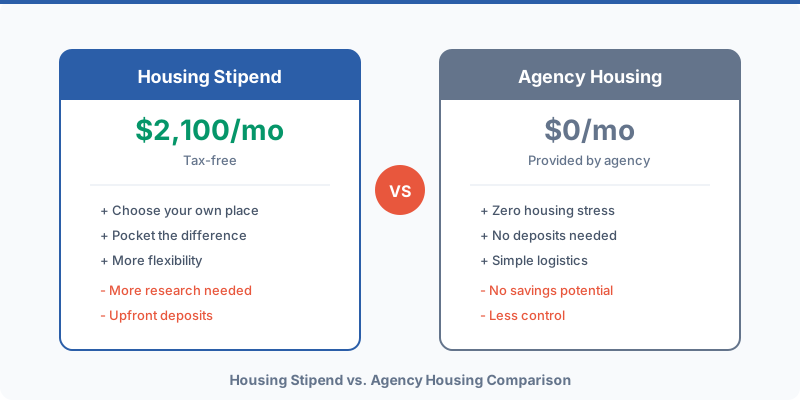
Can my agency help me find housing even if I take the stipend? Some agencies will share housing leads, recommend landlords, or connect you with other nurses heading to the same city, even if you have opted for the stipend. It never hurts to ask your recruiter. For more on the stipend vs. agency housing decision, see our housing stipend guide.
What if my top choice falls through at the last minute? This is why you narrow to three options in Step 4 rather than putting all your hopes on one listing. If your first choice falls through, you have backups ready to go. If all your options fall through, default to an extended-stay hotel for the first week and restart from Step 3 locally.
Key Takeaways
- Follow the 7-step process for every assignment. Budget, research, search, compare, verify, negotiate, secure. It works.
- Start four to six weeks before your start date. Earlier if you are heading to a competitive market.
- Search multiple platforms simultaneously. Furnished Finder , Airbnb, VRBO, extended-stay hotels, and Facebook groups. The best option could be anywhere.
- Verify every listing. Reverse image search, Google Street View, video tour, and landlord reviews. No exceptions. Read our scams guide for the full checklist.
- Negotiate. Monthly rates are rarely the final price, and 13-week tenants have real leverage.
- Document everything at move-in to protect your security deposit.
Ready to start? Begin your search on Furnished Finder and work through each platform methodically. Your next great housing find is out there.
Related Internal Links
- Travel Nurse Housing Guide
- Furnished Finder Review
- Airbnb vs. Extended Stay
- Travel Nurse Housing Scams
- Travel Nurse Extended Stay Hotels
- Housing Stipend vs. Agency Housing
- Travel Nurse Budget Template
- Cost of Living Tool
Affiliate Placement Notes
- Furnished Finder affiliate link in Step 3 and key takeaways
- Airbnb referral link in Step 3 and introduction
- VRBO referral link in Step 3
- Extended stay hotel booking affiliate links in Step 3
- Renters insurance affiliate link in Step 1 budget section
