
How to Compare Travel Nurse Pay Packages (Step-by-Step Guide)

Disclosure: Some links in this post are affiliate links. If you click through and make a purchase, we may earn a small commission at no extra cost to you. Learn more about how we make money.
Introduction: Why Comparing Pay Packages Is Harder Than It Looks
Two travel nurse contracts can look nearly identical on paper and still differ by $10,000 or more over a single 13-week assignment. I have seen nurses jump at a flashy hourly rate only to realize weeks later that their take-home pay is lower than a “lesser” offer they turned down. The reason is simple: travel nurse compensation is not one number. It is a bundle of taxable wages, tax-free stipends, bonuses, and benefits that interact in ways most people never learn about in nursing school.
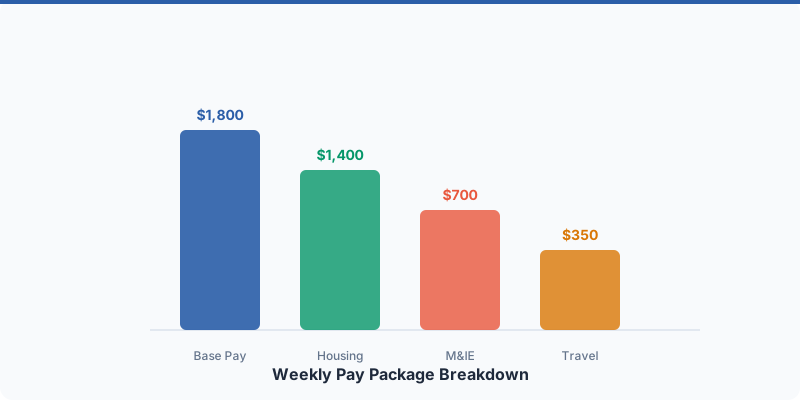
If you only compare hourly rates, you are comparing apples to spark plugs. The hourly rate is just one slice of a much larger pie, and sometimes it is intentionally inflated or deflated to make a package look more attractive than it actually is.
This guide walks you through a repeatable, step-by-step method for comparing any two (or five) pay packages side by side so you always know which offer actually puts the most money in your pocket. Whether you are evaluating your first travel contract or your fifteenth, this system works. And if you want to speed up the math, the Excursion Health pay calculator does the heavy lifting for you.
Understanding Total Compensation: The Big Picture
Before you can compare packages, you need to understand what you are comparing. Travel nurse pay is not a salary. It is a total compensation package made up of several distinct components, each with its own tax treatment.
Total compensation is the sum of everything your agency pays you or pays on your behalf over the life of a contract. Hourly rate is just the taxable wage line on your paycheck. Take-home pay is what actually lands in your bank account after taxes and deductions. These three numbers can tell very different stories.
The Four Pillars of a Travel Nurse Pay Package
Almost every travel nurse contract is built on four components:
-
Taxable hourly base rate — This is your W-2 wage. It is subject to federal income tax, state income tax (where applicable), Social Security, and Medicare. It is also the number used to calculate overtime, retirement contributions, and what shows up when a lender checks your income.
-
Housing stipend — A payment intended to cover your lodging at the assignment location. If you maintain a qualifying tax home, this is tax-free. If you do not have a tax home, it becomes taxable income.
-
Meals & incidentals (M&IE) stipend — A daily or weekly payment meant to cover food and incidental expenses while you are away from your tax home. Same tax rules as the housing stipend.
-
Travel reimbursement — A one-time or per-trip payment to cover the cost of getting to and from your assignment. This can be a flat dollar amount or mileage-based.
Why Agencies Structure Packages Differently
Every agency has a different relationship with the facilities they staff. The facility pays the agency a bill rate — a single hourly amount for every hour you work. Out of that bill rate, the agency has to cover your pay, their overhead, benefits, insurance, and profit. What is left over gets split between your taxable wages and tax-free stipends.
Some agencies run lean and pass more to you. Others have higher overhead. Some shift more money into stipends to make the package look larger on a job board. That is why two agencies staffing the exact same unit at the exact same hospital can offer you packages that look completely different.
Breaking Down Each Component
Taxable Hourly Rate
Your taxable hourly rate is the foundation of your pay package. It is the number the IRS sees, the number lenders use when you apply for a mortgage, and the number used to calculate overtime pay. A low base rate might make your overall package look bigger (because more money flows into tax-free stipends), but it creates real-world consequences.
If your base rate is $20 per hour and you work 36 hours per week for 13 weeks, your W-2 will show roughly $9,360 in taxable wages. That can make it tough to qualify for a home loan, and your overtime pay will be calculated at just $30 per hour (1.5 times $20). Compare that to a $30 base rate where your OT jumps to $45 per hour and your annual W-2 income is significantly healthier.
Typical taxable base rates in 2026 range from $18 to $35 per hour depending on specialty, location, and how aggressively the agency shifts money into stipends. Critical care and OR nurses often see higher base rates, while med-surg contracts may sit at the lower end.
Housing Stipend
The housing stipend is usually the largest tax-free component of your package. Agencies base their stipend amounts on GSA (General Services Administration) per diem rates, which set a maximum tax-free lodging amount for every county in the United States. You can look up the GSA rate for any assignment location at gsa.gov.
To receive this stipend tax-free, you must maintain a legitimate tax home. If you do not have a tax home, the stipend becomes taxable income and your take-home pay drops significantly.
When evaluating a housing stipend, check whether the offered amount is reasonable for the location. A $2,800 weekly housing stipend for a rural assignment in Mississippi should raise a flag — it likely exceeds the GSA rate for that area, which could create problems if you are ever audited.
Meals & Incidentals (M&IE) Stipend
The M&IE stipend covers food, tips, laundry, and small daily expenses. The GSA publishes standard M&IE rates that range from around $59 to $79 per day depending on the location. Some agencies list M&IE as a separate line item; others bundle it into the housing stipend to keep the pay stub simpler.
The bundling itself is not a problem, but you should know how to unbundle it when comparing packages. If Agency A offers a $2,100 weekly housing stipend and a $400 weekly M&IE stipend, while Agency B offers a $2,500 “combined stipend,” those two packages may actually be identical. Make sure you are adding all stipend components together before comparing.
Travel and Completion Bonuses
Travel reimbursement is usually a one-time payment (or two — one at the start and one at the end) to cover your cost of getting to the assignment. Common amounts range from $500 to $1,500 round trip.
Completion bonuses are lump sums paid after you finish the full contract. They can range from $500 to $5,000 or more. Read the fine print: many completion bonuses include clawback clauses that require you to repay the bonus if you leave early or if the facility cancels your contract.
When comparing packages, prorate bonuses across the contract length. A $1,300 completion bonus on a 13-week contract adds $100 per week to your effective compensation.
The Apples-to-Apples Comparison Method
Here is the five-step method I recommend for comparing any two pay packages. Grab a spreadsheet or use the pay calculator to follow along.
Step 1: Convert Everything to a Weekly Gross Value
Take each component and express it as a weekly amount. If a stipend is listed monthly, divide by 4.33. If a bonus is a one-time payment, divide by the number of contract weeks.
| Component | Package A | Package B |
|---|---|---|
| Taxable hourly rate x guaranteed hours | $22 x 36 = $792 | $28 x 36 = $1,008 |
| Weekly housing stipend | $1,680 | $1,260 |
| Weekly M&IE stipend | $406 | $406 |
| Travel reimbursement (prorated) | $1,000 / 13 = $77 | $500 / 13 = $38 |
| Completion bonus (prorated) | $1,500 / 13 = $115 | $0 |
| Weekly gross total | $3,070 | $2,712 |
At first glance, Package A looks like the clear winner. But we are not done.
Step 2: Subtract Estimated Taxes from the Taxable Portion Only
Only your taxable hourly wages (and taxable bonuses) are subject to income tax. Estimate your effective tax rate — for most travel nurses, a combined federal and state rate of 22-30% is a reasonable starting point.
| Package A | Package B | |
|---|---|---|
| Weekly taxable income | $792 + $115 = $907 | $1,008 |
| Estimated taxes (25%) | -$227 | -$252 |
| After-tax taxable income | $680 | $756 |
Step 3: Add Back Tax-Free Stipends
Now add the tax-free stipends back in to get your estimated weekly take-home.
| Package A | Package B | |
|---|---|---|
| After-tax taxable income | $680 | $756 |
| Housing stipend | $1,680 | $1,260 |
| M&IE stipend | $406 | $406 |
| Travel reimbursement | $77 | $38 |
| Estimated weekly take-home | $2,843 | $2,460 |
Package A still leads, but the gap is narrower than the gross numbers suggested.
Step 4: Factor in Benefits Costs
Does one agency charge $150 per week for health insurance while the other charges $50? Does one offer a 401(k) match? Subtract insurance premiums and add the value of matching contributions.
Step 5: Account for Location-Specific Costs
If Package A is in San Francisco and Package B is in Houston, the cost-of-living difference could easily erase that $383 weekly gap. Also consider state income tax: California will take a bigger bite than Texas (which has no state income tax).
After running all five steps, you might find that Package B is actually the better deal — or Package A might still win. The point is that you cannot know until you run the full analysis.
Using the Excursion Health Pay Calculator
The Excursion Health pay calculator automates the five-step method above. Here is how to get the most out of it:
-
Enter your base pay details — Input your taxable hourly rate, guaranteed hours, and contract length. If you expect overtime, add those hours separately.
-
Input your stipends — Enter housing and M&IE stipends as weekly amounts. Toggle whether they are taxable or non-taxable based on your tax home status.
-
Add bonuses — Enter any travel reimbursement, completion bonus, or sign-on bonus. The calculator will prorate them across the contract.
-
Set your tax variables — Select your assignment state and estimate your federal tax bracket. The calculator handles the rest.
-
Review your results — You will see gross weekly pay, estimated net weekly pay, and total contract value. Use the comparison view to evaluate multiple packages side by side.
Common mistakes when using the calculator include marking stipends as non-taxable when you do not actually have a qualifying tax home, forgetting to include insurance premiums, and comparing gross pay instead of net pay.
Hidden Costs That Change the Math
Even after running the numbers, there are real-world costs that can shift the equation.
State income tax is one of the biggest variables. A contract in California might carry a 9-13% state tax burden, while the same contract in Texas, Florida, or Nevada has zero state income tax. Use the pay calculator to model this difference — it is often worth hundreds of dollars per week.
Cost of living varies wildly. A $2,500 weekly take-home in Manhattan looks very different from $2,500 in rural Alabama. Research housing costs, gas prices, and grocery costs at your potential assignment location.
Other hidden costs include parking fees (hospital parking can run $100-$200 per month in cities), required certifications that the agency does not reimburse, scrubs or uniforms not provided by the facility, and health insurance premiums deducted from your paycheck.
Finally, pay attention to guaranteed hours clauses. If your contract guarantees 36 hours but the unit is slow and you get cancelled two shifts in a row, you want to know whether you are still getting paid. A contract with no guaranteed hours is a gamble, no matter how high the rate looks.
Red Flags in Pay Packages
After reviewing thousands of pay packages, these are the warning signs I watch for:
Unusually high stipends with a rock-bottom base rate. If your taxable hourly rate is $15 but your stipends total $2,800 per week, the math does not add up against GSA rates for most locations. This structure can trigger an IRS audit and puts you at risk.
No guaranteed hours clause. Without guaranteed hours, you can be cancelled at will and lose a significant portion of your expected income.
“Blended rate” with no itemized breakdown. If an agency quotes you a single number like “$55 per hour blended” but refuses to show you how that breaks down into taxable wages and stipends, walk away. You have a right to see the itemization.
Completion bonuses with harsh clawback terms. Some agencies require full repayment of the bonus if you leave even one day before the contract ends, even if the facility cancels your assignment. Read the fine print.
Negotiation Tips After Comparing
Once you have compared packages using the method above, you are in a strong position to negotiate.
Use competing offers as leverage. You do not need to be aggressive. Simply tell your recruiter, “I have another offer that comes out to $X more per week after taxes. Can you match that?” Most recruiters appreciate transparency and have some room to adjust.
Ask for the bill rate. Not every recruiter will share it, but asking signals that you understand the business. If the bill rate is $95 per hour and your total package works out to $55 per hour, the agency is keeping a $40 margin. That is higher than industry average, and there may be room to negotiate.
Negotiate specific line items. Rather than asking for “more money,” ask for a higher base rate, a larger housing stipend, or a completion bonus. Agencies have more flexibility on some line items than others.
Know when to walk away. If an agency refuses to provide an itemized breakdown, pressures you to accept quickly, or offers a package with clear red flags, move on. There are dozens of agencies competing for your skills.
Pay Package Differences for Traveling RTs and Surgical Techs
The five-step comparison method above works identically for respiratory therapists and surgical technologists. The math is the same, the stipend structures are the same, and the tax rules are the same. What differs is the magnitude of the taxable base rate and a few profession-specific nuances worth understanding.
Lower Base Rates, Similar Stipends
The most important distinction is this: RT and surgical tech pay packages typically have lower taxable hourly base rates than nursing packages, but the tax-free stipend portions are often comparable. Housing stipends and M&IE stipends are based on GSA per diem rates for the assignment location, not the traveler’s profession. A travel RT and a travel RN working at the same hospital in the same city will receive stipends based on the same GSA rates.
This means the total compensation gap between professions is smaller than the base rate gap suggests. It also means that maintaining a valid tax home is just as financially critical for RTs and surgical techs as it is for nurses — arguably more so, since the tax-free stipends represent a larger proportion of total compensation when the base rate is lower.
Overtime Implications
Because the base rate is lower, overtime pay (calculated at 1.5 times the base rate) is also lower for RTs and surgical techs. A travel nurse with a $30 base rate earns $45 per overtime hour, while a surgical tech with a $24 base rate earns $36. Over a contract with regular overtime availability, this difference adds up. When comparing packages, pay attention to whether overtime is realistically available at the facility and factor in your discipline-specific OT rate.
Comparing Across Disciplines
If you are an RT or surgical tech comparing your package to what travel nurses report online, do not be discouraged by the headline numbers. Compare your package to other RT or surgical tech packages, not to nursing contracts. The bill rates facilities pay for RTs and surgical techs are lower than nursing bill rates, which sets the ceiling for your total compensation. Within your discipline, the same rules apply: work with multiple agencies, compare offers using the five-step method, and negotiate from an informed position.
The Excursion Health pay calculator works for all travel healthcare disciplines, not just nursing. Enter your specific base rate, stipends, and contract details regardless of your profession.
FAQ: Travel Nurse Pay Package Comparison
Should I always take the highest-paying package?
Not necessarily. The highest-paying package on paper might be in an expensive city with high state taxes, or it might come from an agency with poor support and a history of cancellations. Pay is important, but you should also consider location, facility reputation, agency support, housing availability, and your own quality-of-life preferences. That said, running the numbers with the pay calculator ensures that when you do choose a lower-paying package, you are doing it intentionally and know exactly what you are leaving on the table.
How do I compare packages in different states?
The five-step method above accounts for state differences by factoring in state income tax and cost of living in Steps 2 and 5. The key is to compare estimated net weekly take-home, not gross pay. A $3,000 gross weekly package in California might net less than a $2,700 package in Texas once you subtract state income tax. Use the calculator and adjust the state setting for each package.
Is a higher stipend always better?
A higher stipend means more tax-free income, which generally means more take-home pay. However, there are two important caveats. First, if you do not have a qualifying tax home, your stipends are taxable anyway, so a higher stipend does not give you a tax advantage. Second, stipends that exceed GSA rates for your assignment location can raise red flags with the IRS. The sweet spot is a stipend amount that is close to but does not exceed the GSA rate for your area.
Can I negotiate after I have already accepted?
Technically, once you have signed a contract, the terms are set. However, when it comes time for an extension, you absolutely can and should negotiate. Use the same comparison method and any new competing offers as leverage. Some nurses also negotiate mid-contract if the facility increases the bill rate, though this is less common and depends on your agency relationship.
How do extensions affect pay?
Extension pay is not always the same as your original contract pay. Bill rates can change, and agencies may adjust your package up or down. Always run the extension offer through the same five-step comparison as if it were a brand-new contract. Do not assume the same terms carry over automatically.
Key Takeaways
- Never compare hourly rates alone. Total take-home pay after taxes is the only number that matters.
- Use the five-step method — convert to weekly, subtract taxes on taxable income, add back stipends, factor in benefits, and adjust for location costs.
- Watch for red flags like missing itemization, no guaranteed hours, and stipends that exceed GSA rates.
- Negotiate from a position of knowledge. When you can show a recruiter exactly how two packages compare, you earn credibility and leverage.
- Run every offer through the pay calculator before making a decision. Five minutes of math can save you thousands over a 13-week contract.
Related Internal Links
- Travel Nurse Pay Calculator
- Travel Nurse Stipend Explained
- Blended Rate vs. Itemized Pay
- How to Negotiate Travel Nurse Contract
- Travel Nurse Tax Home Guide
- Travel Nurse Salary
Affiliate Placement Notes
- Pay calculator tool: embed CTA after the “Using the Excursion Health Pay Calculator” section
- Tax software affiliate link in the “Hidden Costs” section where state income tax is discussed
- Link to recommended CPA directory in the “Red Flags” section
