
Housing Stipend vs. Agency Housing: Which Should Travel Nurses Choose?

Disclosure: Some links in this post are affiliate links. If you click through and make a purchase, we may earn a small commission at no extra cost to you. Learn more about how we make money.
Introduction: The Housing Decision Every Travel Nurse Faces
Every travel nurse contract forces a choice that can save — or cost — you thousands of dollars: take the tax-free housing stipend and find your own place, or let the agency handle housing for you.
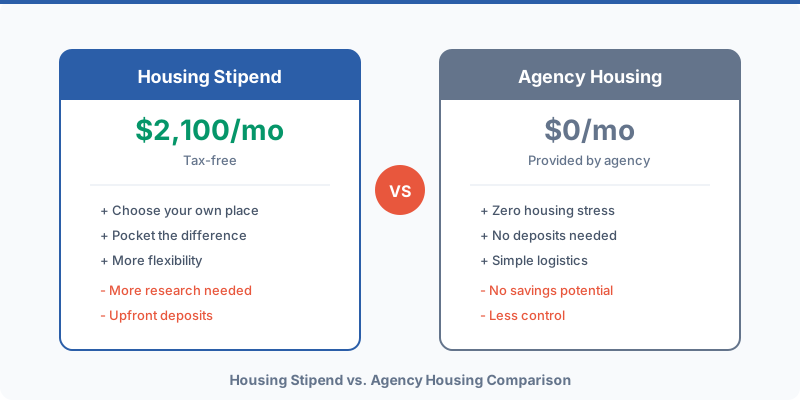
Neither option is universally better. The right answer depends on your experience level, the assignment location, the housing market, your lifestyle, and your financial goals. But making an informed decision requires understanding how each option actually works, what each one costs you, and where the hidden trade-offs are.
This guide breaks down both options with real numbers so you can make the best call for every contract.
Disclaimer: This guide is for educational purposes only and does not constitute tax advice. Consult a qualified tax professional for guidance specific to your situation.
How Agency Housing Works
When you choose agency housing, the staffing agency finds and pays for your accommodation directly. You show up, move in, and start working. The agency handles the lease, security deposit, and rent payments.
What you typically get: Agency housing usually means a furnished apartment, corporate housing unit, or extended-stay hotel room. Most placements include basic furniture, kitchen essentials, linens, and utilities. Some agencies include internet and parking; others do not.
What you might not get: Quality and amenities vary widely. Some agencies provide comfortable, well-located apartments. Others place nurses in dated extended-stay hotels far from the facility, or worse, in shared housing with a roommate you have never met. The experience is unpredictable unless you ask detailed questions upfront.
How it affects your pay package: When the agency provides housing, they remove or significantly reduce the housing stipend from your compensation. The money that would have gone to you as a tax-free stipend instead goes to the landlord or hotel directly. Your weekly paycheck is noticeably smaller — but you have no housing bills to pay out of pocket.
The convenience factor: For nurses who want simplicity, agency housing delivers. No searching for apartments, no security deposits from your own funds, no risk of scams, and no lease to manage. You pack your bags and go.
How the Housing Stipend Works
When you take the housing stipend, the agency adds a weekly or monthly tax-free payment to your paycheck. You then find, secure, and pay for your own housing.
The stipend amount is typically based on GSA (General Services Administration) per diem rates for the assignment area, which reflect the government’s estimate of reasonable lodging costs. In a high-cost city like San Francisco, the stipend will be significantly higher than in a rural area of Mississippi.
The financial opportunity is straightforward: if you find housing that costs less than your stipend, you pocket the difference — tax-free. If your stipend is $1,200 per week and you find a furnished apartment for $800 per week, that extra $400 per week is yours to keep without owing a dime in taxes (assuming you maintain a valid tax home).
You also get full control. You choose the neighborhood, the type of housing, whether to bring pets, and whether to share a space or live alone. For a detailed explanation of how stipends work, see our travel nurse stipend guide.
Financial Comparison
The Math Behind Agency Housing
When an agency provides your housing, they are spending money on that housing — but typically less than what your stipend would have been. Agencies negotiate corporate rates with hotels and apartment complexes, and those rates are often well below market price.
Here is an example. Suppose your contract in Austin, Texas offers:
- With housing stipend: $22/hr base + $1,100/week housing stipend + $350/week M&IE
- With agency housing: $22/hr base + $0 housing stipend + $350/week M&IE + agency-provided apartment
With the stipend, your weekly gross is $1,142 (taxable) + $1,450 (non-taxable) = $2,592.
With agency housing, your weekly gross is $1,142 (taxable) + $350 (non-taxable M&IE) = $1,492 — a difference of $1,100 per week on paper. The agency, meanwhile, might be paying $700 per week for your apartment at a negotiated corporate rate. That $400 gap between your stipend and their cost is money that stays with the agency.
The Math Behind Taking the Stipend
Using the same Austin example with the $1,100 weekly housing stipend:
- You find a furnished one-bedroom apartment on Furnished Finder for $850 per week
- Your housing cost: $850/week
- Your stipend: $1,100/week
- Your weekly savings: $250 (tax-free)
- Over a 13-week contract: $3,250 in additional tax-free income
Now use the pay calculator to model this for your specific assignment and see the real difference.
Side-by-Side Comparison
| Factor | Housing Stipend | Agency Housing |
|---|---|---|
| Weekly take-home (example) | $2,592 | $1,492 |
| Out-of-pocket housing cost | $850/week | $0 |
| Net weekly after housing | $1,742 | $1,492 |
| 13-week net difference | +$3,250 | — |
| Effort required | High (you find housing) | Low (agency handles it) |
| Control over quality | Full | Limited |
| Risk of scams | Some | None |
When agency housing wins financially: In extremely expensive markets where short-term rental prices exceed the stipend amount — think Manhattan, parts of the Bay Area, or resort towns during peak season — agency housing can actually save you money. The agency’s negotiated rates may beat anything you can find on your own.
Pros and Cons of Agency Housing
Pros
- Zero effort to find housing. The agency does all the legwork.
- No security deposits or lease agreements. You are not on the hook for deposits or early termination if your contract changes.
- No risk of housing scams. The agency has vetted the property and handles payments directly.
- Move-in ready. Furnished, usually with utilities included, ready for day one.
- Great for first-time travelers. Reduces the number of things you need to figure out on your first assignment.
Cons
- Usually costs you more in lost stipend value. The financial comparison almost always favors taking the stipend.
- Limited control over location and quality. You might end up far from the hospital or in a place that does not meet your standards.
- Roommate risk. Some agencies place two nurses in a shared apartment to save costs. If you are not comfortable sharing with a stranger, clarify this before accepting.
- Difficult to accommodate pets or family. Agency housing often has restrictions on pets, guests, and additional occupants.
- Quality varies wildly. Horror stories about agency housing are common in travel nurse communities — from roach-infested apartments to hotels with no kitchens.
Pros and Cons of Taking the Stipend
Pros
- Higher total take-home pay in most cases. The math almost always works in your favor.
- Full control over where you live. Choose the neighborhood, the building, the amenities, and the commute time.
- Lifestyle flexibility. Bring your pet, your partner, or your family. Choose a place that fits your life.
- Tax-free income. With a valid tax home, the stipend is not taxed, and any money saved on housing is tax-free savings.
- Build skills and relationships. Over time, you get efficient at finding housing fast. Repeat travelers build networks of landlords and fellow nurses who share leads.
Cons
- You do all the work. Finding short-term furnished housing in an unfamiliar city takes time and effort.
- Scam risk. Especially in tight housing markets, scammers target travel nurses with fake listings. Never wire money or pay before verifying a property.
- Security deposits and lease obligations. You may need to put down a deposit, and breaking a lease early if your contract is canceled can be costly.
- Housing may exceed your stipend. In some expensive markets, you may spend more on housing than the stipend covers, eating into your other earnings.
- More financial planning required. You are managing another monthly bill and need to budget for deposits, potential gaps, and unexpected costs.
When to Choose Agency Housing
Agency housing makes the most sense in specific situations:
- Your first travel assignment. There is already so much to learn on your first contract — new hospital, new city, new charting system. Removing the housing variable lets you focus on getting your feet under you. Many experienced travelers took agency housing on assignment one and switched to the stipend from assignment two onward.
- Assignments in extremely tight housing markets. If the assignment is in a location where short-term rentals are scarce or wildly expensive, agency housing removes a major headache.
- Very short contracts (less than 8 weeks). For short stints, the effort of finding housing may not be worth the savings, especially if security deposits eat into your margin.
- Remote or rural assignments. In areas with few rental options, the agency may have connections you do not.
- When you value convenience above all else. Some nurses simply prefer not to deal with housing logistics. That is a valid choice as long as you understand the financial trade-off.
When to Take the Stipend
The stipend is almost always the better financial choice when:
- You have experience finding short-term housing. After one or two assignments, most nurses develop a system that makes the process efficient.
- The assignment is in a location with affordable furnished rentals. Cities with large student populations, military bases, or established travel nurse communities tend to have good options.
- You want to maximize take-home pay. If your goal is to save aggressively, the stipend gives you the biggest financial upside.
- You have pets or a travel companion. Agency housing rarely accommodates either. The stipend lets you choose pet-friendly or family-friendly options.
- You have specific preferences. Need a quiet space, a home gym, or a yard? The stipend lets you prioritize what matters to you.
Tips for Making Agency Housing Work
If you go the agency housing route, protect yourself:
- Ask to see photos or a virtual tour before accepting. If the agency cannot show you the property, ask for the address and look it up yourself.
- Clarify exactly what is included. Utilities, internet, parking, and laundry access should all be confirmed in writing.
- Ask about roommate policies. Will you have a private unit, or could the agency place another nurse with you? Get this in writing.
- Know your rights if the housing is substandard. If you arrive to find the housing is unsafe or drastically different from what was described, document everything with photos and contact your recruiter immediately. Most agencies will relocate you, but you need to advocate for yourself.
- Ask about switching to the stipend mid-contract. Some agencies allow this if the housing situation is unworkable. It is easier to negotiate this option upfront than to fight for it later.
Tips for Finding Your Own Housing
If you take the stipend, approach housing like a project:
- Start searching 4 to 6 weeks before your start date. Good furnished rentals go fast, especially in popular travel nurse markets. Do not wait until the last week.
- Use Furnished Finder as your primary resource. It is built specifically for travel nurses and healthcare professionals, with listings from landlords who understand short-term leases and travel schedules.
- Check Airbnb for monthly rates. Many Airbnb hosts offer significant discounts for stays of 28 days or longer. A 13-week stay can often be negotiated to a favorable monthly rate.
- Join local Facebook groups. Search for “[City] Travel Nurses” or “[City] Short-Term Rentals” groups. Fellow nurses often post leads and reviews.
- Verify every listing. Never wire money to someone you have not verified. Look up the property on Google Maps, ask for a video tour, and pay through secure methods. For more on avoiding scams, see our travel nurse housing scams guide.
- Negotiate monthly rates for 13-week stays. Landlords prefer guaranteed tenants over vacancies. A 3-month commitment gives you negotiating leverage, especially at extended-stay properties.
FAQ
Can I switch from agency housing to the stipend mid-contract?
Some agencies allow this, but it depends on the terms of your contract and the agency’s policies. If you are considering this possibility, negotiate the option before signing. Once you are locked into agency housing with a lease the agency has signed, breaking it mid-contract is harder. If you do switch, the agency will add the housing stipend to your pay and you will need to find your own accommodation for the remainder of the contract. The earlier you make this decision, the smoother it goes.
What if agency housing is terrible?
Document everything with photos and written descriptions the moment you arrive. Contact your recruiter immediately — not in a few days, immediately. Most agencies have policies for relocating nurses from substandard housing, but you need to escalate quickly. If the agency is unresponsive, know that you have leverage: the facility needs you, and the agency does not want to lose the placement. In extreme cases, you can request a switch to the stipend and find your own housing.
Does my housing choice affect my tax home?
No. Your housing choice at the assignment location does not affect your tax home status. Your tax home is your permanent residence — the place you maintain when you are not on assignment. Whether you take agency housing or the stipend at your assignment has no bearing on whether you have a valid tax home. What matters is that you maintain a real residence elsewhere. For the full breakdown, see our tax home guide.
Can I negotiate a higher stipend if I refuse agency housing?
Not typically, but it is worth asking. The stipend amount is usually based on GSA rates for the assignment area and is set as part of the overall pay package. However, some agencies have flexibility in how they allocate the total compensation. If the agency was going to spend $900 per week on your housing but your stipend is only $800 per week, pointing this out may give you grounds to request more. The worst they can say is no.
What about agency housing for travel nurses with families?
This is where agency housing usually falls short. Most agency-provided housing is designed for a single occupant — a studio or one-bedroom unit. Bringing a spouse, partner, children, or even a pet is often not possible with agency housing. If you are traveling with family, the stipend is almost always the better option because it lets you find a two-bedroom apartment, a pet-friendly rental, or a house with a yard. Factor in the extra space you need when running your housing cost comparison.
Key Takeaways
- Taking the housing stipend usually results in higher take-home pay. The math favors the stipend in the majority of situations.
- Agency housing offers convenience at a real financial cost. You are trading dollars for simplicity.
- Run the numbers for every contract. Do not assume one option is always better. Market conditions, stipend amounts, and local rental availability change from assignment to assignment.
- First-time travelers may benefit from starting with agency housing on their first contract, then switching to the stipend once they know the ropes.
- Use the pay calculator to model both options for your next assignment and see the difference in black and white.
Related Internal Links
- Travel Nurse Housing Guide
- How to Find Travel Nurse Housing
- Travel Nurse Stipend Explained
- Furnished Finder Review
- Travel Nurse Housing Scams
- How to Compare Travel Nurse Pay Packages
Affiliate Placement Notes
- Furnished Finder affiliate link in “Tips for Finding Your Own Housing” section
- Extended stay hotel booking affiliate links in the agency housing section
- Pay calculator CTA in the financial comparison section and key takeaways
- Airbnb referral link where mentioned
