
How to Cover Insurance Gaps Between Assignments
Disclosure: Some links in this post are affiliate links. If you click through and make a purchase, we may earn a small commission at no extra cost to you. Learn more about how we make money.
Introduction
Gaps between travel nurse assignments are inevitable. Whether you are taking a well-deserved vacation, waiting for your next contract to start, dealing with licensing delays in a new state, or navigating a seasonal slowdown, there will be periods when you are not actively on assignment. Going uninsured during these gaps is risky and unnecessary. A single ER visit can cost thousands, and even a minor urgent care trip adds up fast without coverage.
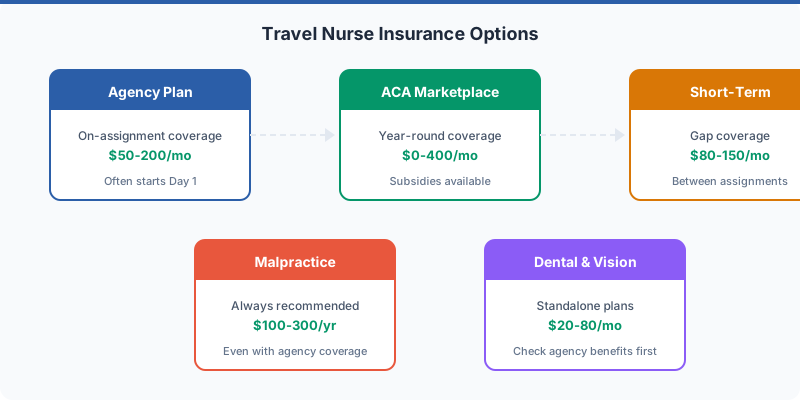
The good news is that several affordable options exist to keep you covered during every gap, no matter how short or long. This guide walks through five proven strategies so you can pick the approach that fits your situation and budget.
This is educational content, not insurance or financial advice. Consult a licensed insurance professional for guidance specific to your situation.
Common Gap Scenarios for Travel Nurses
Before diving into solutions, it helps to understand the different types of gaps you might face. Each scenario may call for a different strategy.
Planned breaks between contracts. You finished a 13-week contract and want two to four weeks off before starting the next one. This is the most common gap and the easiest to plan for.
Unexpected cancellations or early termination. Your facility cancels your contract with little notice, or an assignment ends earlier than expected. These surprise gaps are stressful because you did not have time to arrange coverage in advance.
Licensing delays for a new state. You have accepted a contract in a new state, but your compact license does not cover it and the state board is taking weeks to process your application. You are in limbo with no assignment and no agency benefits.
Waiting for new agency benefits to kick in. You switched agencies, and the new one has a 30-day waiting period before health insurance begins. That is a full month of exposure.
Seasonal slowdowns. The travel nursing market has seasonal ebbs and flows. Late summer and early fall can be slower, and you might go longer between contracts than you planned.
Strategy 1: ACA Special Enrollment Period
This is the most powerful tool in a travel nurse’s gap coverage arsenal, and many nurses do not realize they qualify.
How it works. Losing employer-sponsored health coverage — which happens every time a travel nurse contract ends and agency benefits stop — is a qualifying life event that triggers a Special Enrollment Period (SEP) on the ACA marketplace. You get 60 days from the date you lose coverage to enroll in a marketplace plan.
How to apply quickly. Go to Healthcare.gov (or your state’s marketplace if you live in a state with its own exchange). Select “loss of health coverage” as your qualifying life event. You will need your coverage termination date and basic income information. Most applications can be completed in under 30 minutes.
Choosing a plan for your gap. If you expect a short gap of one to two months, a Bronze-tier plan with the lowest premium may make the most sense. You are mainly looking for catastrophic protection. If the gap might extend longer or you have ongoing medical needs, a Silver plan with cost-sharing reductions offers better day-to-day coverage. For detailed plan selection guidance, see our ACA marketplace guide for travel nurses.
Income estimation during gaps. When applying, you need to estimate your income for the full calendar year. During a gap, your income may be lower, which could actually increase your subsidy amount. Be honest and reasonable in your estimate. If you expect to return to travel nursing within a few weeks, include your expected future income. The marketplace allows you to update your income estimate throughout the year as your situation changes.
Strategy 2: COBRA Continuation
COBRA is not always the best option, but it has one unique advantage: it lets you retroactively elect coverage, which makes it a powerful emergency safety net.
The retroactive enrollment strategy. When your agency coverage ends, you receive a COBRA election notice. You have 60 days to decide whether to enroll. Here is the key insight: you do not have to decide right away. If you stay healthy during your gap, you never elect COBRA and pay nothing. If you have a medical emergency or unexpected health issue, you elect COBRA retroactively, pay the premiums for the months you need, and your coverage applies back to the date your agency plan ended.
Cost considerations. COBRA premiums are steep — typically $500 to $800 per month for individual coverage — because you are paying the full cost of the group plan without the employer subsidy. For a one-to-two-month gap, this can be worth it if you need the coverage. For longer gaps, ACA marketplace plans are almost always cheaper, especially with subsidies.
When COBRA is the clear winner. COBRA keeps you on the same plan with the same network and the same providers. If you are in the middle of treatment, seeing a specialist, or have a procedure scheduled, COBRA ensures continuity of care without having to find new in-network providers.
For a complete breakdown of costs and scenarios, read our COBRA for Travel Nurses guide.
Strategy 3: Short-Term Health Insurance
Short-term health insurance is designed specifically for temporary coverage gaps. It is fast to set up and affordable, but it comes with real limitations.
What short-term plans cover. These plans typically cover emergency room visits, hospital stays, surgery, and some outpatient care. They are catastrophic coverage — meant to protect you from a financially devastating event, not to cover routine care.
What they exclude. Short-term plans commonly exclude pre-existing conditions, prescription drugs, mental health services, maternity care, and preventive care like annual physicals and screenings. They do not meet ACA minimum essential coverage requirements.
Duration and cost. Depending on your state, short-term plans can last from one to twelve months. Monthly premiums typically range from $100 to $250 for a healthy individual, making them 50 to 80 percent cheaper than COBRA. You can usually get approved and start coverage within days.
Best for. Planned short breaks (two to eight weeks) for healthy nurses with no ongoing prescriptions or treatment needs. If you have any pre-existing conditions or regular healthcare needs, an ACA marketplace plan is a better choice.
Strategy 4: Spouse or Partner Coverage
If your spouse or domestic partner has employer-sponsored health insurance, their plan may be your simplest and most cost-effective gap coverage option.
Qualifying life event enrollment. Losing your own health coverage qualifies as a life event that allows your spouse to add you to their plan outside of their employer’s open enrollment period. The enrollment window is typically 30 days from the date you lost coverage.
Timing requirements. Act quickly. Your partner’s HR department will need proof that your prior coverage ended (a letter from your agency or COBRA notice) and will have a strict enrollment deadline. Do not wait until the last week of your gap to start this process.
When this is the most cost-effective option. If your spouse’s employer subsidizes dependent coverage generously, adding you to their plan may cost $100 to $300 per month — often cheaper than COBRA and potentially cheaper than an unsubsidized ACA plan. It also provides comprehensive coverage without the limitations of short-term plans.
Year-round consideration. Some travel nurses stay on a spouse’s plan year-round and skip agency insurance entirely. This simplifies everything: no coverage gaps, no enrollment headaches between contracts, and potentially a higher hourly rate since you are declining agency benefits.
Strategy 5: Maintaining Year-Round Coverage
The most stress-free approach to gap coverage is eliminating gaps entirely by maintaining your own year-round health insurance plan.
How it works. Instead of relying on agency insurance that starts and stops with every contract, you purchase your own ACA marketplace plan (or a private plan) and keep it active all year. When an agency offers you health insurance, you decline it and negotiate a higher hourly rate or stipend instead.
The financial math. Suppose your agency offers health insurance but would pay you $3 per hour more without it. Over a 13-week, 36-hour-per-week contract, that is an extra $1,404. If your own ACA plan costs $200 per month after subsidies, that is $2,400 per year. Working three contracts per year, the extra pay from declining agency insurance totals $4,212 — easily covering your personal plan with money left over.
Continuity of care. With your own year-round plan, you keep the same doctors, the same network, and the same deductible progress regardless of what happens with your assignments. No re-enrollment, no new insurance cards, no wondering if your medications are covered under a new plan.
Best for. Travel nurses who work with multiple agencies, take frequent breaks between assignments, or simply want to eliminate the mental burden of managing insurance changes every 13 weeks. For more on choosing an ACA plan that works for this strategy, see our ACA marketplace guide.
Protecting Dental, Vision, and Other Coverage
Health insurance gets the most attention, but do not forget about the other coverage types that can lapse during gaps.
Dental and vision. If your agency provided dental and vision insurance, those benefits end when your contract ends too. Standalone dental and vision plans are affordable — typically $20 to $50 per month combined — and can be maintained year-round regardless of your employment status. See our dental and vision insurance guide for provider comparisons and recommendations.
Malpractice insurance. Your professional liability coverage should never lapse, even during gaps between assignments. If you carry your own occurrence-based policy (which you should), it remains active as long as you pay the premium. See our malpractice insurance guide for details.
Disability insurance. A personal disability policy stays active between assignments, protecting your income even when you are not on contract. Agency-provided disability coverage, like agency health insurance, stops when your contract stops. Read our disability insurance guide for more.
Prescription drug coverage. If you take regular medications, make sure your gap coverage includes prescription benefits. Short-term health plans often exclude prescriptions. ACA marketplace plans and COBRA both cover prescriptions, making them better choices if you have ongoing medication needs. You can also use HSA or FSA funds to cover prescription costs during gaps.
Frequently Asked Questions
What is the cheapest way to stay insured between travel nurse assignments?
The cheapest option depends on your gap length and circumstances. For very short gaps of one to four weeks, the COBRA retroactive enrollment strategy costs nothing if you stay healthy and provides a safety net if something happens. For planned gaps of one to three months, a short-term health insurance plan at $100 to $250 per month is the most affordable option. For longer gaps or year-round coverage, an ACA marketplace plan with premium tax credits is often the best value, potentially costing as little as $50 to $200 per month after subsidies.
Does losing my agency health insurance qualify me for a Special Enrollment Period?
Yes. Losing employer-sponsored health coverage is a qualifying life event that triggers a 60-day Special Enrollment Period on the ACA marketplace. Every time a travel nurse contract ends and agency benefits stop, you are eligible to enroll in a marketplace plan regardless of whether it is open enrollment season. Go to Healthcare.gov or your state’s marketplace, select loss of health coverage as your qualifying event, and complete the application. Most applications can be finished in under 30 minutes.
Should I keep my malpractice and disability insurance active during gaps?
Absolutely. Both malpractice and disability insurance should remain active at all times, even during gaps between assignments. If you carry your own occurrence-based malpractice policy, it covers incidents that happen while the policy is active, so any lapse creates an unprotected window. Personal disability insurance protects your income regardless of your employment status. At their relatively low monthly costs, these policies are too important to let lapse for a few weeks of savings.
Is it worth maintaining year-round health insurance instead of relying on agency coverage?
For many experienced travel nurses, maintaining a personal year-round ACA marketplace plan is the simplest and most cost-effective strategy. When you decline agency insurance, most agencies increase your hourly rate by three to five dollars per hour. Over three 13-week contracts per year at 36 hours per week, that extra pay totals over $4,000, which more than covers the cost of a personal marketplace plan. You also get continuity of care with the same doctors, the same network, and no re-enrollment headaches every time you switch contracts.
What should I do about dental and vision coverage during gaps?
Standalone dental and vision plans are affordable and can be maintained year-round regardless of your employment status. Budget $30 to $60 per month combined for solid dental and vision coverage through providers like Delta Dental and VSP. These plans offer nationwide networks that work well for travel nurses in any state. Alternatively, discount dental programs cost $80 to $200 per year and provide reduced rates at participating providers with no waiting periods or claim forms.
Frequently Asked Questions
What is the cheapest way to cover a short gap between travel nurse assignments?
For a planned gap of two to four weeks, the cheapest option is often the COBRA retroactive enrollment strategy, which costs nothing if you stay healthy. You hold onto your COBRA election notice and only elect coverage if a medical issue arises during the gap. If you prefer active coverage, a short-term health insurance plan typically costs $100 to $250 per month and provides basic catastrophic protection. For longer gaps or if you have ongoing medical needs, an ACA marketplace plan with subsidies may cost $50 to $200 per month and provides comprehensive coverage.
Does losing my agency insurance qualify me for a Special Enrollment Period?
Yes. Losing employer-sponsored health coverage, which happens every time a travel nurse contract ends and agency benefits stop, is a qualifying life event that triggers a 60-day Special Enrollment Period on the ACA marketplace. During this window, you can enroll in a marketplace plan regardless of whether it is open enrollment season. You will need your coverage termination date to complete the application, and most applications can be finished in under 30 minutes at Healthcare.gov or your state’s marketplace website.
Should I keep my malpractice and disability insurance during gaps between assignments?
Absolutely. Malpractice insurance and disability insurance should never lapse during gaps between assignments. If you carry your own occurrence-based malpractice policy, it protects you from claims related to incidents that occurred while you were on assignment, even if the claim is filed months or years later. A personal disability policy continues to protect your income during gaps, which is especially important since you would have no agency safety net if you were injured during a break. At their relatively low monthly cost, keeping both active year-round is an easy and essential decision.
Is it worth maintaining year-round ACA coverage instead of using agency insurance?
For many travel nurses, maintaining a personal year-round ACA marketplace plan is the most stress-free and often the most cost-effective approach. By declining agency insurance and negotiating a higher hourly rate, you can come out ahead financially while eliminating enrollment headaches between every contract. Over three 13-week contracts per year, the extra pay from declining agency insurance often totals $4,000 or more, which more than covers a personal plan. You also get continuity of care with the same doctors and network regardless of your assignment.
What should I do if my contract is cancelled unexpectedly and I lose insurance?
An unexpected contract cancellation triggers the same qualifying life event as a planned end, giving you 60 days to enroll in an ACA marketplace plan through a Special Enrollment Period. In the immediate term, your COBRA election notice serves as a free safety net since you can elect coverage retroactively if needed. Contact your agency’s benefits administrator to confirm your exact coverage termination date, and begin your marketplace application as soon as possible. If you have a spouse with employer insurance, your loss of coverage also qualifies as a life event for their plan, which may offer a faster enrollment path.
Key Takeaways
- Never go uninsured between assignments. Affordable options exist for every gap length and budget.
- Loss of agency coverage triggers an ACA Special Enrollment Period. You have 60 days to enroll in a marketplace plan — use it.
- COBRA retroactive enrollment can cover surprise gaps. Keep the election notice handy as a free safety net.
- Short-term plans are cheapest for planned short breaks. But they exclude pre-existing conditions and many services.
- Consider year-round personal ACA coverage for maximum simplicity. Decline agency insurance, negotiate higher pay, and eliminate gaps entirely.
- Keep malpractice and disability active even during gaps. These are too important to let lapse.
Related Resources
- Travel Nurse Health Insurance: Complete Guide
- COBRA for Travel Nurses: Is It Worth the Cost?
- ACA Marketplace Plans for Travel Nurses (2026 Guide)
- Dental and Vision Insurance for Travel Nurses
- How to Become a Travel Nurse
- Travel Nurse Tax Deductions
Affiliate Placement Notes
- ACA marketplace enrollment assistance link after Strategy 1
- Short-term health insurance quote tool after Strategy 3
- Year-round ACA plan comparison after Strategy 5
- Sidebar widget for “Get a gap coverage quote” CTA
