
COBRA for Travel Nurses: Is It Worth the Cost?
Disclosure: Some links in this post are affiliate links. If you click through and make a purchase, we may earn a small commission at no extra cost to you. Learn more about how we make money.
Introduction
COBRA lets you keep your old health plan after leaving a job, but the sticker shock is real. You pay the full premium — the portion you were paying as an employee plus the portion your agency was paying on your behalf — along with a 2 percent administrative fee. For travel nurses bouncing between 13-week contracts, COBRA can be a lifeline in specific situations or a money pit if you use it by default.
This guide explains exactly how COBRA works for travel nurses, what it costs, when it genuinely makes sense, and when you should choose a cheaper and often better alternative.
This is educational content, not insurance or financial advice. Consult a licensed insurance professional for guidance specific to your situation.
What Is COBRA and How Does It Work?
COBRA stands for the Consolidated Omnibus Budget Reconciliation Act, a federal law passed in 1985 that gives employees the right to continue their employer-sponsored group health coverage after a qualifying event, such as job loss or reduction in hours.
Eligibility requirements. COBRA applies to employers with 20 or more employees. Most major travel nursing agencies meet this threshold. When your contract ends and your agency-sponsored health coverage terminates, that counts as a qualifying event. You are eligible for COBRA regardless of whether you quit, were terminated, or simply completed your contract.
The 60-day election window. After your coverage ends, your agency’s benefits administrator must send you a COBRA election notice within 14 days. From the date you receive that notice, you have 60 days to decide whether to elect COBRA. This window is critical — if you miss it, you lose the option.
Retroactive coverage. Here is the feature that makes COBRA strategically valuable for travel nurses: if you elect COBRA within the 60-day window, your coverage is retroactive to the day your agency plan ended. There is no gap in coverage, even if you wait until the last day to elect. You then have an additional 45 days to make your first premium payment.
Duration. Standard COBRA coverage lasts up to 18 months from your qualifying event. In certain circumstances — disability during the COBRA period or a second qualifying event — coverage can extend to 29 or 36 months.
Mini-COBRA for smaller agencies. If your agency has fewer than 20 employees, federal COBRA does not apply. However, many states have their own “mini-COBRA” laws that provide similar continuation rights with varying durations and rules. Check your state’s insurance department for details. This is more common with smaller, regional staffing agencies.
The True Cost of COBRA for Travel Nurses
COBRA premiums are the number one reason most travel nurses look elsewhere for gap coverage.
Why premiums are so high. When you are employed, your agency typically pays 50 to 80 percent of your health insurance premium. You only see your share on your paycheck stub. Under COBRA, you pay the full 100 percent plus a 2 percent administrative fee. What felt like a $75-per-week plan suddenly costs $400 to $800 per month.
Average monthly COBRA costs (2026 estimates):
| Coverage Type | Monthly COBRA Premium |
|---|---|
| Individual | $550 - $800 |
| Employee + Spouse | $1,000 - $1,500 |
| Family | $1,400 - $2,200 |
Actual costs depend on your specific agency plan. Your COBRA election notice will state the exact premium.
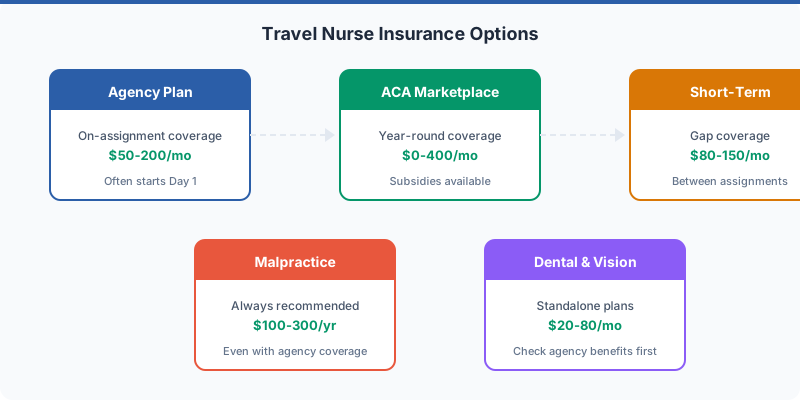
Comparing COBRA to ACA marketplace. An ACA marketplace plan for an individual travel nurse might cost $200 to $500 per month before subsidies. With premium tax credits (which many travel nurses qualify for due to non-taxable stipend income), the cost could drop to $50 to $200 per month. The savings over COBRA can be dramatic — potentially $400 to $700 per month for similar or better coverage.
Hidden costs. Beyond the premium, remember that COBRA continues your existing plan’s deductible and out-of-pocket maximum. If you already met your deductible for the year, COBRA preserves that progress — a genuine benefit. But if you are starting fresh in a new plan year, you are paying high premiums and still facing the full deductible.
When COBRA Actually Makes Sense
Despite the cost, there are specific scenarios where COBRA is the right choice for a travel nurse.
You are mid-treatment with a specific provider. If you are seeing a specialist, undergoing a course of treatment, or managing a complex condition through providers in your agency plan’s network, COBRA keeps you on the same plan with the same network. Switching to an ACA plan could mean finding new providers, getting new referrals, and potentially interrupting care.
You are pregnant or have a planned procedure. If you have a surgery scheduled, are in the middle of fertility treatment, or are pregnant and want to maintain continuity with your OB/GYN, COBRA ensures nothing changes in your coverage. Switching plans mid-pregnancy or before a scheduled procedure introduces risk and hassle.
You have already met your deductible. If you have already paid through your annual deductible and out-of-pocket costs for the year, COBRA lets you continue benefiting from that investment. A new plan would reset your deductible to zero.
Short gaps of one to two months. For very brief gaps between contracts, COBRA’s retroactive election feature is powerful. You can let the 60-day election window run while you start your next assignment. If nothing happens and you get on the new agency’s plan, you never elect COBRA and pay nothing. If a medical issue arises during the gap, you elect COBRA retroactively.
The retroactive enrollment strategy in detail. This is the COBRA move every travel nurse should know. When your contract ends, do not immediately elect COBRA. Hold the election notice and let the 60-day clock run. If you stay healthy, you move on to your next contract’s insurance without ever paying a COBRA premium. If you need medical care during the gap, you elect COBRA within the 60-day window, pay the premium for the month(s) you need, and your coverage retroactively covers the expense. It is essentially free insurance for 60 days, with the option to pay only if you need it.
When to Skip COBRA
In many situations, COBRA is not the best option for travel nurses. Here is when to look elsewhere.
Long gaps where ACA or short-term plans are cheaper. If your gap will be three months or longer, the cost difference between COBRA and an ACA marketplace plan (especially with subsidies) becomes substantial. Over three months, you might save $1,200 to $2,100 by choosing an ACA plan over COBRA.
You qualify for ACA subsidies. Travel nurse pay structures with non-taxable stipends can result in a lower Modified Adjusted Gross Income (MAGI), which makes you eligible for premium tax credits on the ACA marketplace. If your subsidized ACA premium is $100 to $200 per month versus $600 or more for COBRA, the choice is clear. See our ACA marketplace guide for details on estimating your subsidies.
Your agency plan network does not cover your gap location. COBRA continues your existing plan, including its network. If your agency plan was centered in one region and you are spending your break in a different part of the country, the network may not include providers near you. Paying COBRA premiums for a plan you cannot practically use is wasteful.
You are young, healthy, and have no ongoing care. If you have no prescriptions, no upcoming medical needs, and a clean bill of health, a short-term health insurance plan ($100 to $250 per month) or the COBRA retroactive strategy (potentially $0 if nothing happens) is more cost-effective.
Better Alternatives to COBRA
For most travel nurses, these options offer better value than COBRA.
ACA Special Enrollment Period. Losing your agency coverage is a qualifying life event that triggers a 60-day Special Enrollment Period on the ACA marketplace. You can enroll in a comprehensive plan, potentially with subsidies, that starts on the first day of the month after you lose coverage. This is the most popular COBRA alternative for travel nurses. Read our complete guide on covering insurance gaps between assignments.
Short-term health insurance. For gaps of one to three months, a short-term plan provides basic coverage at a fraction of COBRA’s cost. These plans are not comprehensive — they exclude pre-existing conditions and some services — but they protect against catastrophic expenses. Premiums run $100 to $250 per month.
Spouse or partner coverage. If your spouse has employer-sponsored insurance, your loss of coverage triggers a qualifying event for their plan. You can be added as a dependent, often at a reasonable cost.
Health care sharing ministries. Not insurance, but a lower-cost option for healthy nurses. Monthly shares typically run $200 to $500. Be aware of significant limitations compared to traditional insurance. See our complete health insurance guide for a full comparison.
Next agency plan with no waiting period. If you are jumping to a new contract quickly, some agencies offer day-one health coverage with no waiting period. Ask about this before accepting your next assignment — it could eliminate the gap entirely.
Frequently Asked Questions
How much does COBRA cost for travel nurses?
COBRA premiums are significantly higher than what you paid as an employee because you are now responsible for the full premium that your agency was previously subsidizing, plus a 2 percent administrative fee. For individual coverage, expect to pay $550 to $800 per month. Family coverage typically runs $1,400 to $2,200 per month. The exact cost depends on your specific agency plan and will be stated clearly on your COBRA election notice.
Can I sign up for COBRA retroactively if I have a medical emergency?
Yes, and this is the most strategic way to use COBRA as a travel nurse. When your contract ends, you receive a COBRA election notice and have 60 days to decide whether to enroll. If you stay healthy during the gap, you never elect COBRA and pay nothing. If a medical issue arises, you elect COBRA within the 60-day window, pay the premium for the months you need, and your coverage applies retroactively to the day your agency plan ended. It is essentially a free safety net that you only pay for if you need it.
Is COBRA or an ACA marketplace plan cheaper for travel nurses?
For most travel nurses, an ACA marketplace plan is significantly cheaper than COBRA. A marketplace plan might cost $200 to $500 per month before subsidies, and with premium tax credits the cost could drop to $50 to $200 per month. That is a savings of $400 to $700 per month compared to COBRA. The only situations where COBRA might be worth the higher cost are when you are mid-treatment with a specific provider, have already met your deductible for the year, or need to maintain continuity of care during a very short gap.
How long does COBRA coverage last?
Standard COBRA coverage lasts up to 18 months from your qualifying event, which for travel nurses is typically the end of a contract when agency health benefits terminate. In certain special circumstances, such as a disability during the COBRA period or a second qualifying event, coverage can be extended to 29 or 36 months. For most travel nurses, 18 months is more than enough since gaps between assignments typically last a few weeks to a few months.
Does my agency have to offer COBRA?
COBRA applies to employers with 20 or more employees, and most major travel nursing agencies meet this threshold. If your agency has fewer than 20 employees, federal COBRA does not apply, but many states have their own mini-COBRA laws that provide similar continuation rights with varying durations and rules. Check with your state’s insurance department if you work for a smaller, regional staffing agency. Your agency’s benefits administrator is required to send you a COBRA election notice within 14 days of your coverage ending.
Frequently Asked Questions
How much does COBRA cost for travel nurses?
COBRA premiums for individual coverage typically range from $550 to $800 per month for travel nurses. Family coverage can run $1,000 to $2,200 per month. These costs are significantly higher than what you paid as an employee because you are now responsible for the full premium, including the portion your agency previously subsidized, plus a 2 percent administrative fee. Your exact COBRA premium will be stated on the election notice you receive from your agency after your coverage ends.
Can I sign up for COBRA retroactively after a medical emergency?
Yes, and this is the most strategic way to use COBRA as a travel nurse. When your contract ends, you receive a COBRA election notice and have 60 days to decide whether to enroll. If you stay healthy during that window, you never elect COBRA and pay nothing. If a medical emergency or unexpected health issue arises, you elect COBRA retroactively within the 60-day window, pay the premiums for the months you need, and your coverage applies back to the date your agency plan ended. This strategy essentially provides free insurance for up to 60 days with the option to pay only if needed.
Is COBRA or an ACA marketplace plan cheaper for travel nurses?
In most cases, an ACA marketplace plan is significantly cheaper than COBRA. An individual marketplace plan might cost $200 to $500 per month before subsidies, and with premium tax credits that many travel nurses qualify for, the cost could drop to $50 to $200 per month. Compared to COBRA premiums of $550 to $800 per month, the savings can be $400 to $700 per month for similar or better coverage. The main exception is when you are mid-treatment with a specific provider and need to maintain the same plan and network.
How long does COBRA coverage last?
Standard COBRA coverage lasts up to 18 months from the date of your qualifying event, which for travel nurses is typically the end of your agency contract. In certain circumstances, such as a disability determination during the COBRA period or a second qualifying event, coverage can extend to 29 or 36 months. For most travel nurses using COBRA strategically to cover short gaps between contracts, you will only need one to three months of coverage at most.
Does COBRA apply if my staffing agency has fewer than 20 employees?
Federal COBRA only applies to employers with 20 or more employees. Most major travel nursing agencies meet this threshold, but if you work for a smaller or regional staffing agency with fewer than 20 employees, federal COBRA does not apply. However, many states have their own “mini-COBRA” laws that provide similar continuation rights with varying durations and rules. Check your state’s insurance department website to find out what continuation coverage options are available to you through state law.
Key Takeaways
- COBRA is expensive but useful for short, specific situations. It shines when you need continuity of care, are mid-treatment, or have met your deductible.
- Always compare COBRA cost to ACA marketplace plans before enrolling. The savings from an ACA plan with subsidies can be $400 to $700 per month.
- You have 60 days to elect COBRA retroactively — use this strategically. Hold the election notice as a free safety net during short gaps.
- Job loss triggers a Special Enrollment Period for ACA plans. You do not have to wait for open enrollment to get marketplace coverage.
- For most travel nurses, ACA marketplace or short-term plans are more affordable. COBRA is the default many people reach for, but it is rarely the cheapest option.
- Factor in network access, deductible progress, and ongoing care when making your decision — cost is not the only consideration.
Related Resources
- Travel Nurse Health Insurance: Complete Guide
- How to Cover Insurance Gaps Between Assignments
- ACA Marketplace Plans for Travel Nurses (2026 Guide)
- HSA vs. FSA for Travel Nurses: Which One Works?
- Travel Nurse Agency Benefits Comparison Guide
- How to Become a Travel Nurse
Affiliate Placement Notes
- ACA marketplace enrollment tool link after Better Alternatives section
- Short-term health insurance quote widget after short-term mention
- “Compare COBRA vs. ACA costs” calculator CTA in sidebar
- Bottom CTA for gap coverage consultation
