
Best Cashback Apps for Travel Nurses
Disclosure: Some links in this post are affiliate links. If you click through and make a purchase, we may earn a small commission at no extra cost to you. Learn more about how we make money.
You Are Already Spending the Money — Start Getting Some of It Back
Every 13 weeks, you relocate to a new city, stock a new kitchen, fill your gas tank for a long drive, and settle into a new routine. Groceries, gas, household supplies, the occasional online order for something your rental is missing — the spending adds up fast. What if you could get a percentage of all that spending handed back to you, automatically, for about five minutes of effort per week?
That is exactly what cashback apps do. They are not coupons. They are not loyalty programs that take a year to pay off. They are straightforward tools that give you real cash back on purchases you are already making. The average user saves a few hundred dollars a year. But travel nurses, with their higher-than-average spending on groceries, gas, and household setup, can realistically save $500 to $1,200 annually — and that number climbs even higher when you stack cashback apps with credit card rewards.
The best part: once you set these apps up, most of them run on autopilot. Here are the ones worth your time.
Best Grocery Cashback Apps
Ibotta
Ibotta is the single most useful cashback app for travel nurses, and it should be the first one you download. It works by offering cash back on specific grocery items — sometimes brand-specific, sometimes any-brand offers like “$0.25 back on any gallon of milk.” You activate the offers before you shop, buy your groceries normally, then either scan your receipt or link your store loyalty card for automatic credit.
What makes Ibotta particularly valuable for travel nurses is its nationwide coverage. It works at most major grocery chains — Walmart, Kroger, Publix, Albertsons, H-E-B, Meijer, and hundreds more. No matter which city your next assignment takes you to, Ibotta almost certainly works at a store nearby.
Realistic savings: $20 to $50 per month on groceries, depending on how consistently you use it and which offers align with what you buy. That adds up to $240 to $600 per year. Ibotta also runs frequent bonuses — complete a certain number of offers in a month and earn an extra $3 to $5 on top of your regular cash back. These bonuses compound over time.
The key habit to build: spend two minutes browsing Ibotta offers before your grocery run. Add anything that matches what you already plan to buy. Do not change your shopping list to chase offers — that defeats the purpose. The goal is free money on things you were buying anyway.
Fetch Rewards
Fetch takes a different approach than Ibotta. Instead of offering cash back on specific items, Fetch gives you points for scanning any receipt from any store. Every receipt earns you at least 25 points, and receipts that include partner brands earn significantly more. Points convert to gift cards — 1,000 points equals roughly $1.
The appeal of Fetch is its simplicity. You do not need to activate offers or match brands. You just scan every receipt you get — groceries, gas, restaurants, pharmacies, even department stores. It takes about five seconds per receipt. Over the course of a 13-week assignment, those scanned receipts add up to $15 to $30 in gift card value with almost zero effort.
Fetch works best as a complement to Ibotta rather than a replacement. Use Ibotta for its higher-value grocery offers, then scan the same receipt in Fetch for additional points. There is no conflict between the two apps — you can double-dip on every grocery trip.
Best Online Shopping Cashback
Rakuten
If Ibotta is your grocery app, Rakuten is your online shopping app. Rakuten partners with over 3,500 online retailers and gives you cash back — typically 1% to 10% — on purchases you make through their platform. You activate the cashback offer, shop normally, and Rakuten deposits your earnings quarterly via check or PayPal.
Travel nurses tend to do a lot of online shopping, especially during those first few days at a new assignment when you realize your furnished rental is missing a decent pillow, a bath mat, and a power strip. Rakuten works at Amazon, Target, Walmart, Bed Bath and Beyond, Wayfair, and virtually every other major online retailer.
Where Rakuten really shines is on bigger purchases. Buying a new laptop? That 3% cashback on a $1,000 purchase is $30 back. Booking a hotel for your transition week? Many hotel sites offer 3% to 6% through Rakuten. Over the course of a year, nurses who use Rakuten consistently report $100 to $300 in cashback — and the occasional big-ticket purchase can push that number much higher.
Pro tip: install the Rakuten browser extension. It automatically detects when you are shopping at a partner store and reminds you to activate cashback. This eliminates the biggest pitfall of cashback apps — forgetting to use them.
Capital One Shopping and Honey
These browser extensions work alongside Rakuten (or as alternatives) to find coupon codes and price comparisons automatically. When you are checking out at an online store, Capital One Shopping and Honey scan for active coupon codes and apply the best one for you. They also track price drops on items you are watching and notify you when something goes on sale.
Neither of these will generate the same level of savings as Rakuten, but they are completely passive. Install the extension once and forget about it. Every time it finds a working coupon code at checkout, that is money saved that you would have left on the table.
Best Gas Rewards Apps
For travel nurses who drive between assignments — and that is most of you — gas is one of your biggest recurring expenses. A 500-mile drive between assignments at current gas prices can easily cost $80 to $150. Multiply that by four to six assignment transitions per year, plus your daily commute, and gas spending adds up fast.
GasBuddy
GasBuddy is the essential gas app for anyone who drives, but it is especially valuable when you are new to a city and have no idea where the cheap gas stations are. The app shows you real-time gas prices at stations near you, sorted by price, so you can always find the lowest option.
Beyond price comparison, GasBuddy offers a Pay with GasBuddy card that saves you an additional 5 to 25 cents per gallon at participating stations. There is no credit check — it links to your checking account. For a nurse filling up a 15-gallon tank, that is $0.75 to $3.75 saved per fill-up. If you fill up weekly, that is $40 to $195 per year in savings from GasBuddy alone.
The trip cost calculator is another underrated feature. Before accepting a new contract, plug in the drive distance to estimate your fuel costs. This helps you make smarter decisions when comparing pay packages — a contract that pays $50 more per week but requires a 1,200-mile drive to get there might not actually be the better deal.
Upside (formerly GetUpside)
Upside offers cash back on gas purchases at participating stations — typically 10 to 25 cents per gallon, though offers vary by location. You claim an offer in the app before filling up, pay normally, and the cashback appears in your Upside account within a few days.
The savings potential with Upside is solid: on a 15-gallon fill-up at 20 cents per gallon back, that is $3 in cashback. Fill up weekly and you are looking at $150 or more per year. And here is the key — Upside stacks with your credit card rewards. If you are using a gas rewards credit card that earns 3% to 5% back on gas, you get that plus the Upside cashback on the same purchase.
One thing to watch: Upside’s participating stations vary significantly by city. When you arrive at a new assignment, open the app and check which stations near you have offers. Some cities have extensive coverage; others are more limited.
Best Dining and Restaurant Cashback
After a 12-hour shift, the last thing you want to do is cook. Travel nurses eat out more than they would like to admit, and dining cashback apps can soften the blow.
Credit card dining portals from Chase, American Express, and other issuers often offer statement credits at specific restaurants. If your credit card has a dining portal, check it when you arrive in a new city — you might find local restaurants offering 10% to 20% back.
Apps like Seated and Dosh offer cashback at participating restaurants without requiring a special credit card. Seated rewards you with gift cards for dining at partner restaurants, while Dosh links to your credit or debit card and automatically applies cashback at participating locations.
The stacking play here is powerful: pay with a credit card that earns 3% to 4% on dining, use a cashback app that gives you another 5% to 15%, and you are earning a combined 8% to 19% back on a meal. That turns a $40 dinner into an effective $33 to $37 dinner.
The Stacking Strategy: Maximize Every Dollar
Here is where cashback apps go from “nice to have” to “genuinely impactful.” The real savings come from stacking multiple layers of rewards on the same purchase. This is not complicated and it does not require any special skills — just a system.
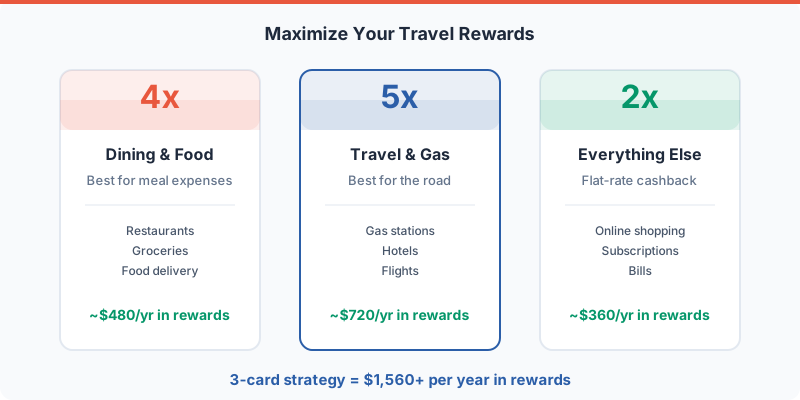
Layer 1: Credit card with a bonus category. Pay for your purchase with a credit card that earns elevated rewards in that category. Groceries on a card that earns 3% to 6% back. Gas on a card that earns 3% to 5% back. This is your foundation. If you do not have the right cards yet, check out our guide to the best credit cards for travel nurses.
Layer 2: Cashback app. Activate the relevant cashback app offer — Ibotta for groceries, Upside for gas, Rakuten for online purchases. This adds another 1% to 10% on top of your credit card rewards.
Layer 3: Store loyalty program or coupon. Many grocery stores have their own loyalty programs with digital coupons. Clip relevant coupons in the store’s app before you shop. This layer is separate from both your credit card and your cashback app.
Real example: You spend $100 on groceries at Kroger. You pay with a credit card that earns 3% on groceries ($3 back). You activated $4.50 in Ibotta offers on items you were already buying. You clipped $2 in digital coupons through the Kroger app. Your total rewards on that single grocery trip: $9.50 — almost 10% back.
Do that every week across groceries, gas, and occasional online shopping, and the annual impact is $500 to $1,200 in savings. For five minutes of effort per week, that is an outstanding return on your time.
Tips for Using Cashback Apps on the Road
Travel nurses need a slightly different approach to cashback apps than someone who shops at the same stores every week. Here are the habits that make the biggest difference.
Download and set up all apps before each new assignment. Coverage varies by city. What works great in Dallas might have limited offers in rural Oregon. Spend 15 minutes when you arrive checking which apps have strong coverage in your area.
Set up auto-linking where possible. Ibotta lets you link store loyalty cards for automatic cashback — no receipt scanning required. Do this at every store you shop at regularly and you will never forget to earn cashback.
Check for sign-up bonuses and referral programs. Most cashback apps offer $5 to $20 bonuses for new users, and many offer referral bonuses when you invite friends. Travel nurses are constantly meeting other travel nurses — share your referral links and you both earn bonus cash.
Cash out regularly. Do not let balances sit in apps indefinitely. Most apps let you cash out once you hit $20 to $25. Transfer the money to your high-yield savings account and let it earn interest.
Track your total cashback savings. Knowing that you saved $847 last year across all your cashback apps is motivating. It also helps you evaluate which apps are worth keeping and which are not earning their place on your phone.
Key Takeaways
Cashback apps are one of the easiest financial wins available to travel nurses. The setup takes about 15 minutes, the ongoing effort is minimal, and the payoff is real money back in your pocket.
- Ibotta and Rakuten are the two essential apps every travel nurse should have. Ibotta handles groceries; Rakuten handles online shopping. Together they cover the majority of your spending.
- Gas rewards apps save $200 to $400 per year for nurses who drive between assignments. GasBuddy finds cheap gas; Upside gives you cash back on top of it.
- Stack cashback apps with credit card rewards for maximum impact. Three layers of rewards on the same purchase can net you 8% to 15% back.
- Refer other travel nurses for referral bonuses. Most platforms pay $5 to $10 per referral, and you are constantly meeting new colleagues.
The money you save with cashback apps is money you can redirect into your emergency fund, your retirement account, or your next vacation. Start with Ibotta and Rakuten this week, add a gas app before your next fill-up, and build from there.
Use our pay calculator to model how cashback savings plus optimized spending can increase your effective hourly rate on your next contract.
Related Internal Links
- Best Credit Cards for Travel Nurses
- Travel Nurse Budget Template
- Best Gas Credit Cards for Travel Nurses
- Best Travel Rewards Programs for Nurses
- Cheapest Cities for Travel Nursing
Affiliate Placement Notes
- Ibotta referral link in grocery cashback section
- Rakuten referral link in online shopping section
- Upside referral link in gas rewards section
- Credit card links in stacking strategy section (cross-reference best credit cards article)
