
Blended Rate vs. Itemized Pay for Travel Nurses: Which Is Better?

Disclosure: Some links in this post are affiliate links. If you click through and make a purchase, we may earn a small commission at no extra cost to you. Learn more about how we make money.
Introduction: Two Ways to Package the Same Money
Two recruiters call you about the same hospital, the same unit, the same shift. One quotes you “$55 per hour blended.” The other says “$22 per hour base plus $1,200 per week housing plus $350 per week M&IE.” They might be offering you the exact same total compensation — but the way it is presented changes everything about how you evaluate, negotiate, and plan around that money.
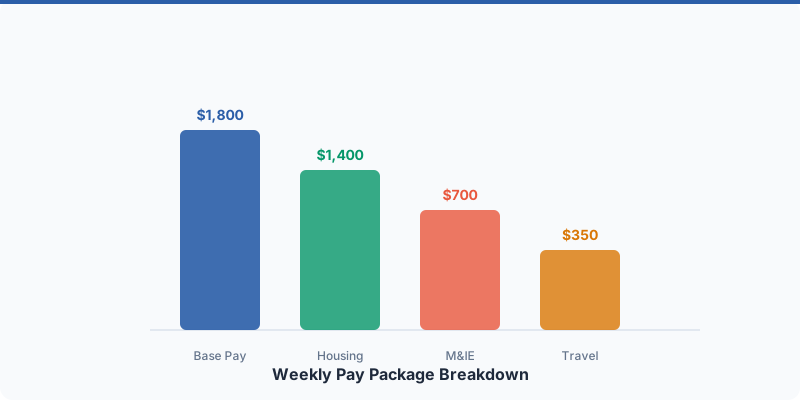
This is the difference between blended rate and itemized pay, and understanding it is one of the most practical skills a travel nurse can develop. The format your agency uses affects your taxes, your ability to negotiate, your visibility into what you are actually earning, and your financial planning for years to come.
Disclaimer: This guide is for educational purposes only and does not constitute tax advice. Consult a qualified tax professional for guidance specific to your situation.
What Is a Blended Rate?
A blended rate is a single hourly number that rolls your taxable wages and non-taxable stipends into one figure. When a recruiter says “We can offer you $55 per hour,” that number includes everything — your base pay, housing stipend, meals and incidentals stipend, and possibly even travel reimbursement.
Behind the scenes, the agency has still calculated each component separately. They know what your base rate is and what your stipends are. They have simply combined them into one number for simplicity.
Why agencies use blended rates: It is easier to pitch. A single number is fast to communicate, easy to compare at a glance, and avoids the complexity that can overwhelm a new travel nurse. For recruiters, it is a quicker conversation.
The problem: You cannot see the breakdown. A $55 blended rate could mean $28 per hour base with generous stipends, or it could mean $18 per hour base with inflated stipends. Those two packages have very different implications for your overtime pay, retirement contributions, mortgage applications, and tax liability. Without seeing the components, you are making a financial decision with incomplete information.
What Is Itemized Pay?
Itemized pay breaks your compensation into distinct line items. A typical itemized package looks like this:
- Base hourly rate: $22/hr (taxable)
- Housing stipend: $1,200/week (non-taxable with valid tax home)
- Meals & Incidentals (M&IE): $350/week (non-taxable with valid tax home)
- Travel reimbursement: $500 one-time (non-taxable)
Each component is visible, verifiable, and individually negotiable. You can check the housing stipend against GSA per diem rates for the assignment area. You can see whether your base rate is competitive. You can assess the tax implications of each piece.
Itemized pay gives you control. You know exactly what is taxable, what is not, and where there might be room to negotiate. For a deeper understanding of how stipends work, see our travel nurse stipend explainer.
Side-by-Side Comparison
Consider this example. A 36-hour-per-week contract at a hospital in Denver, Colorado:
Blended Rate Presentation:
- $55/hr blended rate
- Weekly gross: $1,980
Itemized Presentation (same total):
- Base hourly rate: $22/hr ($792/week taxable)
- Housing stipend: $840/week (non-taxable)
- M&IE stipend: $348/week (non-taxable)
- Weekly total: $1,980
The total is identical. But the itemized version reveals that only $792 per week is taxable income, while $1,188 per week is tax-free. That distinction matters enormously at tax time.
On your pay stub: With a blended rate, you might see a single earnings line or a confusing breakdown that does not match the number your recruiter quoted. With itemized pay, each component appears as its own line item, making it straightforward to verify against your contract. For help decoding your pay stub, see our pay stub walkthrough.
On your W-2: Your W-2 reports only taxable wages. With the itemized example above, your W-2 would show $792 per week in wages (about $41,184 for a full year). The non-taxable stipends do not appear on your W-2. With a blended rate, the same should be true — but without seeing the breakdown, you have no way to verify that the split is correct.
Pros and Cons of Blended Rate
Pros
- Simple to understand at a glance. One number, easy to process.
- Easy to compare to staff nurse hourly rates. Useful for a quick gut check on whether the assignment is worth it.
- Less initial complexity. For a first-time travel nurse, fewer numbers can feel less overwhelming.
Cons
- Hides the actual breakdown. You do not know your base rate, stipend amounts, or how the agency allocated the money.
- Impossible to verify GSA compliance. You cannot check whether stipend amounts fall within IRS-acceptable limits if you do not know what they are.
- Cannot tell if your base rate is unreasonably low. A low base rate hurts your overtime pay (calculated on the base rate), reduces retirement contributions, and weakens mortgage applications that rely on documented taxable income.
- Harder to negotiate. You can only negotiate the total — you cannot push for a higher base rate or a specific stipend amount.
- May mask financial risks. If the base rate is extremely low and stipends are extremely high, you are more exposed if your tax home status ever comes into question. All those “non-taxable” stipends become taxable, and you may owe a large, unexpected tax bill.
Pros and Cons of Itemized Pay
Pros
- Full transparency. You see every component and can evaluate each one independently.
- Verify GSA compliance. Confirm that stipend amounts are within the GSA per diem rates for the assignment area, which is important for tax home compliance.
- Easier to negotiate specific line items. Want a higher base rate for overtime or mortgage purposes? You can ask for exactly that.
- Better tax planning. Knowing your taxable vs. non-taxable split helps you plan withholdings and estimated payments accurately.
- Clearer documentation. If the IRS ever questions your stipends, having a clear itemized breakdown supports your position.
Cons
- More numbers to process. For nurses new to travel, multiple line items can feel confusing.
- Can be overwhelming at first. Learning what each component means takes some effort.
- Some agencies resist providing breakdowns. Not every agency voluntarily itemizes, which can create friction if you request it.
Tax Implications
The way your pay is structured has real tax consequences. With an itemized package, you and your CPA can clearly see the taxable and non-taxable portions of your income. This makes filing accurate returns straightforward and reduces the risk of errors.
With a blended rate, the tax split still exists on the agency’s side — but you may not have visibility into it. If the agency’s internal allocation does not match GSA guidelines, or if stipend amounts are higher than what the IRS would consider reasonable, you could face issues during an audit.
Your W-2 should reflect only the taxable portion of your earnings regardless of how the pay was presented to you. But verifying that your W-2 is correct requires knowing what the breakdown was supposed to be. If you only ever saw a blended rate, you are trusting the agency to get it right.
A travel-nurse-savvy CPA will always prefer to see an itemized breakdown. It makes their job easier and your returns more defensible.
Which Should You Choose?
The answer is clear: always request an itemized breakdown, even if the agency initially presents a blended rate. Here is why and how.
When a blended rate is acceptable: Only as a quick screening tool. If a recruiter calls and says “$55 per hour blended,” that gives you a starting point for whether the assignment is in the right ballpark. But before you go any further, ask for the itemized version.
Red flag — an agency that refuses to itemize: If an agency cannot or will not tell you how your pay breaks down, that is a serious concern. Every agency calculates the components internally. If they will not share the breakdown with you, ask yourself why. Transparency should be a baseline expectation, not a bonus feature.
How to ask your recruiter for the breakdown: Keep it simple and professional. Try this language:
“Thanks for the offer. Can you send me the itemized breakdown showing the base hourly rate, housing stipend, M&IE, and any other components separately? I want to make sure I understand the full picture before I decide.”
Most recruiters will provide this without hesitation. If yours pushes back, consider it a signal about how the agency operates. For more on evaluating contracts, read our guide on how to negotiate travel nurse contracts.
How to Convert Blended to Itemized
If you only have a blended rate, you can reverse-engineer an approximate breakdown. Here is how:
Step 1: Determine the GSA rates for the assignment area. Look up the GSA per diem rates for lodging and M&IE in the city where you will be working. These are the maximum non-taxable stipend amounts the IRS allows.
Step 2: Calculate the maximum weekly stipends. Multiply the daily GSA lodging rate by 7 for your weekly housing stipend cap. Do the same for M&IE.
Step 3: Subtract stipends from total compensation. Take your total weekly pay (blended rate times contracted hours) and subtract the maximum weekly stipends. What remains is approximately your taxable base pay.
Step 4: Calculate the implied base hourly rate. Divide the remaining taxable amount by your contracted weekly hours. This is your estimated base hourly rate.
Example: You are offered $55/hr blended for 36 hours per week in Denver. The GSA lodging rate is $120/day and M&IE is $59/day.
- Weekly total: $55 x 36 = $1,980
- Max weekly housing stipend: $120 x 7 = $840
- Max weekly M&IE: $59 x 7 = $413
- Remaining for base rate: $1,980 - $840 - $413 = $727
- Implied base hourly rate: $727 / 36 = $20.19/hr
Step 5: Verify with the recruiter. Share your estimate and ask if it is close to the actual breakdown. This shows the recruiter you understand pay structures and often prompts them to provide the real numbers.
Use the pay calculator to run this conversion quickly and compare multiple packages side by side.
FAQ
Is a blended rate illegal or unethical?
No. Blended rates are a legitimate way to present compensation, and many reputable agencies use them. The issue is not legality but transparency. A blended rate is a communication choice, not a deceptive practice by definition. However, if an agency uses the blended format specifically to obscure an unfavorable breakdown — such as an extremely low base rate — that is a problem you should be aware of. Always request the itemized version so you can evaluate the offer properly.
Do all agencies offer itemized breakdowns?
Most agencies will provide an itemized breakdown if you ask. It is standard practice among the larger, more established agencies. Smaller or less transparent agencies may push back, but every agency calculates the breakdown internally for payroll and tax purposes. If they have the numbers, they can share them. An agency that categorically refuses to itemize is one you should approach with caution.
Can I negotiate to switch from blended to itemized?
You are not really “switching” anything — the underlying pay structure is the same regardless of how it is presented. What you are asking for is visibility into the components. This is a reasonable request that does not change the agency’s costs. Frame it as needing the information for tax planning and financial documentation, which is true and hard to argue against.
Which format is more common?
Industry-wide, itemized pay is becoming more common as travel nurses get more financially savvy and demand transparency. However, blended rates remain popular in initial conversations because of their simplicity. Many agencies will quote a blended rate on the first call and then provide the itemized breakdown in the formal offer. If the itemized version does not come with the offer, ask for it before signing.
Does the format affect my actual pay?
The presentation format does not change your total compensation. Whether you see $55/hr blended or $22/hr base plus stipends, the money flowing to you is the same. What changes is your ability to verify the package, negotiate effectively, plan your taxes, and catch errors on your pay stubs. Those differences are meaningful, even if the dollar amount is identical.
Key Takeaways
- Blended rates hide important details. They are fine for a quick comparison but should never be the basis for your final decision.
- Always request an itemized breakdown showing base hourly rate, housing stipend, M&IE, and any other components.
- Itemized pay gives you control over negotiation, tax planning, and error detection.
- The total compensation may be the same either way, but your understanding and financial protection are dramatically different with itemized pay.
- Use the pay calculator to break down any blended rate and compare packages on equal terms.
Related Internal Links
- How to Compare Travel Nurse Pay Packages
- Travel Nurse Stipend Explained
- How to Read Travel Nurse Pay Stub
- Travel Nurse Tax Home Guide
- How to Negotiate Travel Nurse Contract
Affiliate Placement Notes
- Pay calculator tool CTA in “How to Convert Blended to Itemized” section
- CPA referral link in “Tax Implications” section
- Agency comparison links where discussing agencies that do/do not itemize
