
Best Gas Credit Cards for Travel Nurses (2026)

Disclosure: Some links in this post are affiliate links. If you click through and make a purchase, we may earn a small commission at no extra cost to you. Learn more about how we make money.
Introduction: Why Gas Rewards Matter for Travel Nurses
If you drive between assignments — and most travel nurses do — fuel is one of your biggest recurring expenses. Between relocating every 13 weeks and commuting to unfamiliar hospitals, many travel nurses spend $3,000 to $8,000 or more on gas each year. That is a significant chunk of money flowing straight through your debit card and out of your budget.
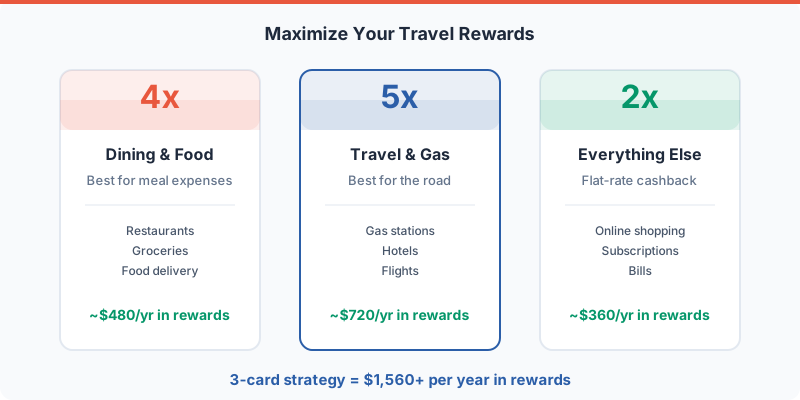
The good news is that the right gas credit card can put $200 to $500 back in your pocket annually, just from spending you are already doing. Gas rewards cards offer elevated earning rates at the pump, sometimes as high as 5% cash back or 5x points per dollar. When you combine that with gas station loyalty programs and smart route planning, you can meaningfully reduce what is otherwise a sunk cost of the travel nursing lifestyle.
This guide breaks down the best types of gas credit cards for travel nurses, how to maximize your fuel rewards, and the math behind which card saves you the most at every spending level. We will not name specific card products here, but we will describe exactly what to look for so you can choose the right card for your situation.
Quick Comparison: Best Gas Credit Cards for Travel Nurses
Here are the top gas credit card options ranked by fuel rewards, fees, and extra benefits.
| Card | Gas Cashback Rate | Annual Fee | Other Benefits |
|---|---|---|---|
| Citi Custom Cash | 5% (on top category, up to $500/mo) | $0 | Auto-selects your highest spend category each month |
| Wells Fargo Autograph | 3x on gas + transit | $0 | 3x on dining, travel, streaming; no annual fee |
| Chase Freedom Flex | 5% rotating (gas 1-2 quarters/yr) | $0 | 3% dining and drugstores year-round |
| Amex Blue Cash Preferred | 3% on gas (at U.S. stations) | $95 | 6% on groceries (up to $6K/yr), 6% streaming |
| PenFed Platinum Rewards | 5x on gas | $0 | 3x on groceries; credit union membership required |
| Discover it | 5% rotating (gas 1-2 quarters/yr) | $0 | Cashback Match doubles all rewards in year one |
Earning rates and terms are subject to change. Verify current offers before applying.
How Much Travel Nurses Spend on Gas
Let’s put some real numbers behind this. The average travel nurse assignment involves a relocation of 200 to 800 miles, and most nurses take three to four assignments per year. That is 600 to 3,200 miles just in moving. Add in daily commuting — many travel nurses drive 15 to 30 miles each way to the hospital — and you are looking at another 2,000 to 4,000 miles per 13-week assignment.
Over the course of a year, a typical travel nurse logs 15,000 to 25,000 miles. At an average fuel cost of roughly $0.15 to $0.20 per mile (depending on your vehicle and gas prices), that translates to $2,250 to $5,000 per year on gas alone. Nurses who take assignments in rural areas, drive SUVs or trucks, or relocate frequently can easily spend $6,000 to $8,000 or more.
The key insight is that gas spending for travel nurses is both predictable and large. You know you will spend thousands on fuel every year. That predictability makes it one of the most optimizable categories in your budget. A card earning 5% back on $5,000 in gas spending returns $250 per year — and that is before stacking loyalty programs and other strategies on top.
Use our pay calculator to understand your full take-home picture, then see how gas card savings fit into your overall budget plan.
Our Top Gas Credit Card Picks
Best Overall Gas Card
Look for a card that offers 5% cash back or 5x points at gas stations with no cap or a high annual cap (at least $6,000 in spend). The ideal card in this category has a low or moderate annual fee ($0 to $95), a strong sign-up bonus worth $150 to $200, and bonus earnings in at least one other useful category such as groceries or dining. Some of the best overall gas cards also include roadside assistance or auto rental insurance — perks that directly benefit nurses who are on the road constantly.
Why this type wins: The combination of a high gas earning rate, useful secondary categories, and practical travel protections makes this the best all-around choice for travel nurses who want to maximize fuel savings without juggling multiple cards.
Best No-Annual-Fee Gas Card
Not everyone wants to pay an annual fee, and you do not have to. The best no-fee gas cards offer 3% to 4% cash back at gas stations as a permanent, uncapped category. You will sacrifice a percentage point or two compared to premium options, but you will never have to worry about whether your gas spending justifies the fee.
Look for a card with no annual fee, at least 3% back at gas stations, a reasonable sign-up bonus (even $100 to $150 is solid), and a clean rewards structure with no rotating categories to track. Some no-fee cards also offer 2% to 3% on groceries, which creates a useful one-card solution for daily spending.
Best for: Travel nurses who want consistent gas savings without any fee overhead, especially those whose annual gas spend is under $3,000.
Best Gas Card With Flexible Rewards
If you want gas rewards that can also fund your next vacation, look for a flexible points card that earns 3x to 5x on gas and lets you transfer points to airline and hotel partners. These cards typically come from issuers with robust travel ecosystems, offering 10 to 15 transfer partners including major airlines and hotel chains.
The annual fee is usually $95 to $250, but the card often pays for itself through the sign-up bonus, elevated earning rates, and transfer value. When you redeem points through transfer partners rather than as cash back, you often get 1.5 to 2 cents per point in value — meaning your 5x gas earning is effectively worth 7.5% to 10% back in travel value.
Best for: Travel nurses who want their gas spending to contribute toward free flights and hotel stays. This is the card for you if you are building a broader rewards strategy and want gas spending to feed into your travel fund.
Best Rotating Category Card for Gas
Rotating category cards offer 5% cash back on specific categories that change each quarter. Gas stations are frequently featured, typically appearing in one or two quarters per year. During those quarters, you earn an exceptional rate on fuel purchases. The rest of the year, you would use your primary gas card.
These cards almost always have no annual fee, making them a cost-free addition to your wallet. The trade-off is that you need to activate the bonus each quarter and track when gas is an active category. Most of these cards cap the 5% earning at $1,500 in spend per quarter.
Best for: Travel nurses who are willing to pay attention to quarterly category calendars and swap cards at the pump depending on the current bonus. Pair this with a consistent gas card for full-year coverage.
Gas Station Loyalty Programs That Stack With Credit Cards
Credit card rewards are only half the equation. Gas station loyalty programs are free to join and stack directly on top of your card rewards, giving you a second layer of savings at every fill-up.
Shell Fuel Rewards is one of the most widely available programs, offering at least 5 cents off per gallon as a Gold Status member, with opportunities to earn higher discounts through linked grocery purchases. With Shell stations in all 50 states, this is a reliable option no matter where your assignment takes you.
ExxonMobil Rewards+ lets you earn points on every gallon that convert to cents-off savings on future fill-ups. The earning rate translates to roughly 3% back, and the program frequently runs bonus point promotions.
BP Rewards offers a similar cent-per-gallon structure, and BPme users can pay directly through the app for additional savings. This is convenient in states with heavy BP presence.
Pilot Flying J deserves a special mention for travel nurses making long-distance relocations. Their rewards program offers fuel discounts plus points on in-store purchases including food, drinks, and supplies. If your assignment moves involve interstate highway driving, you will likely pass plenty of Pilot and Flying J locations.
GasBuddy is not a loyalty program but rather a gas price comparison app that helps you find the cheapest stations along your route. The GasBuddy card itself offers modest additional savings (up to 25 cents off per gallon in the first months, then roughly 5 cents off ongoing). Use GasBuddy for price comparison even if you do not use their card.
The strategy is straightforward: use your gas credit card for payment and scan your loyalty program at the pump. You earn credit card rewards and loyalty discounts simultaneously. On a 15-gallon fill-up, stacking 5% credit card rewards with 5 cents off per gallon from a loyalty program saves you roughly $1.35 per fill-up. Fill up weekly, and that is over $70 per year from stacking alone.
Maximizing Your Gas Rewards
Getting the most from your gas card requires a bit of intentionality. Here are the strategies that make the biggest difference:
Always use your designated gas card at the pump. This sounds obvious, but many people default to whichever card is on top in their wallet. Designate one card as your gas card and use it every single time. If you use a rotating category card during bonus quarters, set a calendar reminder to swap.
Stack credit card rewards with gas station loyalty programs. As described above, this is free money. Sign up for the loyalty program at whichever chain you visit most frequently and scan your membership every time you fuel up.
Use GasBuddy to find the cheapest gas on your route. Gas prices can vary by 20 to 40 cents per gallon within the same metro area. When you are filling a 15-gallon tank, that is a $3 to $6 difference per fill-up. Over a year, the savings from consistently choosing cheaper stations add up to $150 or more.
Fill up before relocating through cheaper-gas states. Gas prices vary dramatically by state due to taxes and regulations. If your relocation route passes through a low-gas-price state, plan a fill-up there. The difference between filling up in South Carolina versus California can be over a dollar per gallon.
Consider warehouse club gas stations. If you have a Costco or Sam’s Club membership, their gas stations typically offer prices 10 to 30 cents below nearby stations. Some travel nurses find that gas savings alone justify a warehouse club membership. Just make sure your gas credit card works at these pumps — not all cards code warehouse club gas as “gas station” purchases.
Combine gas stops with convenience store purchases strategically. Some credit cards include convenience store purchases in their gas station bonus category. If yours does, buying snacks, drinks, or supplies at the station convenience store also earns the elevated rate.
Comparing Gas Card Rewards: The Math
Let’s run the numbers across three annual gas spending levels to see which card type saves you the most.
Low spender: $2,000 per year on gas. A no-annual-fee card earning 3% returns $60 per year. A 5% card with a $95 fee returns $100 minus the fee, netting just $5. At this spending level, the no-fee card wins clearly. You are better off keeping things simple and pocketing the $60 with no strings attached.
Medium spender: $4,000 per year on gas. The no-fee 3% card returns $120. A 5% card with a $95 fee returns $200 minus $95, netting $105. The two options are close, but the no-fee card still edges ahead slightly when you consider the simplicity factor. However, if the 5% card also earns bonus rates on groceries or dining, the total value across all categories could swing the math in its favor.
High spender: $6,000 or more per year on gas. At this level, the 5% card returns $300 or more, netting $205-plus after a $95 fee. The no-fee 3% card returns $180. The higher-earning card wins decisively, and the gap only grows as spending increases. If you are driving a lot between assignments and commuting long distances, the premium gas card is worth the fee.
For most travel nurses, gas spending falls in the medium to high range, making a dedicated gas card with an elevated earning rate a worthwhile investment. Factor in sign-up bonuses and other category spending, and the total annual value can reach $500 or more.
FAQ
Do all gas stations qualify for bonus rewards?
Most credit cards define “gas stations” based on merchant category codes, which cover the vast majority of standalone gas stations and major chains. However, gas purchased at supermarkets, warehouse clubs, or big-box stores sometimes codes differently and may not qualify for the gas bonus. Gas bought inside a convenience store (rather than at the pump) can also code differently depending on the merchant. To be safe, check your card issuer’s terms for exactly which merchant codes qualify. If you frequently fill up at warehouse clubs, verify that those purchases earn the gas bonus rate before relying on it.
Is a dedicated gas card worth it, or should I use my main card?
For most travel nurses, a dedicated gas card is worth it if your annual gas spending exceeds $2,000 to $3,000. The difference between a 1.5% general rewards rate and a 5% gas rate on $4,000 in annual fuel spending is $140 per year — meaningful savings for simply using a different card at the pump. If you prefer simplicity and your main card already earns 3% or more on gas, you may be fine sticking with one card. But if your primary card only offers 1% to 2% on gas, adding a dedicated gas card is one of the easiest optimizations in your financial toolkit.
How do gas rewards compare to cash back?
Gas rewards are typically delivered as cash back, statement credits, or points that can be redeemed for cash or travel. In most cases, gas rewards and cash back are the same thing — you are earning a percentage back on your fuel purchases. The distinction matters more when using a flexible points card, where gas rewards come as points that can be transferred to airline and hotel partners. In those cases, your gas rewards may be worth more than their cash value if you redeem strategically for travel. For a deeper look at maximizing point value, check out our guide on earning 100K points as a travel nurse.
Can I use a gas card for diesel?
Yes. Diesel purchases at gas stations earn the same bonus rate as regular gasoline, as long as the merchant codes as a gas station. If you drive a diesel vehicle, your gas credit card works exactly the same way at the diesel pump. The merchant category code is determined by the station, not the type of fuel purchased.
What about electric vehicle charging rewards?
The EV charging rewards landscape is still evolving. Most traditional gas credit cards do not offer elevated rewards at EV charging stations because those stations often have different merchant category codes. However, some newer cards and specific EV-focused rewards programs are starting to address this gap. If you drive an EV, look for cards that specifically list EV charging networks in their bonus categories, or use a flat-rate cash back card at charging stations until the market matures. As more travel nurses transition to electric or hybrid vehicles, expect this category to develop rapidly.
Key Takeaways
Gas is one of the largest and most consistent expenses in a travel nurse’s budget, and the right credit card turns that unavoidable cost into meaningful rewards. Whether you choose a high-earning dedicated gas card, a no-fee option for simplicity, or a flexible points card that feeds your travel fund, the important thing is to stop leaving money on the table at the pump.
Stack your gas credit card with free loyalty programs and use GasBuddy to find the cheapest stations on your route. At $4,000 to $6,000 in annual gas spending, these strategies combined can save you $300 to $500 per year — money that is better spent on your next vacation, your emergency fund, or paying down debt.
Ready to start earning on every fill-up? Choose the card that matches your spending level and start saving today.
Related Internal Links
- Best Credit Cards for Travel Nurses
- Travel Nurse Budget Guide
- Best Travel Rewards Cards for Nurses
- How to Earn 100K+ Points as a Travel Nurse
- Pay Calculator
Affiliate Placement Notes
- Credit card referral/affiliate links for each recommended card (4 card slots above)
- GasBuddy app referral link in the maximizing section
- Gas station loyalty program sign-up links in the stacking section
