
Best Credit Cards for Travel Nurses (2026 Picks)

Disclosure: Some links in this post are affiliate links. If you click through and make a purchase, we may earn a small commission at no extra cost to you. Learn more about how we make money.
Why Travel Nurses Should Be Strategic About Credit Cards
Most people use credit cards on autopilot. They swipe whatever card is in their wallet, pay the bill, and never think twice about it. If that sounds like you, you are leaving serious money on the table — probably somewhere between $2,000 and $5,000 every single year.
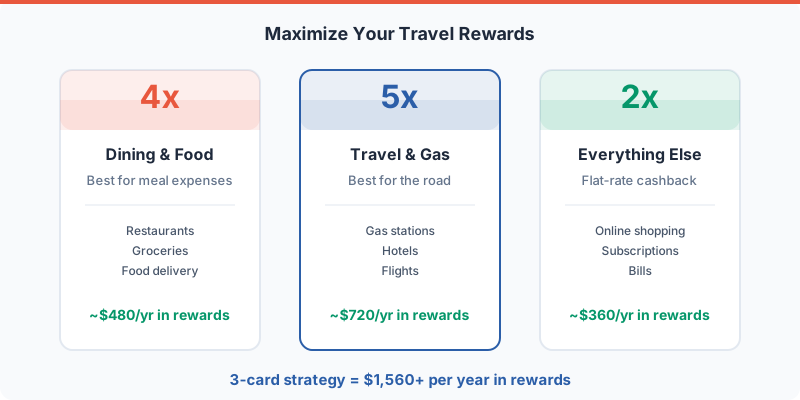
Here is the thing: travel nurses are in one of the best positions imaginable to rack up credit card rewards. Think about your spending patterns for a second. You drive hundreds or thousands of miles between assignments. You furnish temporary housing from scratch every few months. You spend heavily on groceries because eating out on every shift gets expensive fast. You book hotels during transition weeks. You might even pay rent on a credit card. All of that spending is happening whether you optimize it or not, so you might as well get paid for it.
I have watched travel nurses fund entire vacations, pay off student loan chunks, and pocket thousands in cash back simply by choosing the right cards and using them intentionally. This is not about gaming the system or taking on debt. It is about making the spending you are already doing work harder for you.
In this guide, I am going to walk you through the best credit cards for travel nurses across every major category — best overall, best for travel rewards, best for cash back, best for gas, best for hotels, best with no annual fee, and best for building credit. For each pick, I will explain exactly why it works for the travel nursing lifestyle and how much value you can realistically expect.
A note on transparency: This page contains affiliate links. If you apply for a card through one of our links, we may earn a commission at no extra cost to you. This is how we keep the site running. We only recommend cards we genuinely believe are strong picks for travel nurses.
Quick Comparison: Best Credit Cards for Travel Nurses
Here is a side-by-side look at our top credit card picks across categories so you can find the right fit at a glance.
| Card Name | Annual Fee | Welcome Bonus | Earning Rate | Best For |
|---|---|---|---|---|
| Chase Sapphire Preferred | $95 | 60,000 pts ($750+ value) | 5x travel, 3x dining, 2x groceries | Best overall travel + dining rewards |
| Amex Gold | $250 | 60,000 pts ($600+ value) | 4x dining, 4x groceries, 3x flights | Heavy grocery and dining spenders |
| Capital One Venture | $95 | 75,000 miles ($750 value) | 2x on all purchases | Simplicity with no category tracking |
| Citi Custom Cash | $0 | $200 cash back | 5% on top spending category (up to $500/mo) | Automatic bonus on gas or groceries |
| Discover it | $0 | Cashback Match (doubles year 1) | 5% rotating categories, 1% everything else | First-year double rewards, no fee |
Rates and bonuses are subject to change. Verify current offers before applying.
How We Chose These Cards
Not every great credit card is a great credit card for travel nurses. A card that shines for someone with a stable 9-to-5 and a fixed address might be mediocre for someone who relocates every 13 weeks and has wildly different spending patterns from month to month.
We evaluated dozens of cards against criteria that specifically matter for the travel nursing lifestyle. First, we looked at sign-up bonus value relative to the spending requirement. Travel nurses tend to have naturally high spending during assignment transitions — housing deposits, furniture, supplies, gas for long drives — so cards with higher spending thresholds but bigger bonuses are often more accessible to you than to the average consumer. A card that requires $4,000 in spending over three months might sound aggressive to most people, but if you are starting a new assignment and furnishing an apartment, you could hit that in the first two weeks.
Second, we weighted earning rates in the categories where travel nurses spend the most: gas, groceries, dining, travel bookings, and general purchases. A card that earns 5% back on streaming services but only 1% on gas is not built for your life.
Third, we factored in the annual fee versus the realistic rewards you would earn. A $95 annual fee card that consistently delivers $500 or more in value is a no-brainer. A $550 annual fee card needs to deliver significantly more, and whether it does depends on how you use it.
Finally, we considered travel-specific perks like trip delay insurance, rental car coverage, no foreign transaction fees, and airport lounge access — benefits that matter more to someone constantly on the move than to someone who flies once a year.
We review and update these picks regularly as card offerings change. The recommendations below reflect the best options available as of early 2026.
Best Overall Credit Card for Travel Nurses
What to look for: A mid-tier annual fee card (around $95 per year) with a strong sign-up bonus worth $750 or more, earning rates of 2x to 5x points across travel and dining categories, and solid baseline earning of at least 1.5x to 2x on everything else.
This is the card that does everything well enough that if you could only carry one card, this would be it. The best overall card for travel nurses earns accelerated rewards on travel and dining — two categories you are hitting constantly — while still earning a respectable rate on the groceries, gas, and random Target runs that make up the rest of your spending.
The sign-up bonus alone should more than justify the first year’s annual fee. Many cards in this tier offer bonuses worth $600 to $1,000 when you meet a spending threshold of $3,000 to $4,000 in the first three months. For a travel nurse starting a new assignment, that threshold is almost effortless. Between your housing deposit, new scrubs, groceries for your first few weeks, and gas to get to your new city, you could clear it before your first paycheck arrives.
Beyond the sign-up bonus, expect to earn roughly $50 to $100 per month in ongoing rewards if you are putting $2,000 to $3,000 in monthly spending on the card. Over a year, that is $600 to $1,200 in rewards on top of whatever the sign-up bonus was worth. Subtract the $95 annual fee and you are still looking at a very healthy return.
Look for cards in this category that also include trip delay insurance, baggage delay coverage, and primary or secondary rental car insurance. These perks can save you hundreds on a single incident, and travel nurses encounter more travel disruptions than most people simply because they are in transit more often.
Ideal for: Nurses who want one card that handles everything without the complexity of managing multiple cards.
Best Travel Rewards Card for Travel Nurses
What to look for: A premium card with an annual fee of $250 to $550, a sign-up bonus worth $1,000 or more, earning rates of 3x to 5x on travel and dining, airline and hotel transfer partners, and perks like airport lounge access and annual travel credits.
If you fly between assignments instead of driving, or if you love using your time off to take real vacations, a premium travel rewards card can deliver outsized value. These cards earn flexible points that transfer to airline and hotel loyalty programs, which means you can sometimes get two to three cents per point in value instead of the flat one cent per point you get with cash back.
The annual fee on these cards looks steep at first glance, but the built-in perks often offset it entirely. Many premium travel cards include $200 to $300 in annual travel credits that apply automatically to airline purchases, hotel bookings, or other travel expenses. They also frequently include airport lounge access, which saves you $30 to $50 every time you use it on a long layover — and makes those six-hour waits between assignment cities a lot more bearable.
Here is a real-world example. Say you fly to your next assignment and the flight costs $350. You earn 5x points on that purchase, giving you 1,750 points. Over the course of your 13-week assignment, you spend $200 per week on dining out and groceries combined, earning 3x points — that is another 7,800 points. Add in your other spending at 1x to 2x, and you could easily accumulate 15,000 to 20,000 points per assignment. Do that across three or four assignments per year and you are sitting on 60,000 to 80,000 points — enough for one or two round-trip domestic flights, free.
For a deeper breakdown of how to maximize travel rewards, check out our guide to the best travel rewards cards for nurses and our 100K points strategy.
Ideal for: Nurses who fly between assignments or want to fund free vacations with their everyday spending.
Best Cash Back Card for Travel Nurses
What to look for: A no-annual-fee or low-fee card with a flat 1.5% to 2% cash back on all purchases, or rotating/fixed bonus categories earning 3% to 5% on groceries, gas, and dining, with a sign-up bonus of $200 or more.
Not everyone wants to deal with points, transfer partners, and redemption strategies. If you would rather get a straightforward statement credit or direct deposit every month, a strong cash back card is the way to go. There is something satisfying about seeing cold, hard dollars appear in your account — no point valuations or transfer calculations required.
The best cash back cards for travel nurses fall into two camps. The first is the flat-rate card: you earn the same percentage on every purchase regardless of category. These are dead simple. Swipe the card, get 1.5% to 2% back, done. If you spend $3,000 per month, that is $45 to $60 back every month, or $540 to $720 per year, with zero effort or category tracking.
The second camp is the category bonus card, which pays higher rates — typically 3% to 5% — on specific categories like groceries, gas, dining, or transit, and then a lower 1% rate on everything else. These take a little more thought but can yield significantly more. If you spend $400 per month on groceries (earning 5% back) and $300 per month on gas (earning 3% back), that is $20 plus $9 per month just from those two categories — $348 per year — on top of whatever you earn on the rest of your spending.
Many travel nurses actually carry one of each: a flat-rate card for general purchases and a category card for groceries and gas. The two-card combo is simple to manage and can push your total cash back well above $1,000 per year.
Ideal for: Nurses who prefer simplicity and want rewards they can use immediately without any points-optimization headaches.
Best Gas Credit Card for Travel Nurses
What to look for: A card earning 3% to 5% back at gas stations with no annual fee, ideally with bonus categories on other travel nurse staples like dining or groceries.
If you drive between assignments — and most travel nurses do — gas is one of your biggest variable expenses. A nurse driving from Dallas to Portland for a new assignment is looking at roughly 2,000 miles and $250 to $350 in gas, depending on your vehicle. Do three or four moves like that per year, add in your daily commute to the hospital and weekend errands, and you are easily spending $4,000 to $6,000 per year on fuel.
At 5% back on gas, $5,000 in annual gas spending puts $250 back in your pocket. That is not life-changing money, but it is essentially free, and it adds up when you combine it with the rewards from your other cards.
The best gas cards also tend to earn elevated rates on transit, streaming, or dining, giving you bonus earnings in multiple categories. Some even offer rotating quarterly bonuses that occasionally include gas stations at even higher rates.
If you spend $400 per month on gas driving between assignments and commuting to the hospital, a 5% gas card earns you $20 per month or $240 per year — just on gas. Stack that with a cashback app that offers an extra 5 to 10 cents off per gallon, and you are saving $350 or more per year on fuel without changing your behavior at all.
For our complete breakdown of gas card options, see the best gas credit cards for travel nurses.
Ideal for: Nurses who drive between assignments and want to recoup a meaningful chunk of their fuel costs.
Best Hotel Credit Card for Travel Nurses
What to look for: A card tied to a major hotel loyalty program with an annual fee of $95 to $150, automatic elite status, a free night certificate each year, and elevated earning rates (10x to 17x) on stays within the hotel brand.
This card is a powerhouse for travel nurses who use extended-stay hotels for their housing. If you stay at a branded extended-stay property — and many travel nurses do, especially for their first few assignments or when short-term leases are hard to find — a co-branded hotel card lets you double-dip on points. You earn loyalty points from the hotel stay itself, and you earn credit card points on top of that.
Let me run the numbers. Say you are paying $1,800 per month for an extended-stay hotel. On a 13-week assignment, that is roughly $5,400 in hotel spending. If your hotel card earns 10x points per dollar on hotel stays, that single assignment generates 54,000 points. Many hotel programs value their points at around 0.7 to 1.0 cents each, so that is $378 to $540 in value from one assignment’s housing spend alone.
Now add in the automatic elite status that most hotel cards provide. Elite status at extended-stay properties can mean room upgrades, late checkout, free breakfast, bonus points on stays, and other perks that make a 13-week stay significantly more comfortable. When you are living in a hotel for three months, those little upgrades matter.
Many hotel cards also include an annual free night certificate worth $150 to $300, which effectively reduces or eliminates the annual fee. Use it for a weekend getaway between assignments and the card has already paid for itself.
For a full comparison of hotel card options, check out best hotel credit cards for travel nurses.
Ideal for: Nurses who stay at extended-stay hotels and want to earn massive points while getting elite status perks.
Best No-Annual-Fee Card for Travel Nurses
What to look for: A card with zero annual fee, earning rates of 1.5% to 2% cash back on all purchases or rotating 5% bonus categories, and a sign-up bonus of $150 to $200.
Maybe you are not ready to commit to an annual fee. Maybe you are already carrying a premium card and want a no-fee companion for non-bonus spending. Or maybe you just got out of nursing school, your student loans are staring you down, and the idea of paying $95 a year for a credit card feels wrong. All of those are valid reasons to start with a no-annual-fee card.
The good news is that no-fee cards have gotten remarkably competitive. Several offer flat 1.5% to 2% cash back on everything with no gimmicks, no rotating categories, and no annual fee ever. Others offer 5% back in rotating quarterly categories — and when those categories happen to be gas stations or grocery stores, you can clean up.
A no-fee card earning 1.5% on $2,500 per month in spending yields $37.50 per month, or $450 per year. That is $450 more than you would earn using a debit card, and it costs you nothing. You also start building a longer credit history, which matters when it comes time to apply for a mortgage or a premium rewards card down the road.
These cards also make excellent “sock drawer” cards — cards you keep open to maintain your credit history length and available credit, even if you eventually move your primary spending to a higher-earning card.
Ideal for: Nurses who want solid rewards without paying an annual fee, or anyone looking for a strong secondary card.
Best Card for Building Credit
What to look for: A secured or student credit card with no annual fee (or a very low one), an eventual graduation path to an unsecured card, and monthly reporting to all three credit bureaus.
If you are a newer nurse just starting your career, or if your credit has taken some hits and you are rebuilding, do not skip this section. Your credit score affects everything from apartment applications to car loans to the interest rates you will pay on future credit cards. Building it up now — while your travel nurse income gives you the cash flow to pay bills on time — is one of the smartest financial moves you can make.
Secured credit cards are the most accessible option if your credit is thin or damaged. You put down a refundable deposit — typically $200 to $500 — that becomes your credit limit. You use the card normally, pay the bill in full every month, and the issuer reports your on-time payments to the credit bureaus. After six to twelve months of responsible use, many issuers will upgrade you to a regular unsecured card, refund your deposit, and increase your credit limit.
The key is to use the card for a small recurring expense — maybe your monthly phone bill or a streaming subscription — set up autopay, and let the on-time payments do their work. You do not need to carry a balance to build credit. In fact, carrying a balance actively hurts you by increasing your credit utilization ratio and costing you interest.
Within a year of consistent on-time payments, many travel nurses see their scores climb 50 to 100 points, which opens the door to the premium rewards cards covered earlier in this guide.
Ideal for: Newer nurses or anyone rebuilding credit who wants a reliable path to a strong credit score.
How to Maximize Credit Card Rewards as a Travel Nurse
Picking the right cards is only half the battle. How you use them determines whether you earn $500 or $5,000 in a year. Here are the strategies that separate reward-earning travel nurses from everyone else.
Time your card applications with new assignments. Most sign-up bonuses require you to spend $3,000 to $5,000 in the first three months. Starting a new assignment is hands down the easiest time to hit these thresholds organically. Between the drive to your new city, housing deposits, furnishing your temporary apartment, stocking the kitchen, and buying whatever you forgot to pack, you can blow through a spending requirement without buying a single thing you would not have bought anyway. Plan your applications accordingly — apply for a new card two to four weeks before your next assignment starts, and the timing lines up perfectly.
Use category bonuses strategically. Know which card earns the most in each category and use it for that category. Your gas card for gas, your grocery card for groceries, your travel card for flights and hotels. Keep it simple — you do not need a spreadsheet. Most travel nurses can manage two to three cards without any confusion.
Consider paying rent with a credit card. Services like rent payment platforms let you pay your landlord via credit card for a fee of around 2.5% to 2.9%. Whether this makes sense depends on your card’s earning rate. If your card earns 2% back, the fee wipes out most of your rewards. But if you are trying to hit a sign-up bonus threshold and your rent is $1,500 per month, running rent through the card can get you to that $4,000 minimum spend in a hurry — and the sign-up bonus of $750 or more far exceeds the $40 to $45 processing fee.
Stack rewards with cashback apps. Before you buy anything online, check cashback apps and browser extensions that offer an extra 1% to 10% back at hundreds of retailers. Pair that with your credit card rewards and you are double-dipping on every purchase. If you need new scrubs, a laptop for charting, or household supplies for your new place, routing those purchases through a cashback portal first can add up to several hundred dollars per year.
Never carry a balance. This is the single most important rule. Credit card interest rates typically run 20% to 29% APR. If you carry a $3,000 balance for a year, you will pay $600 to $870 in interest — wiping out every cent of rewards you earned and then some. Rewards are only valuable if you pay your statement balance in full every month. If you cannot do that consistently, the best credit card for you is whichever one has the lowest interest rate, not the best rewards. For help building a budget that keeps you out of credit card debt, see our travel nurse budgeting guide.
Credit Card Strategies for Multiple Assignments Per Year
Travel nurses who take three to four assignments per year have a structural advantage when it comes to credit card rewards. Each new assignment creates a natural spending spike — a predictable period of elevated expenses that makes meeting sign-up bonus thresholds effortless.
The two-card system is the simplest approach that still delivers strong results. Carry one travel or points-earning card for dining, flights, and hotels, and one flat-rate cash back card for everything else. This covers all your bases without requiring you to remember which card earns what on Tuesdays at gas stations during a full moon.
Rotating through sign-up bonuses responsibly is where the real money is. If you open one new card every four to six months — timed to coincide with your assignment transitions — you can collect two to three sign-up bonuses per year worth $500 to $1,000 each. That is $1,000 to $3,000 in bonus value alone, before you even count your ongoing earning. Just be thoughtful about it: space your applications out, keep your total number of open cards manageable, and never open a card you do not intend to use long-term unless you have a clear plan for when to downgrade or close it.
Keep a simple tracker for annual fees and benefits. When you have three or four cards, it is easy to lose track of when annual fees hit, when free night certificates expire, or when travel credits reset. A simple note on your phone or a line in your budget spreadsheet is all you need. Set calendar reminders 30 days before each annual fee posts so you can evaluate whether the card is still earning its keep.
The Sign-Up Bonus Strategy
Sign-up bonuses are the single most valuable element of any credit card — often worth more than an entire year of regular spending rewards. A single sign-up bonus of 60,000 to 100,000 points can be worth $600 to $1,500 or more, depending on how you redeem them. That is why getting the timing right on your applications matters so much.
The best time to apply is two to four weeks before you start a new assignment. This gives you time to receive the card, activate it, and start using it right as your transition spending ramps up. Housing deposits, security deposits, first month’s rent, gas for the drive, furnishing the apartment, groceries for stocking the kitchen, new state nursing license fees — all of this natural spending counts toward your minimum spend requirement.
Let us say a card requires $4,000 in spending within the first 90 days. Here is what a typical assignment transition might look like: $1,500 for first month’s rent (via rent payment service), $300 for the drive to your new city, $500 for basic furniture and household items, $400 for groceries over the first month, $200 for dining out during your first week while you settle in, and $200 for miscellaneous expenses. That is $3,100 right there, and you have not even finished your first month. Add in your regular monthly spending over the next 60 days and you will clear the threshold easily.
A word of caution: never spend money you would not have spent anyway just to hit a sign-up bonus. The goal is to route your natural spending through the new card, not to manufacture spending. If you find yourself buying things you do not need just to hit a threshold, the card is working against you, not for you.
For a complete walkthrough of how to stack sign-up bonuses into 100,000 or more points per year, read our detailed points strategy guide.
Common Mistakes Travel Nurses Make With Credit Cards
Even financially savvy nurses trip up on these. Knowing the pitfalls helps you avoid them.
Opening too many cards too quickly. Each credit card application triggers a hard inquiry on your credit report, which temporarily dings your score by 5 to 10 points. One or two inquiries are harmless and recover quickly. But if you apply for five cards in a month, you could see a 30 to 50 point drop, which matters if you are about to apply for a car loan or apartment lease. Space your applications out by at least three to four months.
Carrying a balance to chase sign-up bonuses. If you cannot meet the minimum spend requirement without going into debt, do not apply for the card. A $750 sign-up bonus is worthless if you end up paying $300 in interest to earn it. Only apply for cards when you know your upcoming natural spending will cover the threshold.
Ignoring travel protections. Many mid-tier and premium cards include trip delay insurance, lost baggage reimbursement, rental car collision coverage, and purchase protection. These benefits can save you hundreds on a single incident, but only if you know they exist and book your travel on the right card. Read your card’s benefits guide once — it takes 15 minutes and could save you thousands over your career.
Letting points expire or devalue. Some loyalty program points expire after 12 to 24 months of account inactivity. Others lose value when programs change their redemption charts. Do not hoard points indefinitely. Redeem them regularly — for flights, hotels, statement credits, or whatever works for your life.
Paying annual fees on cards you have outgrown. If a card is sitting in your drawer unused, the annual fee is pure waste. Before each fee posts, evaluate whether you have earned enough value to justify the cost. If not, call the issuer and ask to downgrade to a no-fee version of the card. This preserves your credit history length without costing you anything.
FAQ
Will applying for credit cards hurt my credit score?
Each application triggers a hard inquiry that typically lowers your score by 5 to 10 points temporarily. The impact fades within a few months and falls off your report entirely after two years. For most travel nurses with decent credit, a single application is a minor and short-lived dip that is more than offset by the rewards you earn. The bigger factor is your overall credit management — paying on time, keeping utilization low, and maintaining a mix of accounts. If you space your applications out by three to four months and always pay your bills on time, your score will generally trend upward over time despite the occasional hard inquiry.
How many credit cards should I have?
There is no magic number, but most financially savvy travel nurses do well with two to four cards. A common setup is one primary rewards card for everyday spending, one category-specific card for gas or groceries, and possibly one hotel card if you stay at branded properties. The right number depends on how much you are willing to manage. If tracking multiple cards sounds stressful, one great all-around card is perfectly fine. The goal is to maximize your rewards without adding complexity that leads to missed payments or forgotten annual fees.
Can I pay rent with a credit card?
Yes, through third-party rent payment services that charge your credit card and send a check or electronic payment to your landlord. The catch is the processing fee, which typically runs 2.5% to 2.9% of your payment. On $1,500 rent, that is about $37 to $44 per month. This rarely makes sense for ongoing rewards earning alone, since most cards earn less than 2.9% back. However, it makes excellent sense when you are working toward a sign-up bonus — the bonus value far exceeds the processing fees. It can also make sense with cards that earn 3% or more on the transaction, though that is rare for rent payment coding.
Should I close cards I no longer use?
Generally, no — at least not right away. Closing a credit card reduces your total available credit, which can increase your credit utilization ratio and lower your score. It also eventually removes that account’s history from your report. A better approach is to downgrade the card to a no-annual-fee version from the same issuer. This eliminates the fee while keeping the account open and your credit line intact. If no downgrade option exists and the annual fee is not worth it, then closing is reasonable, but try to do so when you have low balances on your other cards to minimize the utilization impact.
Which rewards are better — points or cash back?
It depends on how you want to use them. Cash back is simpler and more predictable — a dollar is always worth a dollar. Points can be worth more per unit if you transfer them to airline or hotel partners and book premium travel, sometimes getting two to three cents per point in value. But points require more effort to maximize and their value can fluctuate when programs change their redemption charts. If you enjoy optimizing travel bookings and want to stretch your rewards further, points are the way to go. If you want guaranteed value with zero hassle, cash back wins. Many travel nurses use both — a points card for travel spending and a cash back card for everything else.
Key Takeaways
Travel nurses can realistically earn $2,000 to $5,000 or more in credit card rewards every year. Your lifestyle — frequent moves, high transition spending, consistent gas and grocery bills — puts you in the top tier of reward earners. Most people cannot hit sign-up bonus thresholds without stretching. You do it naturally every time you start a new assignment.
Sign-up bonuses are where the biggest money is. A single bonus can be worth $600 to $1,500. Time your applications with assignment transitions and you can collect two to three per year without breaking a sweat.
Match your cards to your actual spending patterns. If you drive between assignments, get a gas card. If you stay in hotels, get a hotel card. If you want simplicity, get one strong all-around card and call it a day. The best card is the one that aligns with how you actually spend.
Never, ever carry a balance. Credit card interest destroys rewards faster than anything. Pay your statement in full every month. If you are struggling with that, pause the rewards game and focus on building a solid budget first.
Start now, even if it is just one card. You do not need a complex multi-card strategy to see meaningful results. Even a single no-annual-fee cash back card, used consistently, puts hundreds of dollars back in your pocket every year. Build from there as you get comfortable.
Your next assignment is an opportunity — not just to advance your nursing career, but to put your spending to work. Pick a card that fits your life, use it for the spending you are already doing, and let the rewards stack up. Future you will be glad you started today.
Ready to dive deeper into your finances? Check out our complete financial planning guide for travel nurses and use our pay calculator to make sure you know exactly what you are working with.
Related Internal Links
- Best Gas Credit Cards Travel Nurses
- Best Hotel Credit Cards Travel Nurses
- Travel Nurse Earn 100K Points
- Best Travel Rewards Cards Nurses
- Travel Nurse Budget Save
- Travel Nurse Financial Planning
Affiliate Placement Notes
- Individual credit card affiliate/referral links for each card recommendation (marked with
<!-- CARD -->and<!-- AFFILIATE LINK -->comments) - Cashback app referral links (Rakuten, Ibotta) in the maximize rewards section
- Plastiq or rent payment service affiliate link where paying rent with credit card is discussed
