
Travel Nurse Agency Benefits Comparison Guide
Disclosure: Some links in this post are affiliate links. If you click through and make a purchase, we may earn a small commission at no extra cost to you. Learn more about how we make money.
Introduction
Pay rate is just one piece of the puzzle. The benefits package your travel nurse agency offers — or does not offer — can swing your total compensation by thousands of dollars per assignment. An agency offering $45 per hour with a strong benefits package may actually put more money in your pocket than an agency offering $50 per hour with no benefits at all.
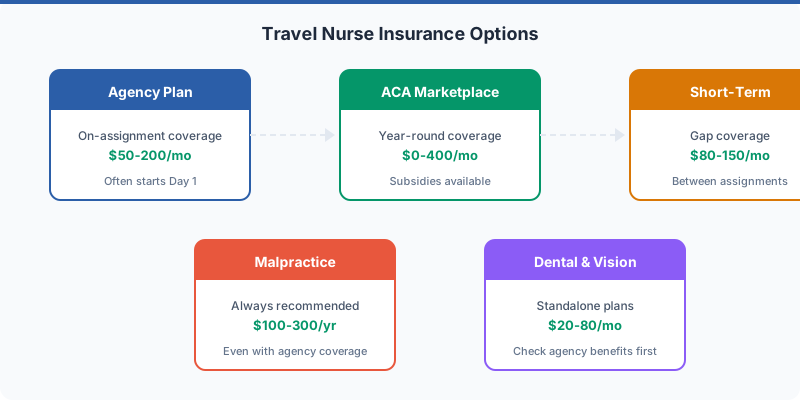
Yet comparing benefits across agencies is harder than comparing hourly rates. Every agency structures its benefits differently, uses different terminology, and buries the details in different places. This guide shows you how to evaluate and compare agency benefits so you can make informed decisions and negotiate for what you deserve.
This is educational content, not insurance or financial advice. Consult a licensed insurance professional or financial advisor for guidance specific to your situation.
Quick Comparison: Agency Benefits at a Glance
Here is how the major travel nurse agencies compare on the benefits that matter most to your total compensation.
| Agency | Health Insurance | 401(k) Match | Day-One Coverage | Housing Support | CEU Reimbursement | Best For |
|---|---|---|---|---|---|---|
| Aya Healthcare | PPO and HDHP options | Up to 50% match (up to 6%) | Yes | Stipend + housing team | Free online CEU platform | Best overall benefits package |
| AMN Healthcare | Multiple plan tiers | Up to 50% match (up to 4%) | Yes | Stipend or agency-provided | Reimbursement up to $500/yr | Nurses wanting large-system access |
| Cross Country Nurses | PPO and HMO options | Up to 50% match (up to 6%) | After 30 days | Stipend or agency-provided | Free CEU access | Long-term agency loyalty |
| Medical Solutions | PPO options | Up to 50% match (up to 4%) | Yes | Stipend with housing assistance | Free CEU platform | Best recruiter support |
| Fusion Medical Staffing | PPO options | Match available | Yes | Competitive stipend | CEU reimbursement | Personal attention + culture |
| Host Healthcare | PPO options | Match available | Yes | Competitive stipend | CEU reimbursement | Top pay packages + benefits |
Benefits change frequently. Always verify current offerings directly with each agency before making a decision.
Why Agency Benefits Matter More Than You Think
Most travel nurses focus on the hourly rate when evaluating a contract offer. That is understandable — the hourly rate is the most visible number. But benefits can represent 20 to 30 percent of your total compensation, and ignoring them means you are making decisions based on incomplete information.
Total compensation vs. hourly rate. Total compensation includes your hourly rate, non-taxable stipends (housing, meals, incidentals), overtime, bonuses, and the dollar value of all benefits the agency provides. Two agencies can offer the same hourly rate but deliver very different total compensation packages when you factor in benefits.
How benefits impact take-home pay. Health insurance, retirement matching, and other benefits have real dollar values. An agency that provides health insurance worth $500 per month and a 401(k) match worth $200 per month is effectively paying you $700 per month more than an agency with no benefits — even if their posted hourly rates are identical.
The hidden cost of agencies with few benefits. Some agencies offer higher hourly rates specifically because they do not provide benefits. That higher rate looks attractive until you factor in the cost of buying your own health insurance ($200 to $600 per month), funding your own retirement ($200 to $500 per month), and covering other insurance needs. Do the math before you celebrate that higher hourly rate.
Why comparing benefits is harder than comparing pay. Every agency packages benefits differently. One offers day-one health insurance but no 401(k). Another offers a great retirement plan but a 30-day insurance waiting period. A third offers neither but pays $5 more per hour. Without a structured approach to comparison, it is easy to make a suboptimal choice. For context on how health insurance fits into the picture, see our complete guide.
Health Insurance Plans by Agency
Health insurance is typically the most valuable benefit an agency can offer. Here is what to evaluate.
Day-one coverage vs. waiting periods. Some agencies offer health insurance starting on your first day of work. Others require a 30-day or even 60-day waiting period. Day-one coverage is a significant advantage because it eliminates the gap between your old coverage ending and new coverage beginning. If an agency has a 30-day waiting period, you need a strategy to cover that gap — see our gap coverage guide.
Premium costs and agency subsidies. Ask your recruiter exactly how much you will pay per week or per month for health insurance, and ask what the agency’s total cost is. The difference between what you pay and what the total premium costs is the agency’s subsidy — that is money the agency spends on your benefit that would otherwise go toward your pay. Typical travel nurse health insurance costs $50 to $200 per week for individual coverage, but the full cost (your share plus the agency’s share) may be $300 to $800 per month.
Plan types and network breadth. Does the agency offer PPO plans, HMO plans, or HDHPs? For travel nurses, PPO plans with broad networks are the most useful because they provide coverage across state lines. Ask about the insurer (Blue Cross Blue Shield, Cigna, Aetna, UnitedHealthcare) and whether the network extends nationwide.
How to evaluate if agency insurance is worth taking. Ask your recruiter this direct question: “What would my hourly rate be if I decline health insurance?” If the rate increases by $3 to $5 per hour, multiply that by your expected hours to see the annual value. Compare that to the cost of a personal ACA marketplace plan with subsidies. In many cases, declining agency insurance and buying your own plan gives you better coverage, more continuity, and more money in your pocket.
Retirement Benefits (401k and More)
Retirement benefits are the second most valuable benefit after health insurance, yet many travel nurses overlook them.
Which agencies offer 401(k) plans. Most large agencies — AMN Healthcare, Aya Healthcare, Cross Country Nurses, Medical Solutions, Triage Staffing, and others — offer 401(k) plans. Smaller agencies may not. The 401(k) is the most common retirement vehicle, though some agencies offer 403(b) plans or SIMPLE IRAs.
Employer match percentages. The employer match is free money. A common match structure is 50 percent of your contributions up to 6 percent of your pay. If you earn $1,500 per week and contribute 6 percent ($90), the agency adds $45. Over a 13-week contract, that is $585 in free money. Over a year of back-to-back contracts, it could be $2,340 or more. Some agencies offer dollar-for-dollar matches up to a certain percentage, which is even more valuable.
Eligibility requirements and vesting. Many agencies require you to work a minimum number of hours or weeks before you are eligible for the 401(k) plan. Common requirements include 1,000 hours of service or one year of employment. Vesting schedules determine when the agency’s matching contributions become fully yours. Some agencies offer immediate vesting; others use a graded schedule (20 percent per year over five years, for example). If you switch agencies frequently, a longer vesting schedule means you may lose unvested matching funds.
The long-term impact. Even modest 401(k) contributions compound significantly over time. A travel nurse contributing $500 per month with a $250 employer match, earning an average 7 percent annual return, would accumulate roughly $400,000 over 20 years. Skipping retirement contributions in your 20s and 30s costs far more than it saves.
Alternatives if your agency lacks retirement benefits. If your agency does not offer a 401(k), you can contribute to a Traditional or Roth IRA (up to $7,000 in 2026, or $8,000 if you are 50 or older). You can also open a solo 401(k) if you have any 1099 income on the side. The important thing is to save for retirement regardless of what your agency offers.
Housing and Travel Benefits
Housing and travel benefits vary significantly across agencies and have a major impact on your net income.
Housing stipend amounts. Housing stipends are tax-free payments intended to cover temporary housing costs at your assignment location. Stipend amounts vary by location (higher-cost areas receive higher stipends) and by agency. For the same assignment location, one agency might offer $1,800 per month while another offers $2,400. Always compare stipend amounts alongside hourly rates, not in isolation.
Agency-provided housing vs. stipend. Some agencies offer to arrange and pay for housing directly (agency-provided housing) instead of giving you a stipend. The advantage: no apartment hunting, no lease signing, and furnished housing ready when you arrive. The disadvantage: you lose control over where you live, the quality may vary, and the dollar value of agency-provided housing is often less than the stipend you would receive. Most experienced travel nurses prefer the stipend for maximum flexibility and financial benefit.
Travel reimbursement. Most agencies provide travel reimbursement for getting to your assignment location. This may be a flat amount ($500 to $1,000 per assignment) or mileage-based reimbursement. Some agencies pay travel only at the start of the contract; others pay at both the start and end. Ask about the specific policy and whether travel reimbursement is separate from or included in your stipend.
Relocation assistance and licensing support. Some agencies reimburse costs for new state nursing licenses, compact license fees, or certification renewals. This can save you $100 to $500 per new state license. A few agencies also offer relocation stipends or bonuses for assignments in hard-to-fill locations.
Additional Perks and Benefits
Beyond the big three (health insurance, retirement, and housing), agencies differentiate themselves with additional perks.
Continuing education reimbursement. Many agencies offer CEU reimbursement or provide free access to online continuing education platforms. This saves you $100 to $500 per year in CEU costs and keeps your license current. Some agencies partner with specific platforms like Relias or Lippincott to provide unlimited access during your contract.
Referral bonuses and completion bonuses. Referral bonuses ($500 to $2,000 per referral) reward you for recommending other nurses to the agency. Completion bonuses ($500 to $1,500) are paid when you finish a contract on schedule. Both are taxable income but represent real additional compensation.
Dental, vision, and life insurance. As covered in our dental and vision insurance guide, some agencies offer these as add-ons. Life insurance is sometimes included at a basic level ($10,000 to $50,000). Evaluate whether the agency offerings are competitive with standalone options or if you are better off purchasing your own.
Mental health and wellness programs. Employee Assistance Programs (EAPs) provide free confidential counseling sessions (typically three to six per issue per year). Some agencies also offer wellness stipends, gym membership reimbursements, or access to mental health apps. Given the stress of travel nursing, these perks have real value.
Loyalty programs and tenure-based benefits. Some agencies increase benefits or pay rates as you complete more assignments with them. You might receive better health insurance tiers, higher housing stipends, or priority access to desirable assignments after your second or third contract.
How to Compare Benefits Across Agencies
Here is a systematic approach to comparing agency benefits so you can make apples-to-apples decisions.
Create a total compensation spreadsheet. For each agency offer, create a row with the following columns: hourly rate, estimated weekly hours, housing stipend (monthly), meals and incidentals stipend (monthly), health insurance cost (monthly, your share), health insurance value (monthly, total premium), 401(k) match value (monthly), dental and vision cost (monthly), travel reimbursement, completion bonus, and any other quantifiable benefits. Calculate the total monthly and annual value for each.
Calculating the dollar value of each benefit. Assign specific dollar amounts to each benefit:
- Health insurance: the total premium value (your cost + agency subsidy)
- 401(k) match: the maximum annual match amount based on your expected contributions
- Dental and vision: monthly premiums times 12
- Life insurance: the equivalent cost of purchasing privately
- CEU reimbursement: annual amount offered
- Referral and completion bonuses: expected annual amount
Questions to ask your recruiter about benefits:
- What is the difference in my hourly rate with and without health insurance?
- When does health insurance begin — day one or after a waiting period?
- What is the 401(k) match percentage and vesting schedule?
- Is the housing stipend negotiable, and how was the amount determined?
- Are there completion bonuses, and what are the conditions to receive them?
- What dental, vision, and life insurance options are available?
- Do you offer CEU reimbursement or free education platforms?
- What is the travel reimbursement policy?
Red flags in agency benefits packages. Watch for agencies that are vague about benefit details, will not provide a clear benefits summary before you sign, have unusually long waiting periods for insurance (60 or more days), offer no retirement plan at all, or charge significantly more for health insurance than the industry average. These may indicate an agency that is cutting costs on benefits to inflate other numbers.
When to prioritize pay over benefits. If you already have health insurance through a spouse or a personal ACA marketplace plan, you may not need agency health insurance. In that case, an agency with higher pay and fewer benefits gives you more take-home pay. Similarly, if you are maxing out a personal IRA and do not need a 401(k), the retirement benefit is less critical. Your personal situation determines the right balance.
Top Agencies Ranked by Benefits
Agency benefits change frequently, so treat these as general guidance rather than definitive rankings. Always verify current benefits directly with each agency before making a decision.
Tier 1: Strong overall benefits. Agencies in this tier typically offer day-one (or near day-one) health insurance with agency subsidies, 401(k) with employer match, dental and vision options, CEU reimbursement, and competitive housing stipends. Look for agencies that have been consistently rated well by travelers in annual surveys and on review platforms.
Tier 2: Good benefits with some gaps. These agencies offer most major benefits but may have longer waiting periods for health insurance, lower 401(k) matches, or limited dental and vision options. The gaps are manageable but require you to supplement with personal coverage in some areas.
Tier 3: Competitive pay, limited benefits. These agencies compensate for thin benefits with higher hourly rates. This can work well for nurses who have their own insurance and retirement accounts, but it puts the burden of benefits management entirely on you. Make sure the higher pay actually covers the cost of replacing the missing benefits.
How rankings shift based on your priorities. A nurse with a family who needs comprehensive health insurance will value Tier 1 agencies differently than a single nurse with coverage through a spouse who prioritizes maximum hourly rate. There is no universal “best” — only what is best for your situation.
Frequently Asked Questions
How much are agency benefits actually worth in dollar terms?
Agency benefits can add $500 to $2,000 or more per month to your total compensation when you add up the value of health insurance subsidies, 401(k) matching, dental and vision coverage, and other perks. A health insurance plan where the agency pays $400 per month of the premium and a 401(k) match worth $200 per month already adds $600 per month in value. To compare offers accurately, calculate the total dollar value of every benefit alongside the hourly rate and stipends rather than focusing on the hourly number alone.
Should I take agency health insurance or decline it for higher pay?
It depends on your personal situation. Ask your recruiter what your hourly rate would be if you decline health insurance, then multiply the rate difference by your expected hours to see the annual value. Compare that to the cost of a personal ACA marketplace plan with subsidies. In many cases, declining agency insurance and buying your own plan gives you better coverage, more continuity between contracts, and more money in your pocket. However, if you have ongoing medical needs and the agency plan has excellent network coverage, keeping it may be worth the trade-off.
What is the most overlooked benefit when comparing agencies?
The 401(k) employer match is the most commonly overlooked benefit among travel nurses. A 50 percent match on contributions up to 6 percent of your pay can add thousands of dollars per year to your retirement savings at no cost to you. Over a 20-year career, this free money compounds significantly. Many nurses focus entirely on hourly rate and housing stipend while ignoring retirement matching, which is essentially leaving money on the table.
Do all travel nurse agencies offer the same benefits?
No, benefits vary significantly across agencies. Large agencies like Aya Healthcare, AMN Healthcare, and Cross Country Nurses tend to offer more comprehensive packages including day-one health insurance, 401(k) matching, dental and vision coverage, and CEU reimbursement. Smaller agencies may offer higher hourly rates but provide few or no benefits, which means you need to purchase your own insurance and fund your own retirement. Always request a detailed benefits summary from each agency before making a decision.
How do I compare total compensation between two different agency offers?
Create a spreadsheet with columns for hourly rate, estimated weekly hours, housing stipend, meals and incidentals stipend, health insurance cost and value, 401(k) match value, dental and vision costs, travel reimbursement, completion bonuses, and any other quantifiable benefits. Calculate the total monthly and annual value for each offer. This side-by-side comparison reveals the true picture. An agency offering $45 per hour with strong benefits often provides higher total compensation than an agency offering $50 per hour with no benefits at all.
Frequently Asked Questions
How much are agency benefits actually worth in dollar terms?
Agency benefits can add $500 to $2,000 or more per month to your effective compensation. Health insurance alone may be worth $300 to $800 per month when you factor in both your premium share and the agency’s subsidy. A 401(k) match at 50 percent of contributions up to 6 percent of pay can add another $200 to $400 per month. Dental, vision, CEU reimbursement, and completion bonuses add further value. The key is quantifying each benefit in dollars so you can compare total compensation packages rather than just hourly rates.
Should I take agency health insurance or get my own plan?
Ask your recruiter what your hourly rate would be if you decline health insurance. If the rate increases by three to five dollars per hour, multiply that by your expected weekly hours and contract length to see the annual value of declining. Then compare that to the cost of a personal ACA marketplace plan, which may be significantly cheaper than what the agency would charge, especially if you qualify for premium tax credits. Many experienced travel nurses find that declining agency insurance and buying their own year-round plan results in better coverage, more continuity, and more take-home pay.
What is the most important benefit to compare when evaluating agencies?
Health insurance, 401(k) matching, and housing stipends are the three benefits with the largest financial impact. Of these, health insurance is typically the most valuable single benefit because replacing it on your own can cost $200 to $600 per month. However, the relative importance depends on your personal situation. A nurse with coverage through a spouse might prioritize the 401(k) match and housing stipend instead. The best approach is to create a total compensation spreadsheet that assigns a dollar value to every benefit offered by each agency.
Do travel nurse agencies offer day-one health insurance?
Some large agencies like Aya Healthcare and Medical Solutions offer health insurance starting on your first day of work, while others require a 30-day or even 60-day waiting period. Day-one coverage is a significant advantage because it eliminates the gap between your old coverage ending and new coverage beginning, saving you from needing separate gap coverage. Always ask about the insurance start date before signing a contract, and if an agency has a waiting period, make sure you have a strategy to cover that gap.
Is it worth staying with one agency for loyalty benefits?
Some agencies increase pay rates, housing stipends, or insurance tiers as you complete more assignments with them. Whether these loyalty benefits outweigh potentially better offers from competing agencies depends on the specifics. Calculate the dollar value of the loyalty perks and compare them to what other agencies are offering for similar assignments. In many cases, the travel nursing market is competitive enough that shopping around produces better results than loyalty alone. However, if an agency offers a strong 401(k) with a graded vesting schedule, staying long enough to fully vest those matching contributions can be worth thousands of dollars.
Key Takeaways
- Always calculate total compensation, not just hourly rate. Benefits can add $500 to $2,000+ per month to your effective compensation.
- Health insurance, 401(k) match, and housing stipends are the big three. These have the largest financial impact and should drive your comparison.
- Day-one health coverage eliminates costly gaps. An agency with day-one insurance saves you from needing gap coverage strategies every time you switch contracts.
- Some agencies offer higher pay precisely because their benefits are weak. Do the math to see if the higher rate actually compensates for missing benefits.
- Use a spreadsheet to compare offers side-by-side before accepting. Quantify every benefit in dollar terms for a true comparison.
- Ask your recruiter direct questions about benefits before signing. Vague answers are a red flag. For a deeper dive into specific coverage types, explore our guides on malpractice insurance, disability insurance, and HSAs and FSAs.
Related Resources
- Travel Nurse Health Insurance: Complete Guide
- How to Cover Insurance Gaps Between Assignments
- ACA Marketplace Plans for Travel Nurses (2026 Guide)
- HSA vs. FSA for Travel Nurses: Which One Works?
- How to Become a Travel Nurse
- Travel Nurse Tax Deductions
Affiliate Placement Notes
- Agency comparison tool widget after Top Agencies section
- Health insurance comparison link in Health Insurance Plans section
- Total compensation calculator CTA in sidebar
- Bottom CTA for “Compare agency benefits side-by-side” tool
